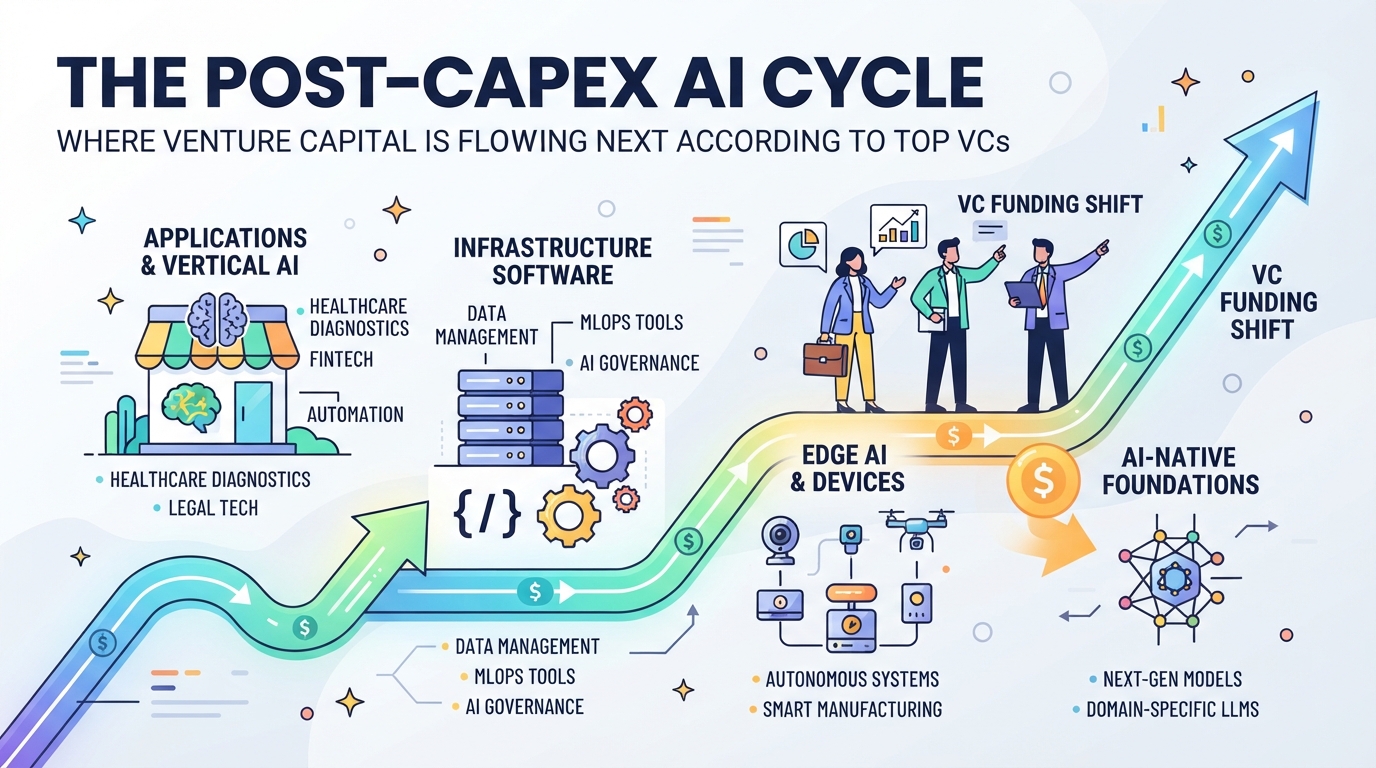
The Post-Capex AI Cycle: Where Venture Capital is Flowing Next according to Top VCs
Introduction: The Structural Shift in AI Venture Capital
For the past two years, venture capital had a singular focus: funding the massive computational infrastructure of artificial intelligence. Billions poured into foundation models, but that initial gold rush is cooling. We are now entering the post-capex AI cycle, a structural pivot where the investment thesis is shifting from raw power to practical application.
Top investors are no longer writing blank checks for GPU clusters. Instead, current AI venture capital trends show a distinct transition toward capital efficiency, unit economics, and undeniable commercial utility.
This evolution marks a clear transition:
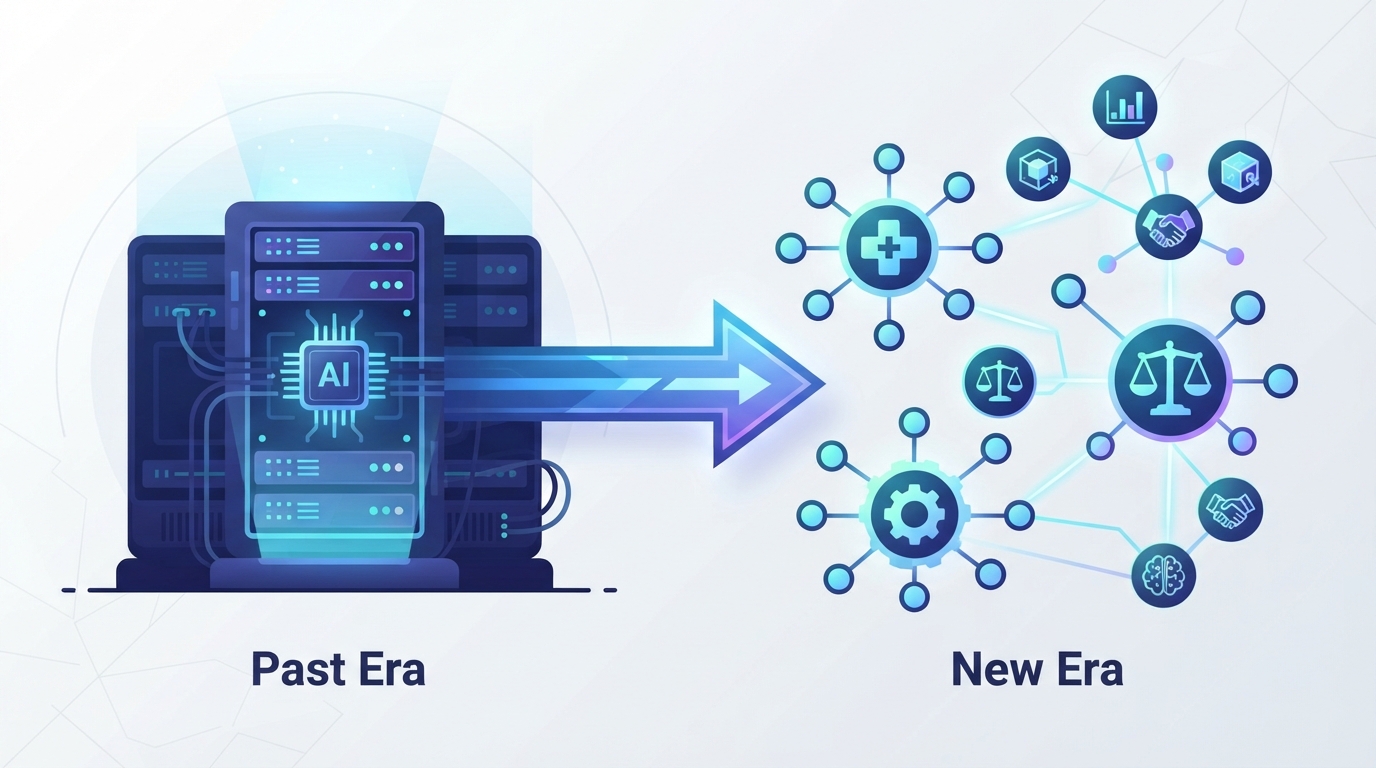
- The Capex Era (2022-2024): Heavy infrastructure, massive model training, and high cash burn.
- The Post-Capex Era (2025+): Application-layer innovation, domain-specific workflows, and clear ROI.
The question for founders is no longer can we build it? but how does it generate value? Here is where the smart money is moving next.
Moving Beyond Infrastructure: Why VCs Are Pivoting from Foundation Models
For years, backing the next major LLM seemed like a guaranteed ticket to hyper-growth. However, the economic reality of building foundation models has set in, and the math no longer works for traditional venture capital.
The retreat from raw compute scale boils down to three harsh realities:
- Astronomical Compute Costs: Training frontier models now requires billions of dollars, pricing out even the most well-funded VC syndicates.
- Compressed Margins: High inference costs and rapid commoditization mean these models suffer from software-like growth expectations but hardware-like margins.
- The Hyperscaler Moat: Tech giants like Microsoft, Google, and Amazon have locked up the necessary distribution and compute, creating insurmountable barriers to entry.
Consequently, the investment thesis has flipped. Instead of funding massive GPU burns, smart money is hunting for capital-efficient startups that leverage existing infrastructure to solve highly specific, high-value enterprise problems.
The Rise of the Application Layer and Agentic AI
With foundation models commoditizing, venture capitalists are aggressively backing application layer AI startups. The focus has shifted from “what can this model write?” to “what can this system do?”
This shift is driving a massive surge in agentic AI funding. Unlike first-generation chatbots that merely summarize data, agentic systems are autonomous, goal-oriented agents capable of executing multi-step enterprise workflows.
Here is how investors are dividing the landscape:
- Gen-1 AI (Copilots): Retrieve information, draft emails, and require constant human prompting.
- Agentic AI (Autopilot): Use APIs, make decisions, self-correct, and complete end-to-end business processes.
VCs are targeting vertical-specific agents in high-value sectors like legal, finance, and healthcare. The ultimate goal isn’t just to assist the human worker, but to act as the worker, unlocking trillions in dormant software spend.
Vertical B2B Workflows and Industry-Specific Solutions
To capture this massive market, VCs are aggressively filtering out superficial applications. The era of simple API wrappers—thin software shells that merely pass user prompts to foundational models—is rapidly coming to an end. Instead, the smart money is flowing into enterprise B2B AI platforms that embed deeply into industry-specific workflows.
These deep-domain solutions command premium valuations by winning on three fronts:
- Proprietary Data Moats: They integrate directly with legacy systems of record, leveraging specialized data that generic models cannot access.
- High Switching Costs: Once woven into complex daily operations (like clinical charting or compliance auditing), they become virtually impossible to rip out.
- Value-Based Pricing: Instead of selling cheap software seats, they monetize by capturing a percentage of the actual work they automate.
While a shallow wrapper faces brutal price competition and high customer churn, vertical AI platforms build defensible, high-margin monopolies by owning the entire workflow.
Specialized Sectors Securing Series A: Defense, Biotech, and Robotics
As software-only markets crowd, forward-looking VCs are shifting capital toward the physical world. The next massive wave of Series A funding is targeting “hard tech”—where advanced neural networks meet heavy machinery, biological systems, and national security.
We are seeing a massive capital reallocation into three distinct frontiers:
- Defense Tech: Modern warfare demands sovereign AI. Startups building autonomous drone swarms, real-time battlefield intelligence, and hardened hardware are securing massive early-stage rounds to redefine national security.
- Biotech: The convergence of generative AI and biology is revolutionizing drug discovery. VCs are backing platforms that use machine learning to design novel proteins and predict molecular behavior in days rather than years.
- Robotics: “Embodied AI” is finally moving past the research lab. Startups are deploying intelligent, adaptive systems capable of navigating unpredictable environments like warehouses, construction sites, and manufacturing floors.
These sectors represent the ultimate moat: a fusion of digital intelligence and physical-world execution that generic software models simply cannot replicate.
The New VC Investment Playbook: Proprietary Data and Enterprise ROI
The era of funding “wrapper” startups that simply API into foundational models is officially over. Today, top-tier VCs have rewritten their investment playbooks, shifting their focus from raw technology to defensible business models.
To secure term sheets in this post-Capex cycle, founders must prove two non-negotiable pillars:
- A Proprietary Data Moat: Algorithms are becoming commoditized. VCs are hunting for startups with exclusive access to unique, hard-to-acquire datasets that create a self-reinforcing feedback loop.
- Quantifiable Generative AI ROI: The days of pilot-phase experimentation are gone. Enterprises now demand proof of value, meaning startups must demonstrate clear metrics like hard cost savings, productivity gains, or direct revenue generation within the first 90 days.
Ultimately, the investment thesis has flipped. VCs are no longer asking what your AI can do—they want to know exactly what it saves or earns.
Conclusion: Navigating the Next Era of AI Entrepreneurship
Navigating the post-capex AI cycle requires a fundamental shift in how founders build and pitch. The era of raising massive rounds just to fund compute is over. To align with today’s shifting AI venture capital trends, early-stage startups must prioritize lean operations and sustainable growth.
To capture investor interest now, focus your pitch on three core pillars:
- Capital Efficiency: Build light. Leverage existing foundational models and open-source architecture to keep your burn rate low and your runway long.
- Native Product Integration: Move beyond simple wrappers. Your AI must be seamlessly woven into the user’s daily workflow, creating a sticky, indispensable user experience.
- Clear Monetization Pathways: Design your pricing model—whether usage-based or value-driven—to capture revenue from day one.
The funding landscape has matured, but the opportunity has never been greater. Founders who build with capital discipline and native utility will define this next era of AI.