Money for Machines: Inside the Payment Architectures Powering Autonomous AI Agents
Introduction: The Rise of the Machine-to-Machine (M2M) Economy
For decades, the internet was built for humans buying from humans. Today, a quiet revolution is underway as autonomous AI agents evolve from simple digital assistants into active economic actors.
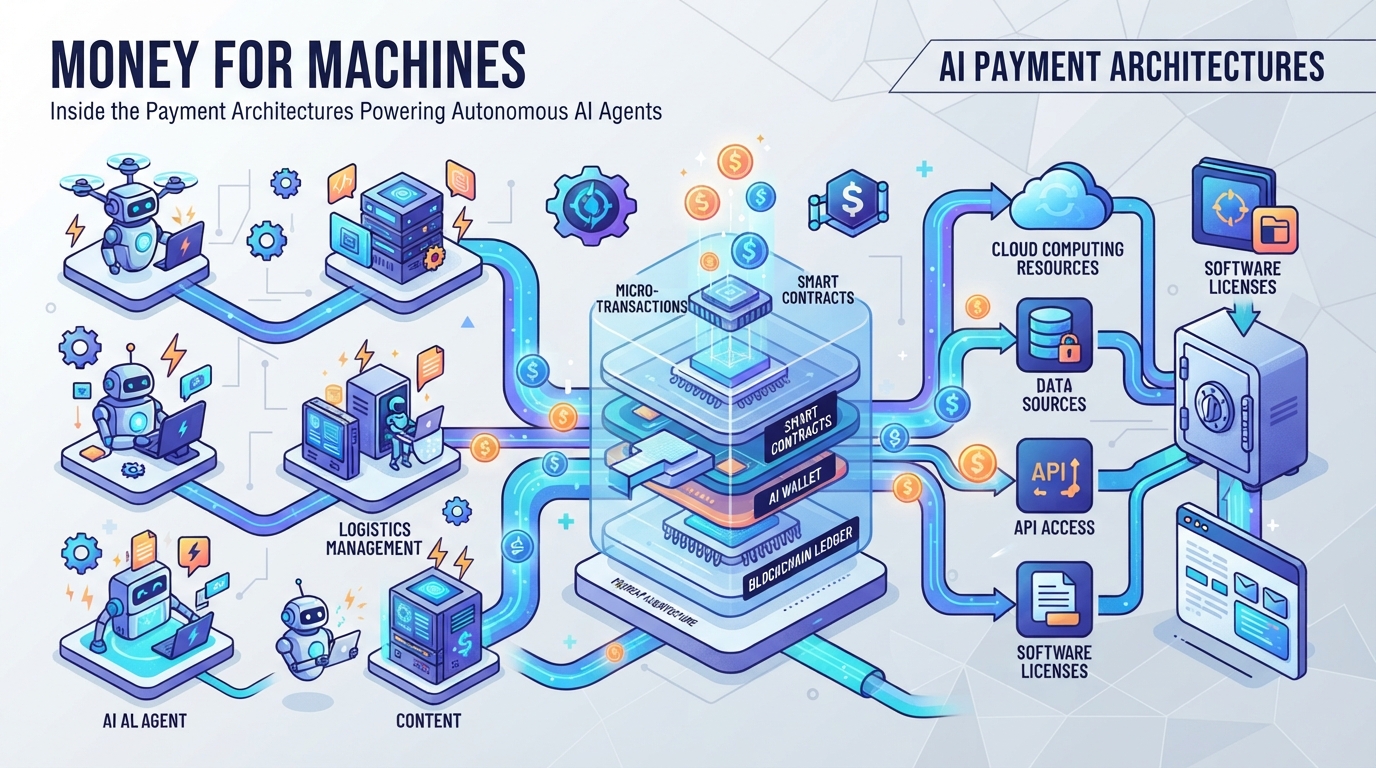
These agents aren’t just searching the web anymore; they are actively hiring other bots, subscribing to APIs, and purchasing cloud compute. To transact seamlessly, they require a new financial rail: payments for AI agents.
Traditional credit cards and legacy banking networks fail when transactions happen in milliseconds. True machine-to-machine payments require a completely redesigned architecture built on three core pillars:
- Micro-transactions: The ability to stream fractions of a cent instantly and continuously.
- Autonomous authorization: Programmatic wallets that spend within strict, pre-defined budgets without needing human approval.
- Zero-trust security: High-speed cryptographic verification to prevent unauthorized fund depletion.
Welcome to the M2M economy, where code pays code.
Why Traditional Banking Fails Autonomous AI Agents
Legacy banking was built for humans who get paid bi-weekly and buy coffee once a day. When an AI agent needs to query an API 50 times a second, traditional financial rails instantly fracture.
Here is why legacy infrastructure collapses under machine workloads:
- The Cost Barrier: Credit cards charge a flat fee plus a percentage (e.g., $0.30 + 2.9%). If an agent needs to buy a single line of code for $0.002, the processing fee is 150 times the purchase price, making micro-payments for AI economically impossible.
- Banking Latency: Settlement times on ACH or SWIFT networks take days. AI agents operate in milliseconds; waiting on banking latency stalls machine workflows and halts automated supply chains.
- The Gatekeeper Problem: Traditional accounts rely on human authorization—like 2FA SMS codes or manual approvals. Legacy banks lack the programmatic APIs required for an agent to securely self-authorize micro-budgets without human intervention.
Put simply, you can’t run a millisecond economy on a 1970s mainframe.
Protocol-Based Micropayments: The Skyfire Model
To bypass legacy banking bottlenecks, developers are turning to native machine-to-machine (M2M) networks. Enter the Skyfire protocol, an open payment network built specifically for autonomous agents.
By integrating developer-friendly SDKs, creators can instantly provision secure AI agent wallets. These wallets utilize stablecoins and other digital assets to bypass traditional intermediaries, enabling frictionless micro-payments for AI at sub-cent levels.
To prevent runaway spending, the network employs a strict, cryptographic verification framework:
- Custom Spending Limits: Set hard programmatic caps on transaction sizes and daily budgets.
- Whitelisted Endpoints: Restrict agent purchases to pre-approved, verified service providers.
- Real-Time Authorization: Execute instant cryptographic checks before any digital asset leaves the wallet.
This combination of instant settlement and granular control ensures agents trade at machine speed, completely autonomously, without risking your treasury.
Web3 Wallets & Account Abstraction (ERC-4337)
Traditional Externally Owned Accounts (EOAs) are a security nightmare for autonomous agents. If an agent holds its own private keys, a single code exploit can drain the entire treasury instantly.
This is where ERC-4337 account abstraction changes the game. By turning AI agent wallets into programmable smart contract wallets for AI, we shift security from “all-or-nothing” private keys to custom, code-enforced rules. This architecture unlocks three critical capabilities:
- Session Keys: Grant agents temporary, restricted signing authority for specific tasks without exposing the master seed phrase.
- Gas Sponsorship: Third-party “paymasters” cover transaction fees, allowing agents to transact seamlessly without holding native gas tokens.
- Batched Transactions: Combine approval and execution into a single cryptographic step, slashing latency and operational overhead.
With ERC-4337, the agent operates as a secure, automated sub-account, keeping your core assets completely isolated while maintaining fluid, machine-to-machine commerce.
Security Parameters: Scoped Session Keys and MPC
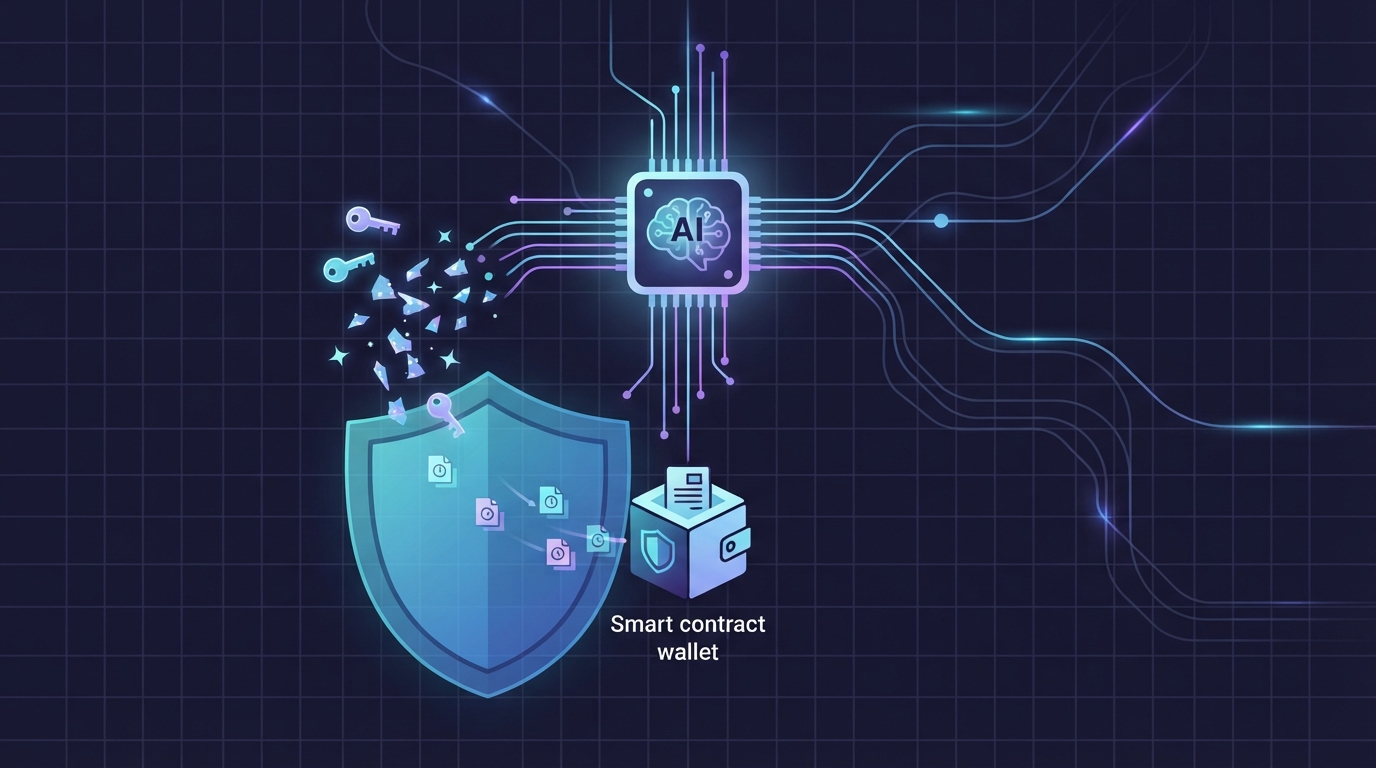
While basic session keys grant temporary access, scoped session keys take control a step further by hardcoding granular guardrails directly into the agent’s permissions. Think of them as highly specific, programmable digital allowances.
To make payments for AI agents truly bulletproof, this architecture is paired with Multi-Party Computation (MPC). MPC splits the cryptographic key into multiple “shares” distributed across separate nodes, ensuring the agent never holds the full key.
Together, they secure machine transactions through three core mechanisms:
- Granular Scoping: Restricts the agent to specific merchant smart contracts, maximum spend limits, and strict expiration windows.
- Collaborative Signing: Transactions require co-signing from both the agent’s key share and a secure, policy-enforcing server.
- Instant Revocation: If an agent’s behavior deviates, the co-signer refuses to sign, freezing funds instantly.
This dual-layer defense allows agents to transact autonomously while keeping your core treasury entirely out of reach.
Conclusion: Building the Financial Rails of the Future
We are standing at the precipice of a brand-new economic layer. Over the next decade, the maturity of secure payments for AI agents will transform these digital assistants from simple productivity tools into fully autonomous economic actors. By establishing robust, frictionless financial rails, we unlock a future where software doesn’t just recommend decisions—it executes them financially.
This evolution relies on three key shifts in machine-to-machine payments:
- Hyper-Granular Microtransactions: Agents will stream fractions of a cent per second for real-time API usage, data access, and compute power.
- Decentralized Liquidity: Machines will trade, lend, and settle transactions with other machines instantly, operating 24/7 without human intermediaries.
- Zero-Friction Scalability: Millions of specialized agents will run concurrently, scaling global economic activity at a speed humans cannot match.
The companies that build, secure, and adopt these machine-compatible financial rails today will define the commerce of tomorrow. The machine economy is coming, and it already has its wallet open.