Edge-AI Video Upscaling: How Free Streaming Tiers Leverage Client-Side Neural Networks to Slash CDN Bandwidth Costs
The High Cost of Free Streaming: The CDN Egress Crisis
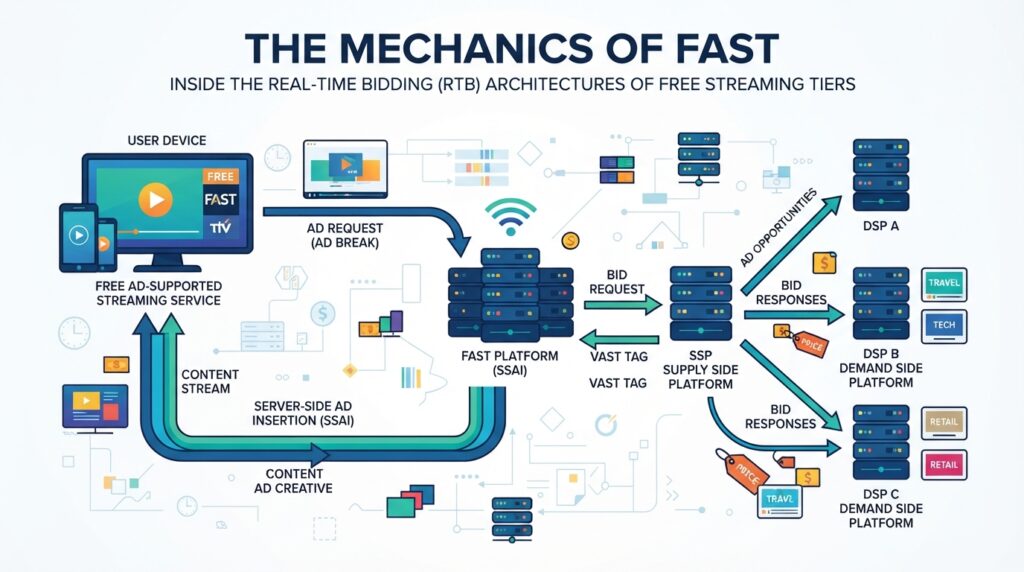
Offering free streaming tiers is a brilliant way to acquire users, but behind the scenes, it’s a financial tightrope. While some platforms focus on scaling dynamic ad insertion algorithms to maximize ad revenue, they must still address the massive infrastructure costs of delivery. While viewers enjoy zero-dollar access, platforms must foot the bill for every single gigabyte delivered.
The culprit? Soaring CDN bandwidth costs. As audiences demand higher-resolution content, the data transfer—charged as egress fees by cloud providers—rapidly outpaces the ad revenue generated per viewer.
This economic squeeze comes down to three harsh realities:
- Asymmetrical Revenue: Ad CPMs are volatile and seasonal, but bandwidth bills are fixed and guaranteed to rise with traffic.
- The HD/4K Tax: Delivering a 1080p stream costs roughly double that of 720p, exponentially inflating egress bills.
- Global Scaling Penalties: Delivering content to international users often incurs premium routing rates from CDN providers.
Ultimately, traditional delivery models make scaling a free tier a victim of its own success. To survive, platforms must find a way to decouple video quality from data transit volume.
What is Client-Side Edge-AI Video Upscaling?
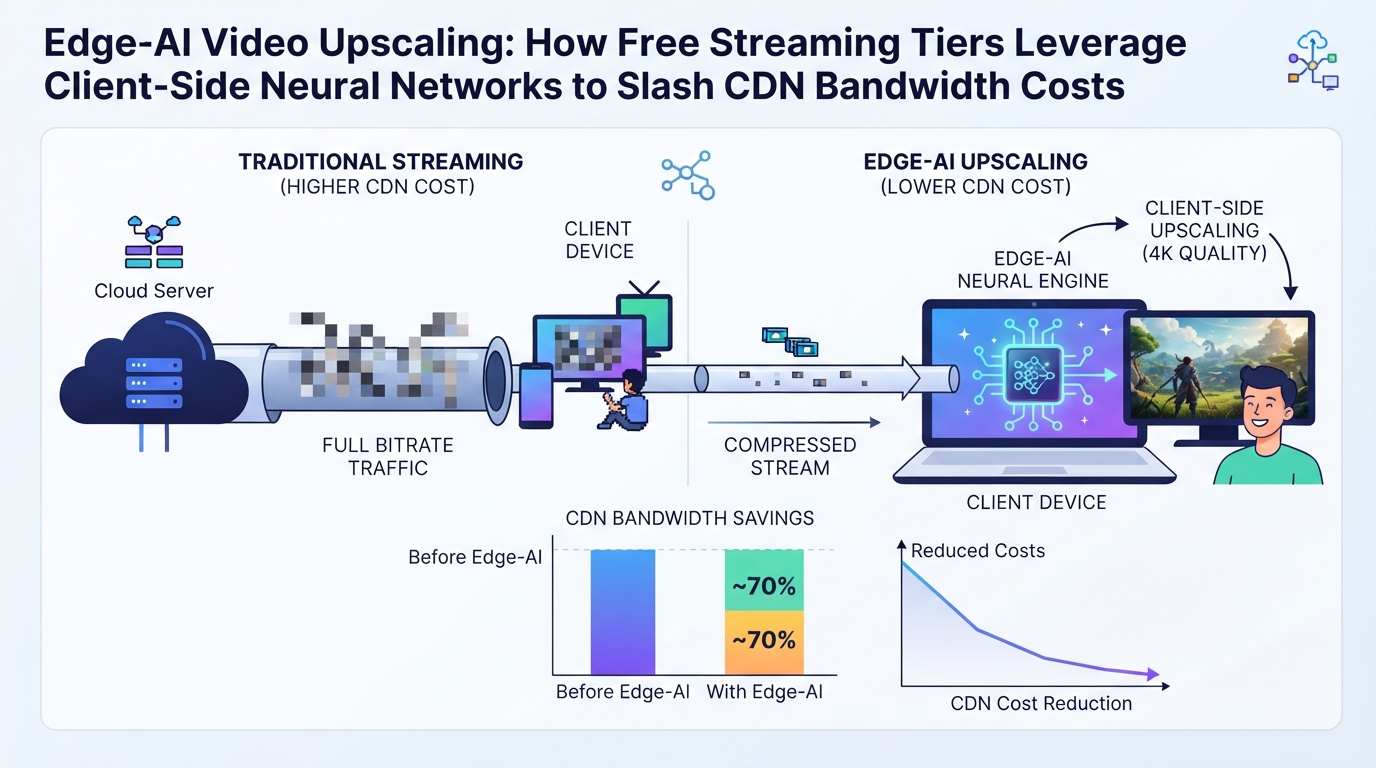
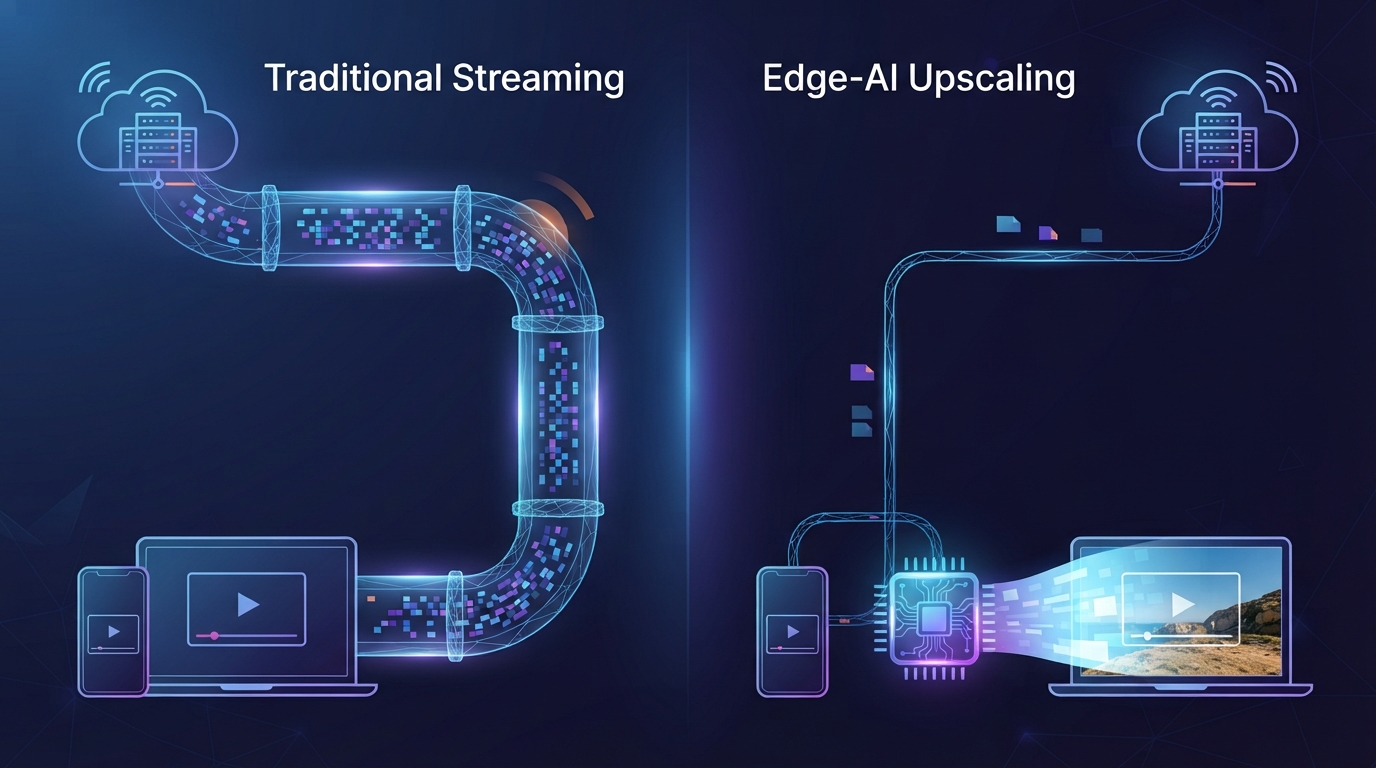
Instead of streaming a heavy 1080p file, platforms send a lightweight 540p stream and let the viewer’s device do the heavy lifting. This is edge AI video upscaling—a process that slashes CDN bandwidth costs by shifting video enhancement from expensive cloud servers to the user’s local hardware.
By leveraging on-device super resolution, the streaming app utilizes local neural networks to reconstruct missing pixels in real-time.
Here is how this modern approach compares to traditional upscaling methods:
- Traditional Interpolation (Bilinear/Bicubic): These mathematical shortcuts simply stretch existing pixels and average the colors of neighboring pixels. The result is a soft, blurry image that lacks true detail.
- AI-Powered Super Resolution: Instead of guessing averages, trained AI models analyze textures, edges, and motion. They actually recreate missing high-frequency details, making a low-bitrate stream look like native, crisp HD.
The Math Behind the Savings: From 720p Streams to 4K Displays
To see the real value of edge-AI, we have to look at the raw numbers. Delivering native 4K video requires massive bandwidth—typically 15 to 20 Mbps per user. By contrast, a high-quality 720p stream needs only 1.5 to 3 Mbps.
When you shift the heavy lifting of 720p to 4K reconstruction to the viewer’s local device, the math swings heavily in your favor. This strategy delivers an immediate bandwidth reduction of 30% to 60% across your CDN distribution network.
Here is how the data requirements stack up for a typical streaming service:
- Native 4K Stream: ~20 Mbps (100% CDN cost)
- 1080p Stream: ~5 Mbps (75% bandwidth savings)
- 720p Stream + Edge-AI: ~2 Mbps (90% bandwidth savings, upscaled locally to 4K)
Crucially, this massive cost reduction doesn’t compromise the viewer’s experience. Local neural networks handle the real-time enhancement, ensuring flawless QoE optimization so users get a crisp, high-definition picture without the buffering.
Leveraging Consumer Hardware: NPUs, GPUs, and Smart TVs
To pull off this real-time upscaling wizardry, streaming apps tap into the specialized silicon already humming inside our daily devices. Much like how AI is accelerating the race for reusable rockets through real-time edge calculations, consumer devices are now tasked with running complex neural networks locally. We aren’t just talking about high-end gaming rigs; today’s everyday consumer tech is packed with AI-ready architecture.
Here is how different platforms handle the heavy lifting:
- Mobile & Streaming Sticks: Modern smartphones and dongles utilize dedicated NPU hardware acceleration. These Neural Processing Units run complex super-resolution models silently, conserving battery life while scaling video frames in milliseconds.
- Smart TVs: Next-gen Smart TV hardware now features integrated AI co-processors designed specifically to handle real-time scene recognition and texture reconstruction directly on the glass.
- Laptops & Desktops: Traditional consumer GPUs leverage specialized tensor cores to execute deep-learning algorithms, effortlessly turning low-bitrate streams into crisp 4K outputs.
By offloading these computations to the edge, streaming platforms turn the viewer’s own hardware into a decentralized CDN optimization engine.
The Roadblocks: Hardware Fragmentation and Thermal Throttling
While shifting the heavy lifting to the edge sounds like a silver bullet, deploying these models in the wild is incredibly complex. Operators face two massive roadblocks when moving neural networks to client-side hardware:
- Extreme Hardware Fragmentation: Unlike a unified cloud infrastructure, the client-side ecosystem is a chaotic mix of chipsets. Streaming apps must support everything from flagship phones with dedicated NPUs to cheap legacy devices relying on weak, generic CPUs. This severe hardware fragmentation forces developers to maintain and optimize dozens of different model variants.
- Aggressive Thermal Throttling: Running continuous AI inference is highly resource-intensive. On fanless mobile devices and compact streaming sticks, sustained workloads quickly generate excess heat. To prevent damage, the operating system triggers thermal throttling, slashing clock speeds and causing the video playback to stutter.
To survive in the wild, streaming engines must dynamically scale their AI models down—or disable them entirely—the moment a device begins to run hot.
The Future of Decentralized Video Delivery Networks
We are standing on the cusp of a massive paradigm shift. As edge silicon matures, the traditional reliance on centralized CDNs will give way to a highly efficient model of decentralized video delivery. By offloading pixel reconstruction directly to the viewer’s hardware, platforms are fundamentally rewriting the economics of digital broadcasting.
This evolution will redefine the future of streaming through three key shifts:
- Zero-Rating Bandwidth: Broadcasters will transmit a single, low-bitrate “source” stream, relying on client-side video upscaling to generate pristine 4K outputs locally.
- Dynamic Orchestration: Next-gen players will intelligently balance rendering workloads between local NPUs and edge-compute nodes based on real-time device capacity.
- Democratic Access: High-fidelity video will no longer be locked behind expensive paywalls, as FAST platforms leverage on-device ML to slash distribution costs.
Ultimately, the screen in your hand is no longer just a passive display—it is the final, most critical node in the delivery network.