The Code Behind the Commercials: How Disney+ Will Scale Dynamic Ad Insertion Algorithms for a Free Tier
Introduction: The Tech Behind Disney’s Ad-Supported Horizon
Imagine millions of families settling in to stream the latest Disney release, only for the screen to freeze on a buffering wheel right before a commercial. For Disney+, launching a free, ad-supported tier isn’t just a business pivot—it’s a massive engineering hurdle.
To pull this off, Disney is rebuilding its AVOD architecture to handle unprecedented scale. The goal is simple yet incredibly complex: deliver targeted, television-quality ads to millions of concurrent viewers simultaneously, without a single millisecond of lag.
At the heart of this transition are sophisticated dynamic ad insertion algorithms. These systems must solve three massive challenges in real-time:
- Zero-Latency Splicing: Merging ad video fragments into the main stream manifest seamlessly.
- Hyper-Personalization: Matching the right ad to the right viewer profile on the fly.
- Concurrency at Scale: Handling millions of simultaneous ad decision requests during peak traffic spikes.
It’s a high-stakes balancing act where code meets commercialization, and the margin for error is zero.
Understanding Dynamic Ad Insertion (DAI) in Modern Streaming
To understand the magic of modern streaming, think of traditional TV advertising as a giant highway billboard—everyone driving past sees the exact same message. Modern streaming, however, uses dynamic ad insertion algorithms to turn that billboard into a digital screen that changes for every single passenger.
Instead of baking static commercials into a broadcast feed, the system swaps ad creatives on the fly. Here is how they stack up:
- Traditional Broadcast: One-to-many delivery, pre-scheduled ad slots, and zero personalization.
- Dynamic Ad Insertion: One-to-one delivery, real-time ad assembly, and hyper-targeted relevance.
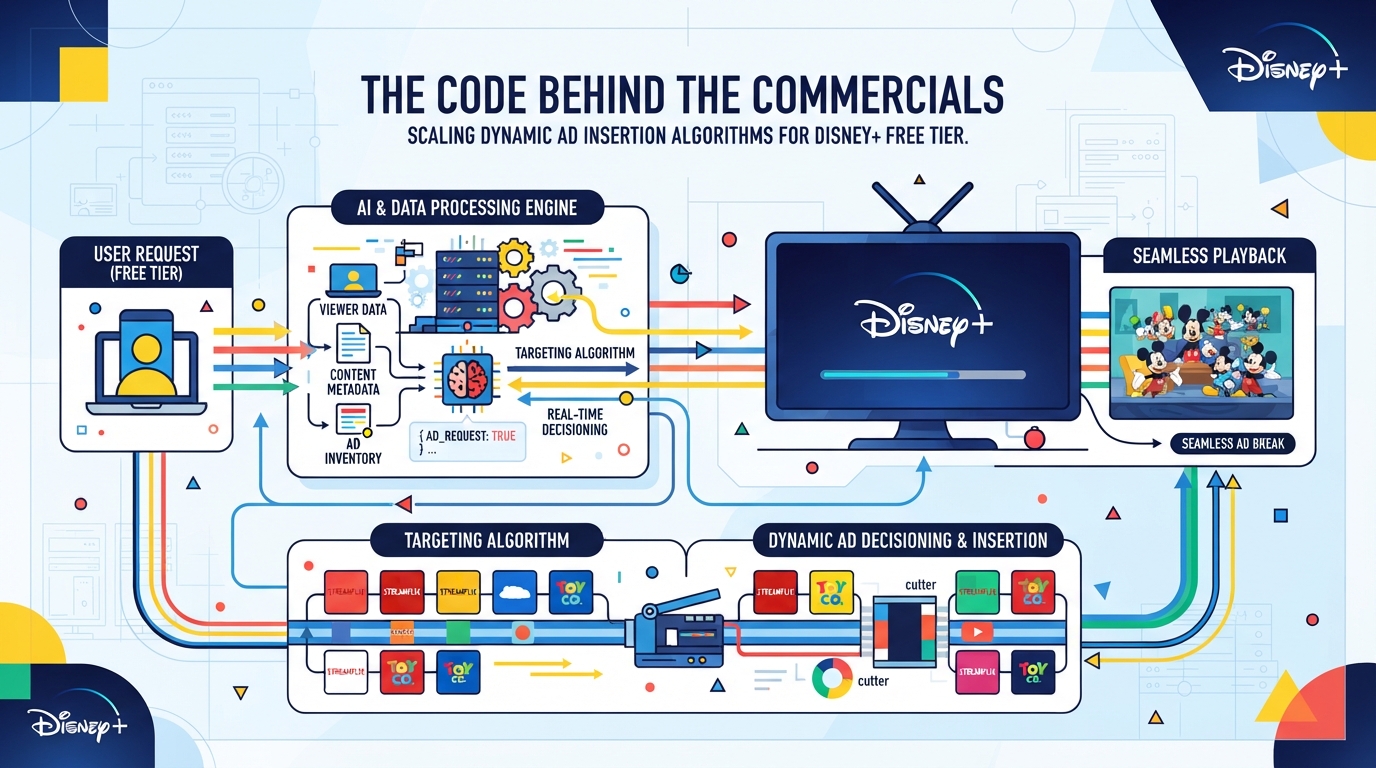
The instant an ad break begins, the video player queries an Ad Decision Server (ADS). This server instantly parses target variables—like viewer location, device type, and viewing history—to determine the perfect ad to stitch into the stream’s manifest file, all in under 100 milliseconds.
The Move to SSAI: Why Client-Side Ad Insertion Fails at Scale
Historically, streaming platforms relied on Client-Side Ad Insertion (CSAI), where the viewer’s device handles the heavy lifting of fetching and playing ads. At Disney+ scale, this decentralized approach completely falls apart.
CSAI introduces three major bottlenecks that ruin the viewing experience:
- Device Fragmentation: Developers must write and maintain custom ad-playback code for thousands of different smart TVs, game consoles, and mobile devices.
- Ad-Blocker Vulnerability: Because the client device makes separate, obvious requests to ad servers, ad-blockers easily intercept and block the commercials.
- High Latency: Switching between the main video and an ad player triggers buffering spins, leading to a clunky, disjointed experience.
To scale a free tier, Disney+ must leverage Server-Side Ad Insertion (SSAI). By stitching the ad directly into the video stream on the server before it ever reaches the device, SSAI bypasses ad-blockers, eliminates buffering, and delivers a seamless, broadcast-quality stream to every screen.
Decoding the Bottleneck: Manifest Manipulation Units (MMU)
To make Server-Side Ad Insertion work, Disney+ relies on a critical component: the Manifest Manipulation Unit (MMU). Think of the MMU as a real-time video editor operating at scale. Instead of stitching raw video files, it intercepts and rewrites the text-based manifest files—HLS (.m3u8) or DASH (.mpd)—that tell your device which video segments to play next.
The MMU dynamically inserts personalized ad segments directly into these playlists. However, this process creates a massive architectural bottleneck during high-traffic events:
- The Spike: Millions of viewers hit an ad break simultaneously.
- The Lookup Storm: The MMU must query the Ad Decision Server (ADS) for millions of unique, targeted ads at the exact same millisecond.
- The Crash Risk: If the ADS or the MMU’s manifest manipulation engine experiences even a millisecond of latency, playlist delivery fails, resulting in buffering or stream crashes.
When scaling a free tier, this microsecond-level orchestration is where systems either shine or shatter.
Decoupling at the Edge: Scaling Workflows with CDN Edge Compute
To survive this bottleneck, we must move the heavy lifting away from the origin. The solution lies in decoupling manifest generation and pushing it directly to CDN edge workflows.
By leveraging serverless functions at the edge, we distribute the computational load globally. Instead of a centralized server compiling every playlist, the edge node closest to the user handles the final manifest manipulation.
Here is how this decoupling splits the workload:
- Origin Servers: Focus solely on hosting core video segments and static templates.
- Edge Compute: Executes real-time ad-stitching, personalizes HLS/DASH playlists, and injects tracking pixels.
- Ad Decision Server (ADS): Feeds targeted metadata to the edge via lightweight, cached APIs.
This shift slashes latency from hundreds of milliseconds to single digits. By executing these micro-operations at the network’s perimeter, the origin remains untouched, ensuring seamless playback for millions of concurrent viewers. Beyond manifest handling, some modern architectures are even leveraging client-side neural networks at the edge to upscale video and further slash CDN bandwidth costs.
Real-Time Programmatic Decisions and Containerized Microservices
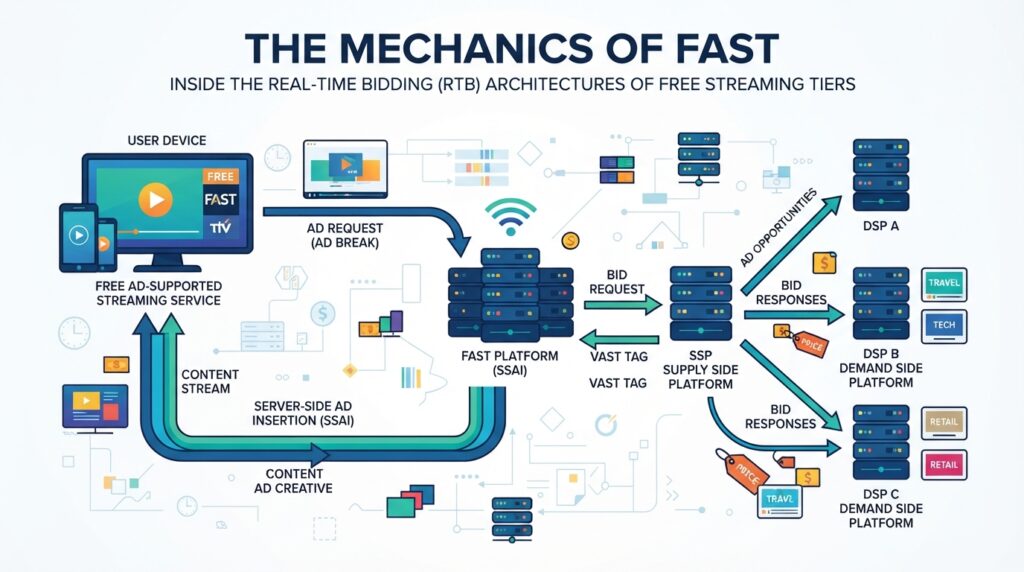
To pull off this magic in under 100 milliseconds, the Ad Decision Server (ADS) can’t act alone. It relies on a highly optimized mesh of containerized microservices, orchestrated via Kubernetes, to communicate with global Supply-Side Platforms (SSPs) instantly.
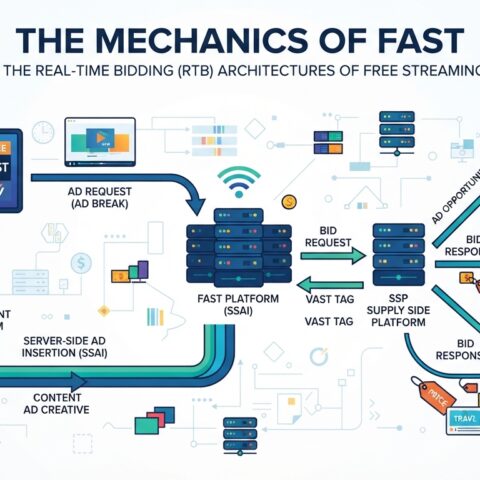
When an ad break triggers, dynamic ad insertion algorithms must orchestrate a lightning-fast programmatic auction, utilizing the same real-time bidding (RTB) architectures that power modern free ad-supported streaming television (FAST) platforms. Here is how that sub-100ms budget is split:
- 0–20ms (Ingress & Parsing): The containerized microservice receives the ad trigger and extracts viewer context.
- 20–70ms (The SSP Auction): Parallel OpenRTB requests go out to external SSPs, bids are collected, and the auction closes.
- 70–90ms (Decisioning): The Ad Decision Server selects the winning creative, enforcing frequency capping and brand safety.
- 90–100ms (Manifest Assembly): The edge node receives the payload and stitches the ad into the video stream.
By containerizing these decision engines, Disney+ can scale individual microservices horizontally during massive traffic spikes—like a live sports event—without dragging down stream quality.
Ensuring QoE: Buffer-Free Transitions in HLS and DASH Streams
Once the manifest is assembled, the real challenge begins at the player level. If the ad’s video properties don’t perfectly match the main feature, the screen flickers, the audio pops, or worse—the video buffers.
To protect QoE, Disney+ relies on sophisticated SSAI transcoding pipelines that dynamically align the ad creative’s DNA with the viewer’s active HLS or DASH stream. This instant normalization targets three critical pillars:
- Resolution & Bitrate Ladders: Matching the ad’s encoding profile to the viewer’s current bandwidth tier to prevent jarring drops in visual quality. This alignment is crucial when streaming over diverse networks, where platforms increasingly rely on next-generation video codecs to balance visual quality and bandwidth efficiency.
- Frame Rate Synchronization: Aligning 24fps cinematic content with 30fps or 60fps ad creatives to eliminate motion stutter.
- Audio Profile Normalization: Standardizing loudness (LKFS) and audio channels (e.g., converting 5.1 surround sound to stereo dynamically) so ads don’t suddenly blast the viewer’s speakers.
By enforcing these strict alignment protocols at the edge, the player perceives the ad transition as just another chunk of the same stream, keeping the viewing experience seamlessly uninterrupted.
Conclusion: The Future of Stream Monetization
Disney’s engineering feat isn’t just about keeping streams running smoothly; it’s a masterclass in modern streaming economics. By mastering real-time stitching at scale, their architecture provides a definitive blueprint for the global AVOD landscape.
As platforms transition to ad-supported tiers, the industry must adopt similar high-concurrency systems. The future of TV monetization belongs to those who can execute complex dynamic ad insertion algorithms without compromising the user experience.
Here is how Disney’s playbook will redefine global streaming standards:
- Zero-Latency Personalization: Merging user data and ad-decisioning engines at edge-level speeds.
- Unified Delivery Pipelines: Treating ad inventory and premium content as a single, cohesive stream.
- Predictive Scaling: Anticipating massive traffic spikes during live events to prevent stream buffering.
Ultimately, the battle for streaming dominance will be won in the backend. Publishers who replicate this seamless, algorithmic approach will unlock unprecedented ad revenue while keeping viewers glued to their screens.