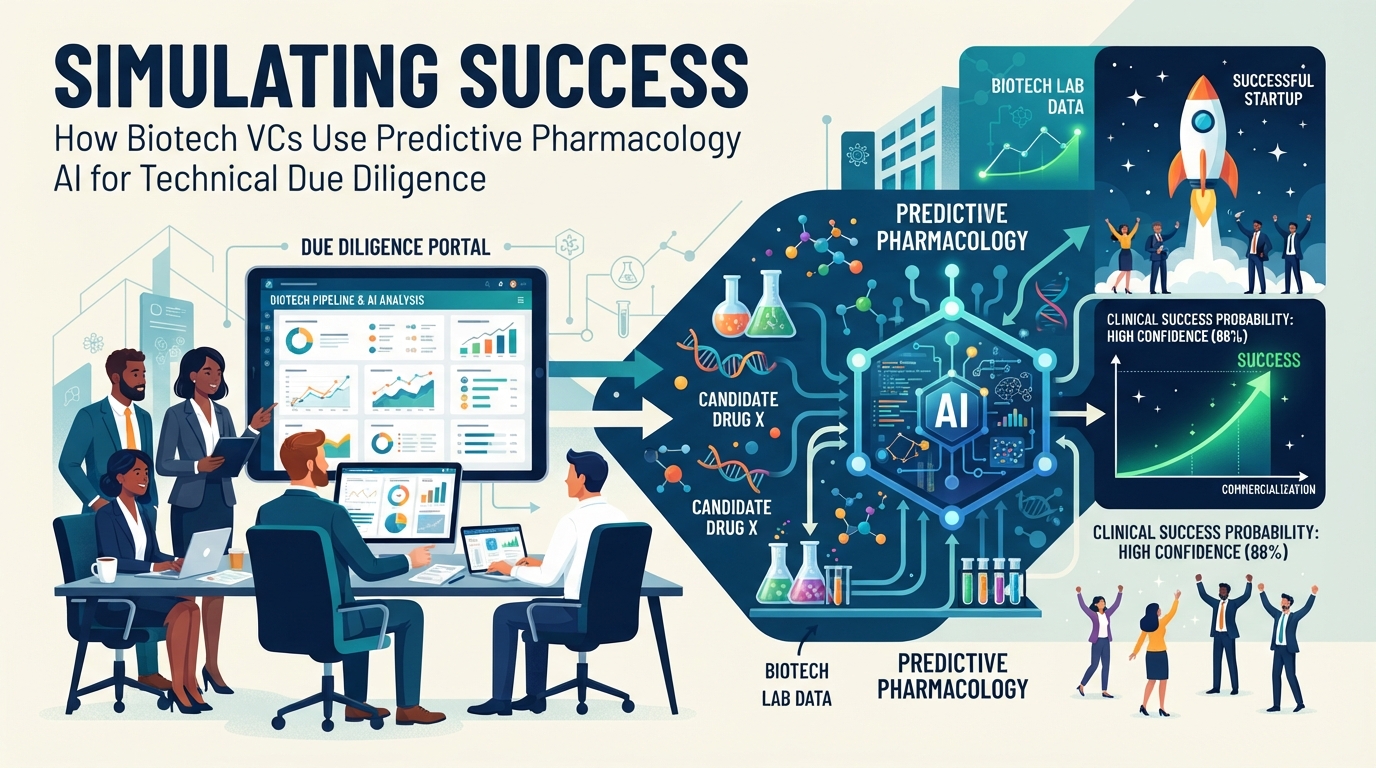
Simulating Success: How Biotech VCs Use Predictive Pharmacology AI for Technical Due Diligence
Introduction: The Paradigm Shift in Biotech Venture Capital Due Diligence
Biotech investing is notoriously high-risk. Over 90% of drug candidates fail during clinical trials, usually due to unforeseen toxicity or lack of efficacy.
Traditionally, biotech venture capital firms relied on static data rooms and historical assays for technical due diligence. While some sectors are adopting advanced zero-knowledge due diligence protocols to protect proprietary startup code during evaluations, biotech investors are focusing heavily on simulation.
Forward-thinking investors are leveraging predictive pharmacology AI for biotech due diligence to simulate drug-target interactions long before a single patient is dosed. This technology transforms how VCs assess risk by turning guesswork into quantifiable, simulated data.
Here is how the diligence landscape is shifting:
- Legacy Diligence: Relies on retrospective lab data, static paper trails, and subjective expert opinions.
- AI-Powered Diligence: Utilizes predictive molecular modeling, real-time in silico simulations, and deep-learning efficacy mapping.
By integrating these advanced simulations, VCs can peer into the biological future of a therapeutic, dramatically reducing portfolio risk from day one.
What is Predictive Pharmacology AI?
At its core, predictive pharmacology AI is the use of advanced computational algorithms to simulate how a drug candidate will behave inside the human body. Instead of waiting years for expensive wet-lab results, VCs use these high-fidelity in silico models to test therapeutics in a virtual environment first.
Think of it as a flight simulator for drug discovery. Just as aerospace engineers use GPU-accelerated computational fluid dynamics to simulate extreme physical environments, these biological models map out complex molecular interactions in a virtual space, answering critical questions before investing millions:
- Target Engagement: Does the molecule actually bind to the disease-causing protein?
- Off-Target Toxicity: Will it accidentally interfere with healthy tissues and cause side effects?
- Efficacy Forecasting: How well will the drug perform compared to existing standards of care?
By translating biochemistry into math, predictive pharmacology AI allows investors to stress-test a startup’s scientific claims. It replaces hope with hard, simulated data, showing VCs exactly how a compound will interact with human biology long before it ever reaches a clinic.
De-Risking Investments with Simulated Drug-Target Interactions
For venture capitalists, the ultimate goal is separation—distinguishing a true blockbuster molecule from a toxic copycat. Computational modeling of drug-target interactions provides this clarity, mapping molecular affinity at atomic resolution to show exactly how a candidate behaves.
Instead of waiting years for expensive wet-lab results, investment committees can computationally analyze two critical pillars of a drug’s viability:
- Precision Selectivity: AI models simulate how tightly a compound binds to its intended target versus similar proteins, predicting off-target reactions before a single physical assay is run.
- Therapeutic Efficacy: By simulating downstream cellular signaling pathways, VCs can visualize whether the drug actually triggers the biological response required to treat the disease.
This computational proof-of-concept is a game-changer for de-risking biotech investments. It transforms speculative biological hypotheses into quantifiable, audit-ready data, allowing VCs to back winning assets with high conviction.
Predicting ADMET Profiles to Preempt Phase I Failures
But binding to a target is only half the battle. A drug can be incredibly potent in a petri dish, but if the human body destroys it too quickly—or worse, turns it toxic—it will crash and burn in Phase I.
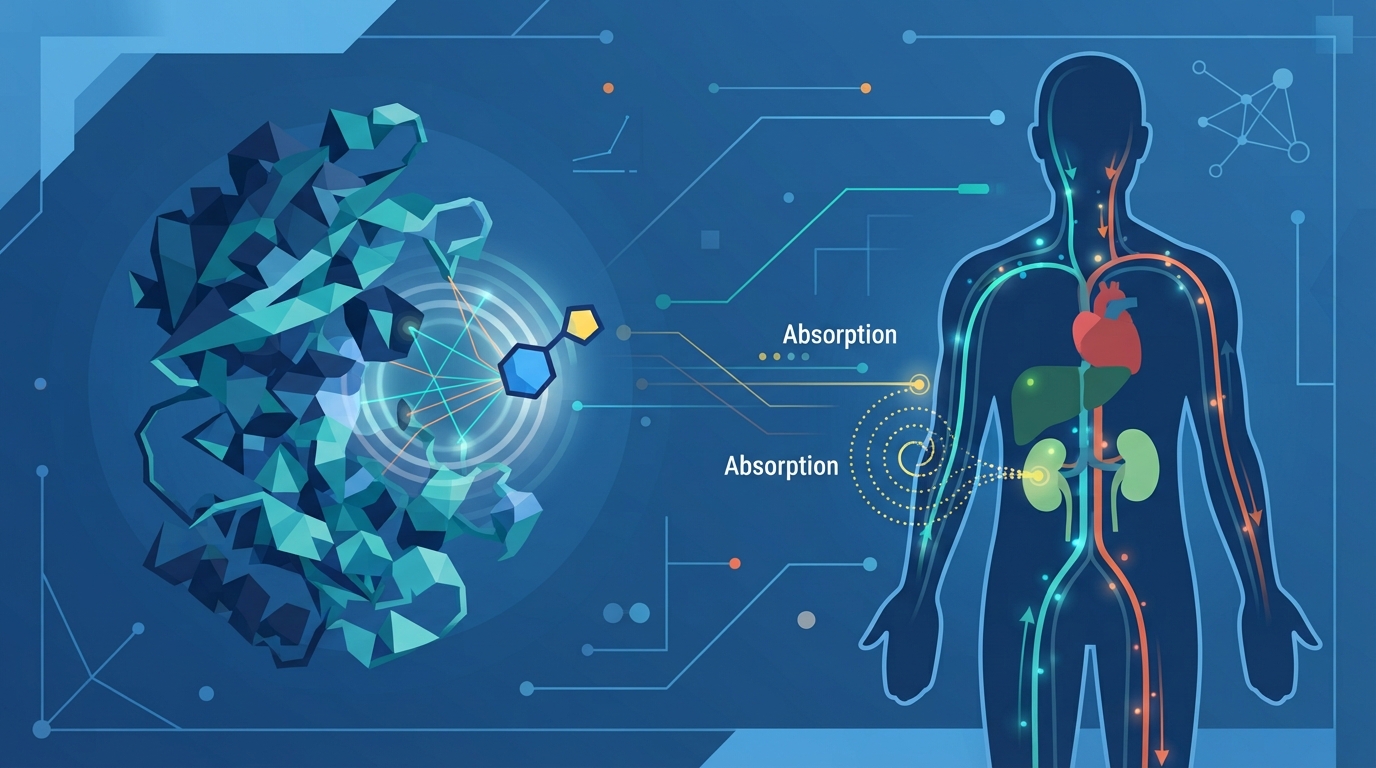
This is where AI-driven ADMET prediction comes in, acting as an early-warning system for VCs. By simulating how a compound is absorbed, distributed, metabolized, excreted, and tolerated, predictive models identify fatal flaws long before clinical trials begin.
Here is how predictive modeling secures viable clinical translation:
- Absorption & Distribution: Simulates whether the compound reaches target tissues in therapeutic concentrations.
- Metabolism & Excretion: Forecasts how the body processes the drug, preventing premature clearance.
- Toxicity: Detects potential cardiotoxicity or hepatotoxicity, the leading causes of safety-related clinical failures.
By screening assets through this virtual gauntlet, VCs can weed out liabilities early and back molecules with a clear, predictable path to human safety.
The Three Pillars of Evaluating AI Drug Discovery (AIDD) Startups
To cut through the generative AI hype during technical due diligence, VCs must look past flashy pitch decks. Conducting rigorous technical due diligence for AI drug discovery startups boils down to three non-negotiable pillars:
- A Closed-Loop Feedback System: Does the platform learn from its own failures? A true closed-loop feedback system seamlessly integrates dry-lab predictions with wet-lab assay results, automatically retraining the AI models to sharpen predictive accuracy.
- Hit-to-Lead (H2L) Efficiency: AI should radically compress development timelines. Evaluate the startup’s actual track record in optimizing virtual hits into synthesis-ready leads, ensuring they do not get bogged down in endless, costly synthesis cycles.
- Rigorous Wet-Lab Validation: Algorithms mean nothing without physical proof. Smart investors verify that the startup’s in silico predictions consistently match in vitro and in vivo data, proving the platform can deliver viable candidates for clinical translation.
Accelerating Timelines: The Competitive Advantage of Computational Diligence
In the high-stakes world of venture capital, speed is a superpower. Traditional technical due diligence often drags on for months as experts manually audit wet-lab notebooks and cross-reference literature. Computational diligence flips this script entirely.
By leveraging predictive pharmacology AI, investment teams can compress these grueling evaluation windows by up to 40%. This rapid turnaround is a game-changer for de-risking biotech investments before competitive term sheets expire.
Here is how computational tools accelerate the deal flow:
- Rapid Asset Stress-Testing: Instantly simulate drug-target interactions instead of waiting weeks for external consultant reports.
- Automated Data Auditing: Spot inconsistencies in a startup’s historical data in minutes, not days.
- Proactive Risk Mapping: Identify potential off-target toxicities early, saving millions in wasted capital.
Ultimately, saving time means securing the best deals. This velocity allows VCs to move from initial screening to high-conviction decision-making before rival funds even finish their preliminary reviews.
Conclusion: The Future of Intelligent Investment in Biotech
In the high-stakes world of biotech venture capital, the margin for error is shrinking. Relying solely on traditional, manual due diligence is no longer enough to consistently outperform the market.
Integrating predictive pharmacology AI into your investment committee’s workflow has shifted from a cutting-edge luxury to an absolute strategic necessity. It transforms speculative bets into highly validated, data-backed decisions.
Here is how forward-thinking funds are using these tools to maximize portfolio success:
- Maximizing Hit Rates: Filtering out biologically unviable assets long before capital is deployed.
- Optimizing Fund Performance: Directing dry powder exclusively toward startups with simulated clinical viability.
- Future-Proofing Portfolios: Building a resilient investment thesis backed by continuous, algorithmic validation.
The future of life sciences investing belongs to those who simulate success before signing the term sheet. Don’t just fund innovation—predict it.