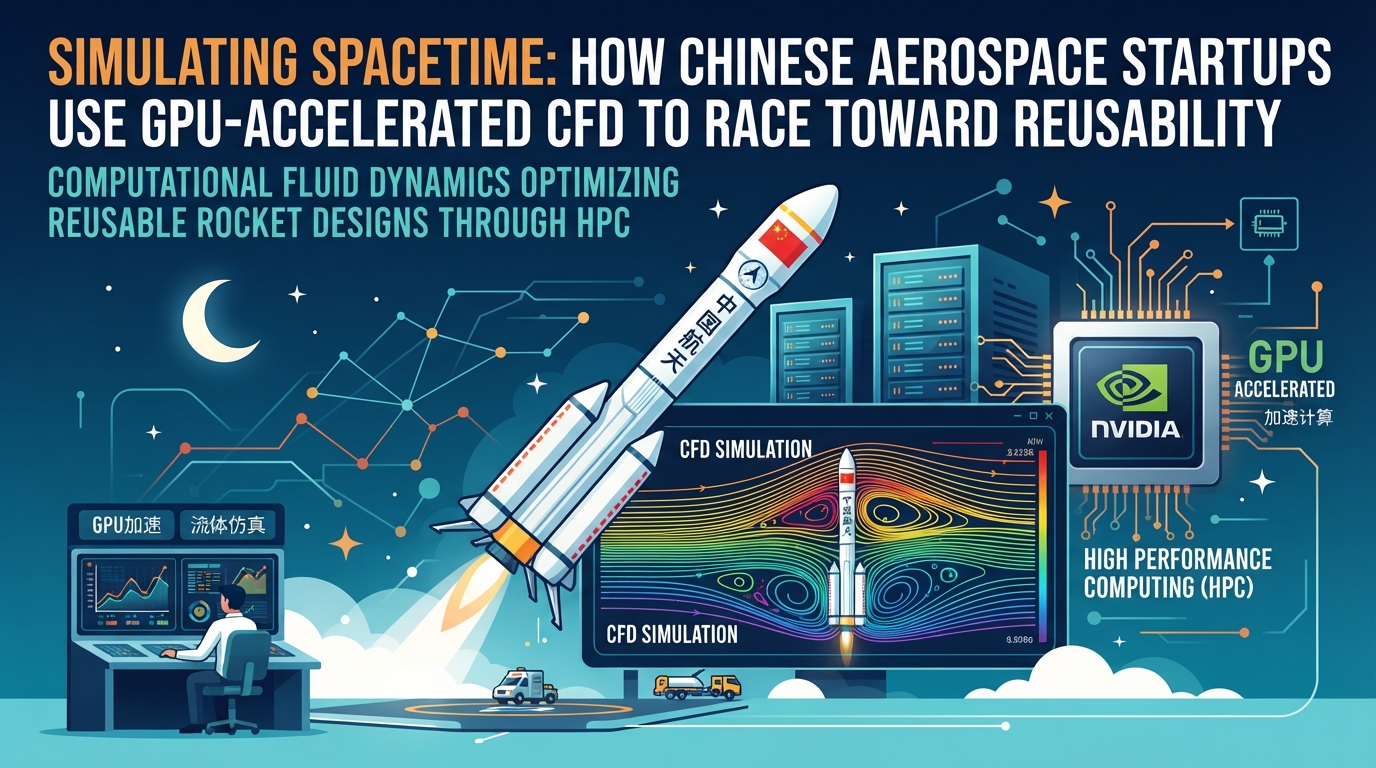
Simulating Spacetime: How Chinese Aerospace Startups Use GPU-Accelerated CFD to Race Toward Reusability
Introduction: The Computational Race to Reusable Rockets
The global space race is no longer just about reaching orbit; it is about getting back down safely, refueling, and launching again. Today, a new wave of private Chinese aerospace startups is sprinting to master reusable rockets, aiming to slash launch costs to a fraction of traditional expendable systems.
Instead of relying on slow, prohibitively expensive physical wind tunnels, these agile disrupters are betting big on cutting-edge digital design. They are leveraging GPU-accelerated CFD aerospace simulations to model extreme flight environments in seconds rather than weeks.
This digital-first approach allows engineers to solve three critical reusability challenges simultaneously:
- Grid Fin Aerodynamics: Navigating the chaotic transonic regime during steering.
- Retropropulsion Plumes: Simulating engine exhaust fighting against supersonic oncoming air.
- Thermal Protection Systems: Predicting exact heat loads during atmospheric re-entry.
By replacing physical steel with virtual pixels, these startups are transforming how hardware is designed, tested, and flown.
The Legacy CPU Bottleneck in Aerospace Design
To understand why GPUs are a game-changer, we first have to look at the traditional engine of digital design: the CPU. For decades, aerospace engineers relied on massive, expensive CPU clusters to run their CFD solvers.
However, traditional CPU bottlenecks quickly turn ambitious design schedules into sluggish waiting games. Because CPUs process tasks sequentially, complex mesh grids with billions of data points choke the system.
This computational drag creates a devastating domino effect on hardware development:
- Stretched Simulation Times: A single high-fidelity re-entry simulation can take weeks to resolve, forcing engineering teams to wait idle.
- Compromised Accuracy: To meet tight deadlines, teams often simplify their mesh models, sacrificing critical aerodynamic details.
- Stifled Iteration: Slow feedback loops mean fewer design cycles, severely limiting a startup’s ability to innovate rapidly.
In a race where the first to build a reliable, reusable rocket wins, relying on legacy CPU architecture is like trying to break the sound barrier in a propeller plane.
Case Studies: LandSpace and Deep Blue Aerospace
To break this computational bottleneck, Chinese pioneers are shifting their simulation workloads to massive GPU clusters. This hardware transition is fueling the rapid development of next-generation liquid oxygen-methane rockets, where two players lead the charge:
- LandSpace: Famous for launching Zhuque-2—the world’s first liquid oxygen-methane rocket to reach orbit—they rely on GPU-accelerated CFD to model complex engine combustion dynamics. By simulating the violent mixing of methane and oxygen in parallel, their engineers slashed simulation times from days to hours.
- Deep Blue Aerospace: Focused heavily on vertical recovery, this startup uses GPU clusters to master the chaotic aerodynamics of retropropulsion. GPU-driven simulations allow them to optimize engine throttling and grid fin aerodynamics on the fly, ensuring a stable pinpoint landing.
| Startup | Primary GPU CFD Focus | Key Achievement |
|---|---|---|
| LandSpace | Combustion chamber dynamics | First methane rocket in orbit |
| Deep Blue Aerospace | Retropropulsion & landing physics | Rapid vertical recovery testing |
Simulating Complex Flight Dynamics: Supersonic Retropropulsion and Grid Fins
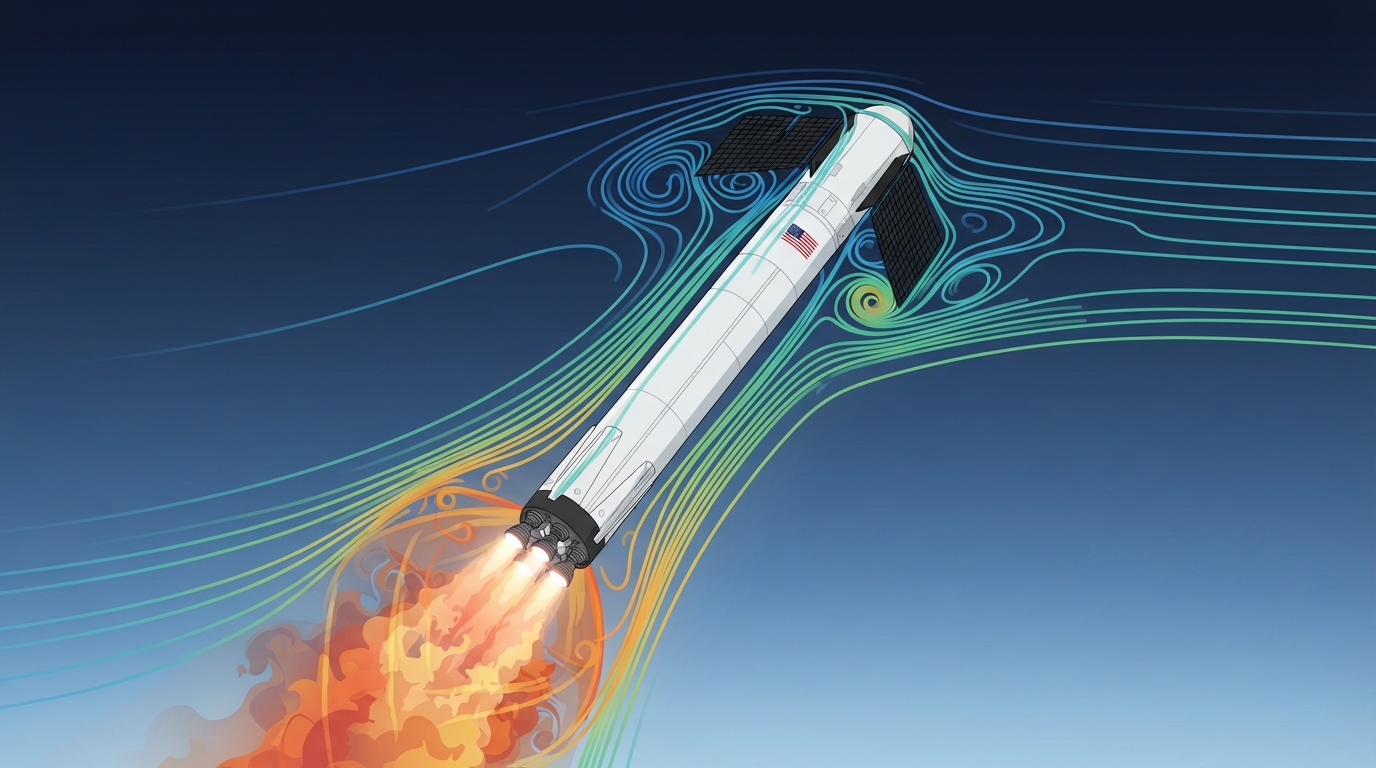
Bringing a booster back from the edge of space is an aerodynamic nightmare. As the rocket plunges back into the atmosphere engine-first, it encounters two massive aerodynamic hurdles that require extreme computational power to solve:
- Supersonic retropropulsion: Firing engines directly into an oncoming supersonic airstream creates a highly unstable, turbulent shockwave interaction. GPU-accelerated CFD models this chaotic flow field in real-time, preventing the rocket from tearing itself apart.
- Grid fin aerodynamics: These waffle-like control surfaces steer the booster through extreme pressure changes. Simulating grid fin aerodynamics requires capturing micro-turbulences inside each tiny pocket—a task that would paralyze traditional CPUs but runs seamlessly on parallel GPUs.
By mastering these dual forces, Chinese startups can predict exactly how a booster behaves during its high-velocity descent. This high-fidelity modeling transforms a chaotic, violent reentry into a controlled, repeatable science.
The Economics of Scaling: Slashing Hardware and Power Costs
For cash-strapped aerospace startups, the true breakthrough of GPU-accelerated CFD isn’t just raw speed—it’s the balance sheet. Running high-fidelity simulations used to require massive, expensive CPU server farms that drained both capital and local power grids.
By transitioning to the native Ansys Fluent GPU solver, companies are achieving massive efficiency gains:
- 5x Reduction in Hardware Costs: A single GPU-accelerated workstation can now match the computational output of a massive, multi-rack CPU cluster, drastically lowering initial capital expenditures.
- 4x Lower Power Consumption: Consolidating server racks into compact GPU nodes means a massive drop in electricity bills and cooling overhead, making continuous design iteration sustainable.
This dramatic reduction in both hardware costs and power consumption democratizes advanced rocket science. It allows agile startups to run thousands of virtual flight tests on a fraction of a legacy aerospace giant’s budget.
Conclusion: Accelerating the Path to Orbit
The race to orbital reusability is no longer just about who has the biggest physical test stands, but who can iterate fastest in the digital realm. By integrating GPU-accelerated CFD aerospace tools, Chinese startups are rewriting the playbook for rocket development. They are squeezing what used to be decade-long timelines into mere years.
This paradigm shift fundamentally compresses R&D cycles in three critical ways:
- Instantaneous Feedback: Engineers can analyze complex aerodynamic loads during hypersonic re-entry and immediately tweak grid fin designs.
- Fail-Fast Virtual Testing: High-fidelity simulations replace risky, multi-million-dollar physical launch failures with safe, digital iterations.
- Rapid Scale-Up: Teams can transition from medium-lift designs to heavy-lift, reusable boosters in record time.
Ultimately, this computational leap doesn’t just speed up individual startups—it permanently accelerates the global timeline for commercial spaceflight. The future of reusable rocketry is arriving years ahead of schedule, simulated in silicon before it ever touches the launchpad.