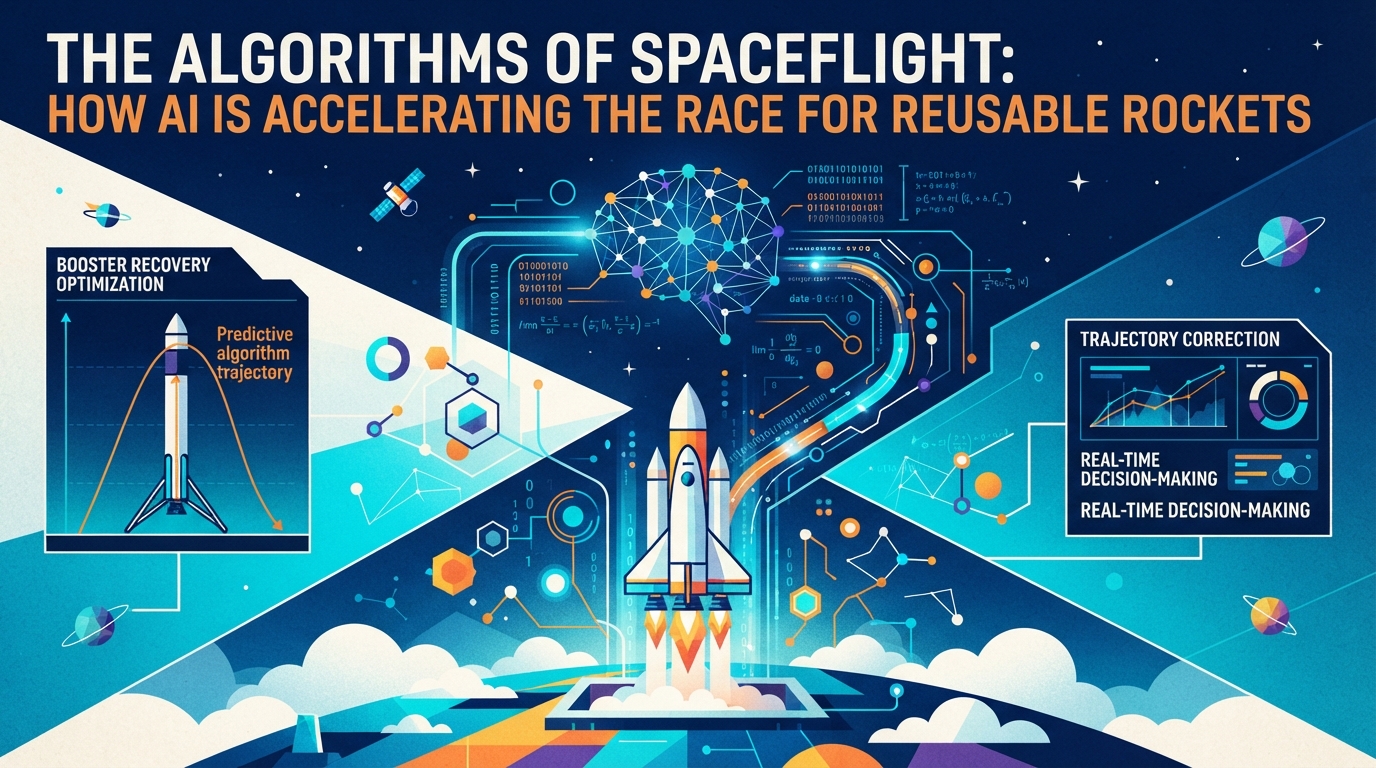
The Algorithms of Spaceflight: How AI is Accelerating the Race for Reusable Rockets
Introduction: The New Era of Reusable Spaceflight
For decades, space exploration followed a wasteful script: build a multi-million dollar rocket, launch it once, and let it burn up in the atmosphere. Today, the industry is undergoing a massive paradigm shift toward reusable boosters that can launch, land, and fly again.
But guiding a 15-story booster back to a pinpoint landing on a floating ocean barge is incredibly complex. Traditional, pre-programmed guidance systems simply cannot react fast enough to unpredictable high-altitude winds and shifting atmospheric densities.
This is where AI in rocket guidance changes the game. By processing real-time environmental data in milliseconds, machine learning algorithms make autonomous rocket landings not just possible, but routine.
- Legacy Systems: Rely on rigid, pre-calculated trajectories that fail under unexpected weather conditions.
- AI-Driven Systems: Dynamically recalculate flight paths mid-air, executing split-second thruster adjustments.
By replacing static math with dynamic, adaptive intelligence, AI is rapidly turning science fiction into daily operational reality.
The Limits of Classical Guidance in Dynamic Environments
Historically, aerospace engineers relied on “nominal trajectories”—essentially, a highly educated guess of the rocket’s flight path calculated days before launch. While this math works perfectly in the vacuum of space, the chaotic return through Earth’s atmosphere is a completely different beast.
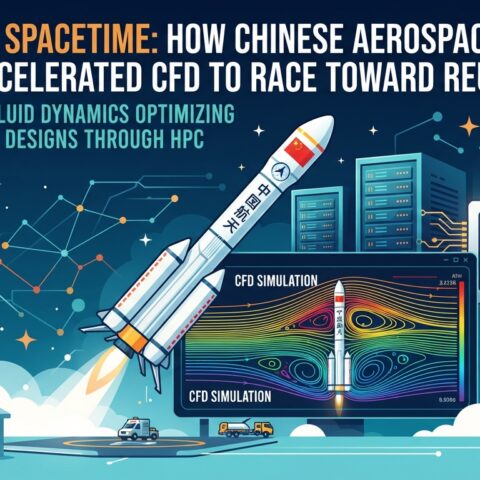
Static math simply cannot keep pace with fluid dynamics. When a booster re-enters the atmosphere at hypersonic speeds, it encounters unpredictable forces that render pre-planned paths useless. To combat this, aerospace engineers are increasingly leveraging GPU-accelerated computational fluid dynamics to simulate reusability and predict atmospheric interactions.
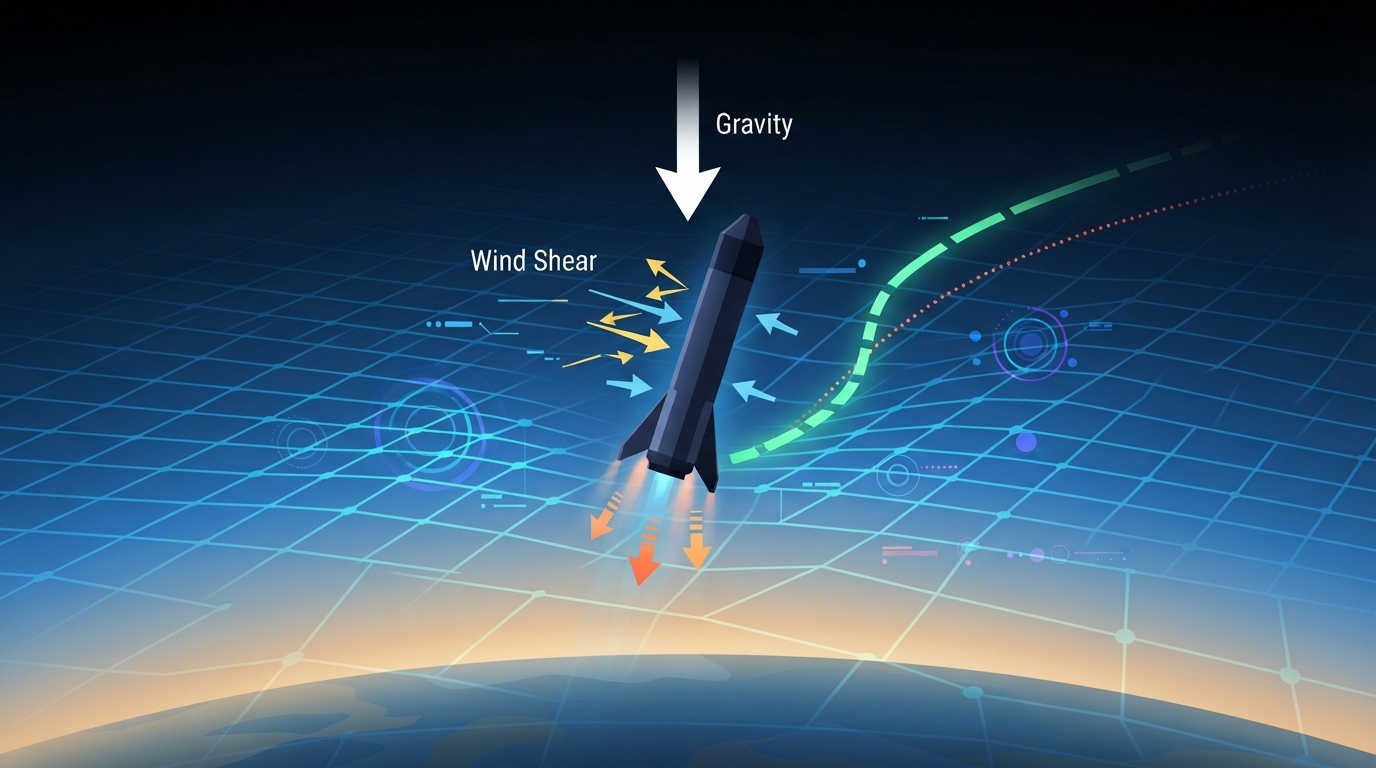
- Micro-bursts and Wind Shear: Sudden, localized wind changes can instantly push a multi-ton rocket off course.
- Thermal and Density Fluctuations: Atmospheric layers are not uniform; rapid temperature and density spikes instantly alter lift and drag.
Without advanced aerodynamic turbulence prediction, legacy flight computers cannot anticipate these forces, leading to dangerous overcorrections. This is why modern recovery demands true closed-loop guidance systems. By constantly feeding real-time sensor data back into the flight computer, the rocket transitions from executing a rigid script to actively navigating a living, changing environment.
How Deep Reinforcement Learning Optimizes Descent Paths
To survive this chaotic environment, modern rockets rely on deep reinforcement learning (DRL). Instead of following rigid, pre-programmed trajectories, a DRL agent learns by simulating millions of landing scenarios, discovering the most efficient physics-based recovery strategies.
During a live descent, the onboard AI processes complex sensor data to make split-second decisions. It continuously outputs precise adjustments to the rocket’s actuators in milliseconds, optimizing two critical systems:
- Thrust-vector control (TVC): Dynamically gimballing the engine nozzle to steer the rocket’s thrust.
- Aerodynamic grid fins: Constantly rotating to harness high-speed airflow for stability.
By instantly balancing engine throttle and fin angles, the algorithm acts like an elite pilot with superhuman reflexes. It doesn’t just react to turbulence; it actively anticipates the optimal descent path to execute a pinpoint landing, saving precious fuel in the process.
Sensor Fusion: The Eyes and Ears of Autonomous Boosters
To execute those split-second maneuvers, a returning booster needs an incredibly sharp sensory system. It relies on sensor fusion in spaceflight—the instantaneous blending of disparate data streams into a single, highly accurate picture of the rocket’s physical state.
Instead of relying on a single instrument, the onboard computer synthesizes inputs from three critical “sensory organs”:
- Inertial Measurement Units (IMUs): Track acceleration and angular velocity to detect the slightest deviation in orientation.
- Radar Altimeters: Provide high-altitude distance tracking to map the exact rate of descent.
- LiDAR Scanners: Generate high-resolution 3D point clouds of the landing zone for pinpoint hazard detection.
By merging these feeds, the AI filters out environmental noise and executes real-time aerodynamic turbulence prediction. This unified data stream feeds directly into the rocket’s actuators, allowing the system to instantly micro-adjust the grid fins and gimbal the engine nozzle. The result is a smooth, controlled descent through chaotic atmospheric forces.
Overcoming Hardware Constraints: AI on Radiation-Hardened Computers
Running advanced AI in deep space has a major catch: standard silicon chips quickly fail under cosmic radiation. While terrestrial industries focus on scaling up massive production facilities like US-based AI hardware fabs, spaceflight hardware must prioritize extreme physical resilience over raw processing power. To survive, spacecraft rely on radiation-hardened flight computers.
However, these rugged processors are notoriously slow, often possessing less computing power than a decades-old smartphone. Relying on Earth-based servers for processing is out of the question, as it introduces unacceptable communication latency during a high-stakes descent.
To bypass this bottleneck, initiatives exploring machine learning for autonomous spacecraft guidance and control are helping to deploy highly optimized, lightweight neural networks directly onto local flight hardware. This evolution in AI in rocket guidance is achieved through two main techniques:
- Network Pruning: Stripping away non-essential neural pathways to drastically shrink the model’s footprint.
- Quantization: Lowering the mathematical precision of the data so complex calculations run on low-power chips without sacrificing landing accuracy.
By shrinking the software rather than waiting for faster hardware, rockets can execute split-second decisions locally, safely, and entirely autonomously.
Measuring the Impact: Fuel Efficiency and Precision Landing
So, what happens when you unleash these lightweight neural networks on actual flight dynamics? The simulated results are nothing short of revolutionary, proving that AI is a massive cost-saver rather than just a high-tech novelty.
Recent simulated trials of AI-driven guidance systems have clocked unprecedented performance milestones:
- 14% Fuel Efficiency Gains: By optimizing the landing trajectory in real-time, the AI minimizes wasteful engine burns and conserves precious propellant.
- Sub-Meter Landing Accuracy: The algorithms guide the booster to a pinpoint touchdown, virtually eliminating lateral drift.
At the heart of these autonomous rocket landings is the AI’s ability to micro-adjust thrust-vector control systems on the fly. Instead of relying on rigid, pre-programmed trajectories, the software dynamically throttles and angles the engines to fight unpredictable atmospheric crosswinds. This hyper-precise control turns what used to be highly volatile descent profiles into routine, reliable touchdowns.
Conclusion: The Autonomous Future of Space Exploration
We are no longer just watching boosters return to Earth; we are witnessing the birth of a fully autonomous space highway. The mastery of autonomous rocket landings is the critical catalyst that transforms spaceflight from a rare, high-risk event into a routine, daily utility.
By embedding AI in rocket guidance systems, we are building the operational foundation required to reach deeper into the cosmos. Here is how this intelligent automation is rewriting our future in the stars:
- True Orbital Routine: Drastically lowering launch costs to make satellite deployment and space tourism as common as commercial aviation.
- Interplanetary Logistics: Ensuring unmanned cargo vessels can safely touch down on the rugged, unsurveyed terrains of Mars or the Moon.
- Real-Time Deep-Space Decisions: Eliminating the dangerous communication lag with Earth by letting spacecraft pilot themselves through unpredictable environments.
The algorithms we refine today are the silent pilots that will eventually guide humanity to new worlds.