Beyond Monolithic LLMs: Why Thinking Machines’ Inkling is Pioneering the Shift to Domain-Specific AI
Introduction: The Shift from Monolithic LLMs to Specialized AI
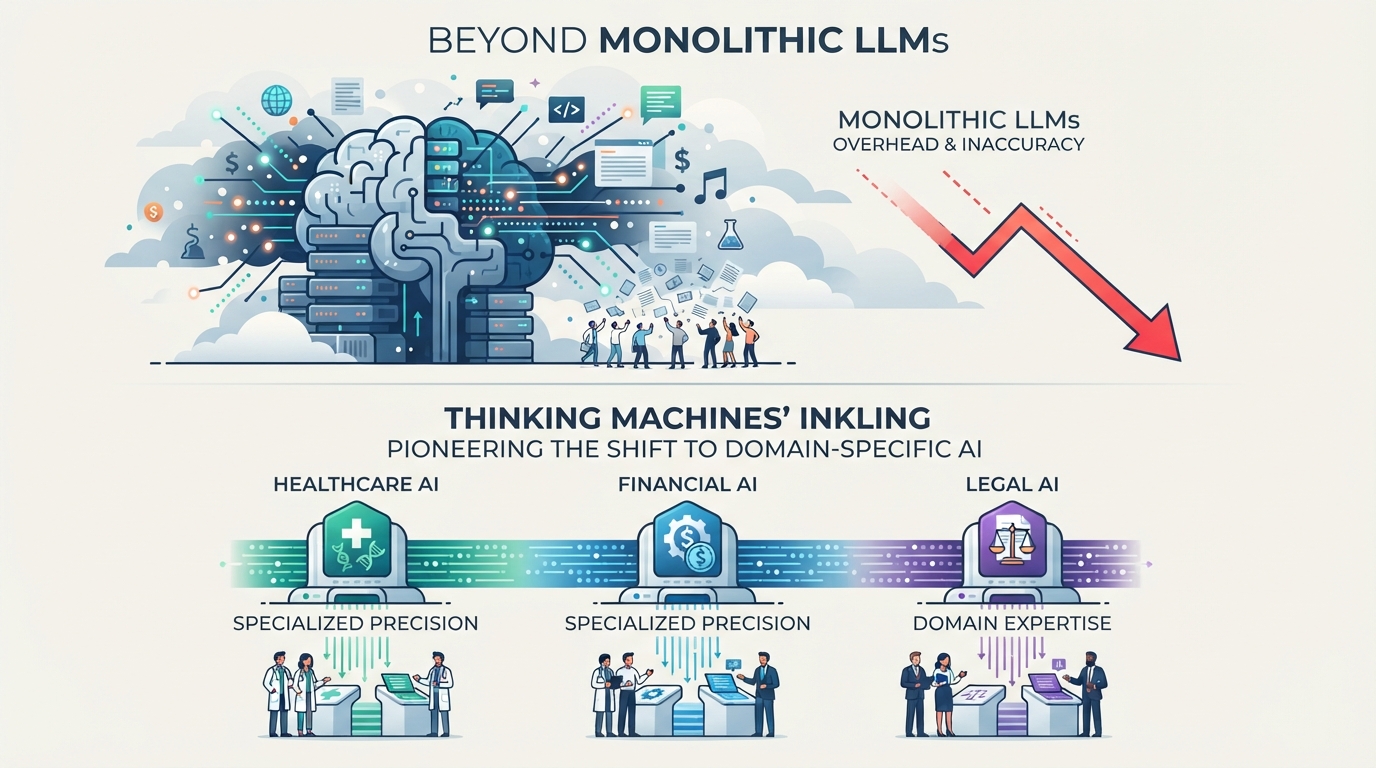
For years, the AI playbook was simple: bigger is better. We marveled at massive, general-purpose monolithic LLMs that could write poetry, code, and summarize articles all in one breath. But as enterprises try to deploy these giants in production, the cracks are starting to show.
The reality is that “jack-of-all-trades” models are often too expensive, too slow, and prone to costly hallucinations when faced with highly technical tasks.
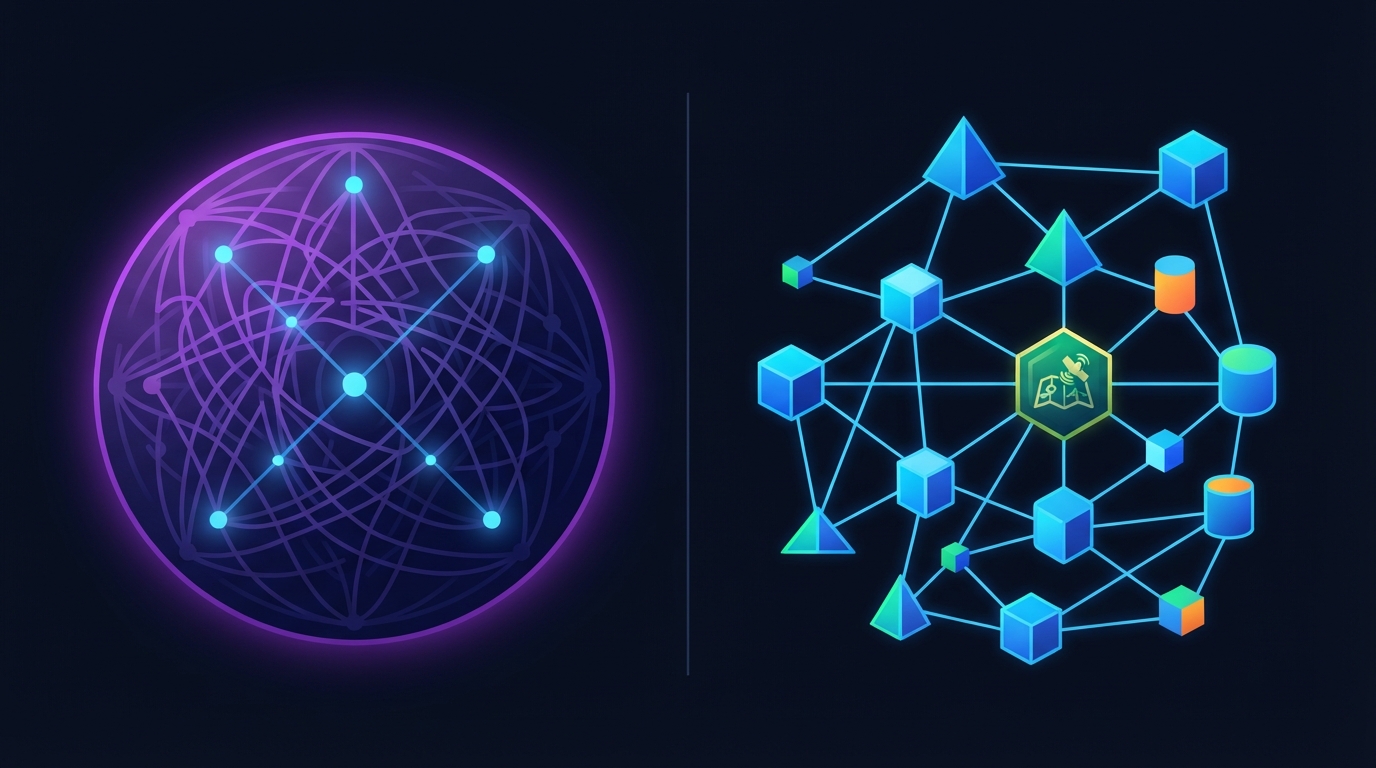
That is why the industry is undergoing a massive paradigm shift toward domain specific AI models. Instead of using a massive model that knows a little bit about everything, businesses are choosing smaller, highly tuned systems designed to do one thing exceptionally well.
Here is why the tide is turning:
- Precision: Specialized models are trained on curated, industry-specific data, drastically reducing errors.
- Efficiency: They require less computational power, leading to faster response times and lower API costs.
- Privacy: It is far easier to secure and deploy smaller models within private cloud environments.
The Pitfalls of General-Purpose LLMs for Enterprise Operations
While monolithic LLMs excel at writing poetry or summarizing general articles, deploying them for critical enterprise AI operations is a risky gamble. Relying on these massive models introduces severe operational bottlenecks that can quickly derail business-critical workflows.
Here are the primary pain points businesses face:
- The Hallucination Hazard: General models are designed to be creative, which is a major liability when you need absolute accuracy in compliance, legal, or financial reporting.
- The Context Gap: They lack access to your proprietary data, meaning they can only guess at internal terminology, product catalogs, or customer histories.
- Data Privacy Risks: Funneling sensitive customer information through external third-party APIs often violates strict regulations like GDPR or HIPAA.
- Astronomical Compute Costs: Querying a trillion-parameter model for simple, repetitive tasks is like renting a semi-truck to deliver a letter—it is incredibly expensive and highly inefficient.
The Core Advantages of Domain-Specific AI Models
To bypass the limitations of massive, general-purpose LLMs, forward-thinking enterprises are turning to domain specific AI models. By narrowing their focus, these specialized systems deliver surgical precision where it matters most.
They achieve this breakthrough performance through two core pillars:
- Targeted Fine-Tuning: Instead of learning everything from Shakespeare to quantum physics, the AI undergoes deep fine-tuning on your industry’s specific terminology. This transforms the model into an elite specialist in your exact field.
- Retrieval-Augmented Generation (RAG): By pairing the model with Retrieval-Augmented Generation, it doesn’t rely on static memory. Instead, it securely queries your internal databases in real-time to deliver hyper-accurate, context-aware answers.
By combining these techniques, businesses get a lean, hyper-focused system. It slashes compute costs, guarantees data security, and eliminates the guesswork that plagues generic models.
Spotlight on Thinking Machines’ Inkling: Specialized Geospatial AI
To see this shift in action, look no further than Thinking Machines Inkling. While generic LLMs struggle to read a simple map, Inkling is a trailblazing platform built specifically for location intelligence.
By focusing entirely on geospatial AI, it translates complex Earth observation data and satellite imagery into actionable, real-world insights. It does not waste compute power on writing poetry; instead, it solves critical spatial challenges that general models cannot comprehend.
Here is how Thinking Machines Inkling delivers high-definition domain expertise:
- Precision Mapping: Automatically detects and tracks infrastructure changes, road networks, and building footprints.
- Environmental Monitoring: Measures deforestation, agricultural health, and climate risks with pinpoint accuracy.
- Rapid Data Fusion: Merges disparate geographic datasets to help organizations make fast, location-based decisions.
By narrowing its focus, Inkling proves that the future of AI isn’t about knowing everything—it is about mastering one critical domain.
Inkling vs. The Giants: Navigating the Geospatial AI Landscape
When we talk about location intelligence, legacy giants like Esri ArcGIS, Mapbox, and CARTO usually dominate the conversation. These platforms are incredible for visualizing spatial data and building custom maps. However, they still require heavy manual lifting, complex queries, and expert GIS analysts to extract actual meaning.
This is where Thinking Machines Inkling carves out its own distinct niche. Instead of just displaying data, Inkling uses advanced geospatial AI to automate localized mapping at scale.
Here is how they stack up:
- Esri ArcGIS & CARTO: Powerhouses for manual GIS analysis and enterprise-grade visualization.
- Mapbox: The gold standard for developer APIs and highly customizable map rendering.
- Thinking Machines Inkling: An automated engine that detects local infrastructure changes and environmental shifts without manual coding.
While the giants help you see the world, Inkling actually interprets it for you. It bridges the gap between raw imagery and instant, automated decision-making.
Conclusion: Preparing for a Domain-Specific Future
The era of relying solely on one-size-fits-all, monolithic LLMs is drawing to a close. To build a true competitive moat, forward-thinking organizations are shifting toward highly specialized tools.
Generic AI might write a decent email, but it cannot map infrastructure changes or predict localized environmental risks. Embracing domain specific AI models is no longer just an option—it is the cornerstone of modern enterprise AI strategy.
Here is why specialized AI secures your long-term advantage:
- Unmatched Precision: Tailored algorithms eliminate generic “hallucinations” by operating within strict, industry-specific parameters.
- Immediate ROI: Automation replaces manual analysis, turning complex data into instant, actionable decisions.
- Strategic Moats: Proprietary, domain-focused workflows are incredibly difficult for competitors to replicate.
The future of technology isn’t just about building bigger models; it is about building smarter, more targeted solutions. It’s time to move beyond the monolith.