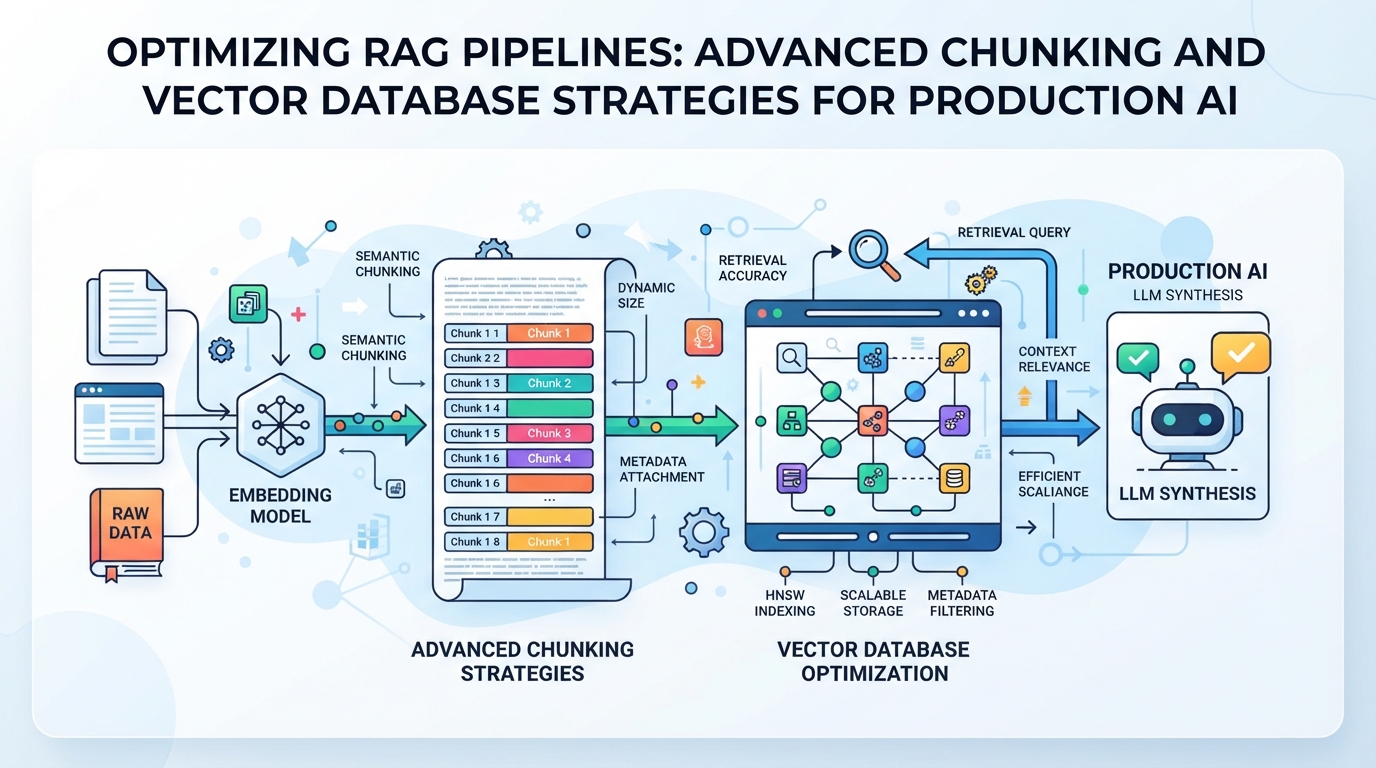
Optimizing RAG Pipelines: Advanced Chunking and Vector Database Strategies for Production AI
Introduction: The Evolution of Production-Ready RAG
Retrieval-Augmented Generation (RAG) revolutionized how we connect LLMs to proprietary data. In the lab, a basic “naive” RAG setup—simply dumping PDFs into a vector store—feels like absolute magic.
But once you transition to a production RAG environment, that magic quickly fades. Real-world users expose critical flaws: hallucinations, sluggish response times, and irrelevant retrievals that derail the entire experience.
To scale successfully, you must move beyond default configurations. Mastering how to optimize rag pipeline performance requires balancing three non-negotiable pillars:
- Accuracy: Delivering hyper-relevant, context-rich data chunks to the LLM.
- Latency: Slashing retrieval and generation times down to milliseconds.
- Cost Efficiency: Minimizing token waste and optimizing vector database storage.
This guide dismantles the bottlenecks of basic setups, offering advanced chunking and database strategies to make your AI system truly production-ready.
Advanced Chunking Strategies: Preserving Semantic Context
Fixed-size chunking is a blunt instrument. Splitting text at arbitrary character counts routinely slices sentences in half, severing vital context and feeding your LLM fragmented nonsense.
To build a production-grade RAG pipeline, you must adopt advanced chunking strategies that respect the natural structure of your data. Two powerful approaches solve this problem:
- Recursive character splitting: This method uses a prioritized hierarchy of separators—like double newlines, single newlines, and spaces—to break text down. It keeps semantically related sentences together rather than cutting them off mid-thought.
- Semantic chunking: This technique analyzes the embedding distance between consecutive sentences. It only triggers a split when a significant shift in meaning occurs, ensuring perfect conceptual integrity.
| Strategy | Best For | How It Works |
|---|---|---|
| Recursive | Markdown, code, structured documents | Splits by logical punctuation hierarchy |
| Semantic | Narrative text, essays, conversational transcripts | Splits by shifts in embedding distance |
Implementing Parent-Child Chunking for Contextual Richness
While recursive and semantic splitting improve chunk quality, they still force a frustrating compromise: do you optimize for precise search retrieval or rich LLM context?
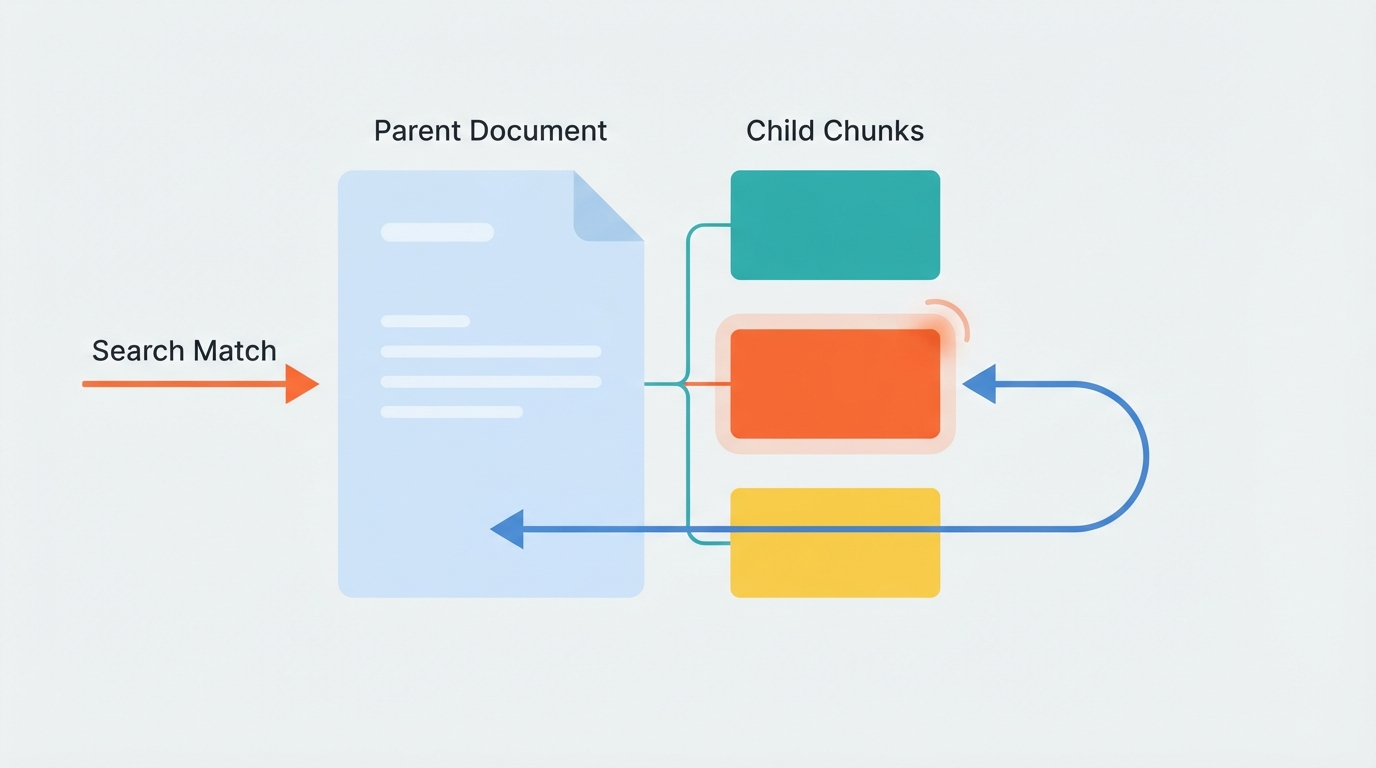
Parent-child chunking eliminates this trade-off by decoupling the data you search from the data you feed to the LLM.
Here is how this two-tiered architecture works:
- The Parents: Large, context-rich document segments (e.g., 1,000 tokens) that retain the full narrative or technical explanation.
- The Children: Small, highly focused sub-chunks (e.g., 150 tokens) generated from each parent.
During retrieval, your system searches only the child chunks. Because these smaller units are highly specific, they generate incredibly accurate vector matches for user queries.
Once a match is found, the system bypasses the child and pulls the broader parent chunk into the prompt. This ensures your LLM receives the complete, uninterrupted context it needs to generate a flawless response without diluting search precision.
Vector Database Optimization: Tuning HNSW Parameters
Once you’ve optimized your chunks, the next bottleneck in your RAG pipeline is retrieval speed and accuracy. This is where vector database optimization becomes critical, specifically through HNSW index tuning.
Hierarchical Navigable Small World (HNSW) is the gold standard for fast vector search, but it requires balancing three crucial configuration levers:
- M (Max Connections): Defines the maximum links per node. Higher values (e.g., 16–64) improve recall for high-dimensional data but increase memory footprint.
- efConstruction: Controls index build quality. Increasing this parameter yields higher recall accuracy, though it slows down your data ingestion.
- efSearch: A runtime parameter that limits the candidate list during queries. Crank this up to boost search precision, but expect higher query latency.
| Parameter | Boosts | Cost |
|---|---|---|
| M | Recall | RAM |
| efConstruction | Accuracy | Build Time |
| efSearch | Precision | Latency |
Balancing Accuracy and Latency: Two-Stage Retrieval
Even with a perfectly tuned HNSW index, relying solely on vector similarity often leaves semantic nuance on the table. To solve this, production-grade systems implement a two-stage retrieval pipeline that elegantly balances speed and precision.
Here is how this high-performance architecture breaks down:
1. Stage 1: Candidate Generation (Speed): You use fast bi-encoders to embed queries and documents independently. This allows your vector database to perform sub-millisecond searches, instantly narrowing millions of documents down to the top 100 candidates.
2. Stage 2: Re-ranking (Accuracy): You feed these candidates into a cross-encoder re-ranking model. Because it processes the query and document simultaneously, it catches deep semantic relationships that vector distance misses, re-ordering the final top 5 with extreme precision.
By combining these two steps, you get the best of both worlds: the sub-second latency of vector search and the deep contextual understanding of transformer-based re-rankers.
Optimizing Speed with Semantic Query Caching
Even with a highly optimized retrieval pipeline, the absolute fastest query is the one you don’t have to process at all. This is where semantic query caching comes in. Unlike traditional caches that require an exact keyword match, a semantic cache uses vector embeddings to identify queries with the same underlying intent.
Here is how this simple workflow achieves dramatic latency reduction:
- The Similarity Check: When a user submits a query, the system searches a dedicated cache database for previously answered questions with a high semantic similarity score (e.g., >0.95 cosine similarity).
- Instant Retrieval: If a close match exists, the system bypasses the entire RAG pipeline and serves the cached answer in milliseconds.
- Cache Miss Fallback: If no match is found, the query runs through your standard RAG pipeline, and the final response is cached for future users.
By intercepting repetitive or slightly rephrased queries, you slash LLM API costs and deliver near-instantaneous responses to your users.
Conclusion: Synthesizing Chunking and Database Strategies
Building a reliable system for production AI isn’t about choosing between smart data prep or fast retrieval—it is about mastering both. When figuring out how to optimize rag pipeline performance, you must treat chunking and vector database strategies as two sides of the same coin.
The most successful enterprise-grade systems rely on a tight, two-pronged feedback loop:
- Upstream Optimization (Chunking): Align your chunking strategies with your document structure to feed your LLM high-signal, low-noise context.
- Downstream Optimization (Retrieval): Leverage advanced database tactics like hybrid search, metadata filtering, and re-ranking to deliver pinpoint accuracy.
Ultimately, your retrieval is only as good as your data preparation, and your data preparation is useless without efficient retrieval. By seamlessly aligning these two phases, you transform a sluggish prototype into a lightning-fast, highly accurate engine ready for enterprise scale.