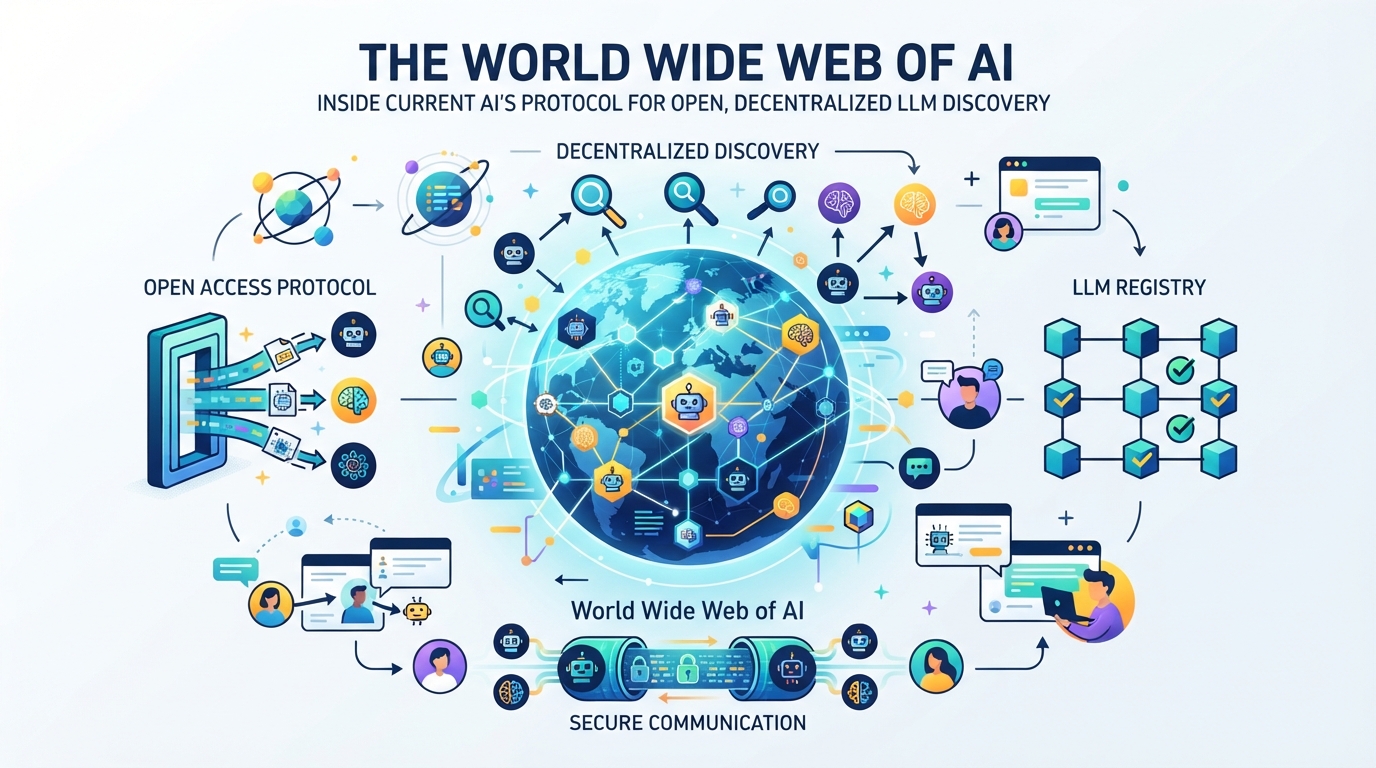
The World Wide Web of AI: Inside Current AI’s Protocol for Open, Decentralized LLM Discovery
Introduction: The Vision of an Open Decentralized AI Network
Think back to the early days of the World Wide Web. It succeeded because it was open, hyperlinked, and democratized. Today, we stand at a similar crossroads with artificial intelligence.
The next evolutionary step of the internet is a decentralized AI network—a global, open ecosystem where independent models connect and collaborate seamlessly.
Currently, AI is trapped in corporate walled gardens. This centralized LLM infrastructure creates severe bottlenecks:
- Gatekeeping: A few tech giants dictate access, pricing, and censorship rules.
- Silos: Brilliant, specialized models remain isolated and undiscovered.
- Single Points of Failure: Centralized servers risk massive downtime and privacy leaks.
To break these barriers, we need a dynamic system for LLM discovery. Just as early search engines mapped the web, a decentralized discovery protocol will allow users to instantly find, query, and utilize the exact model they need, when they need it.
The Need for Decentralized LLM Discovery Systems
Imagine an internet where you could only visit websites approved by a single telecom provider. That is the reality of AI today. To break free, we need an open marketplace where any decentralized LLM can advertise its capabilities without needing a corporate stamp of approval.
An open-source, permissionless LLM discovery system shifts power back to the edges of the network by delivering three critical advantages:
- Censorship Resistance: No central authority can deplatform a model or restrict its output based on shifting corporate policies.
- Democratized Access: Developers globally can publish niche, highly specialized models and get discovered instantly based on merit, not marketing budget.
- Dynamic Redundancy: If one hosting node goes offline, the discovery protocol seamlessly routes your query to an equivalent alternative.
By removing the gatekeeper, we transition from a monopolized oligarchy to a thriving, merit-based ecosystem where the best models win.
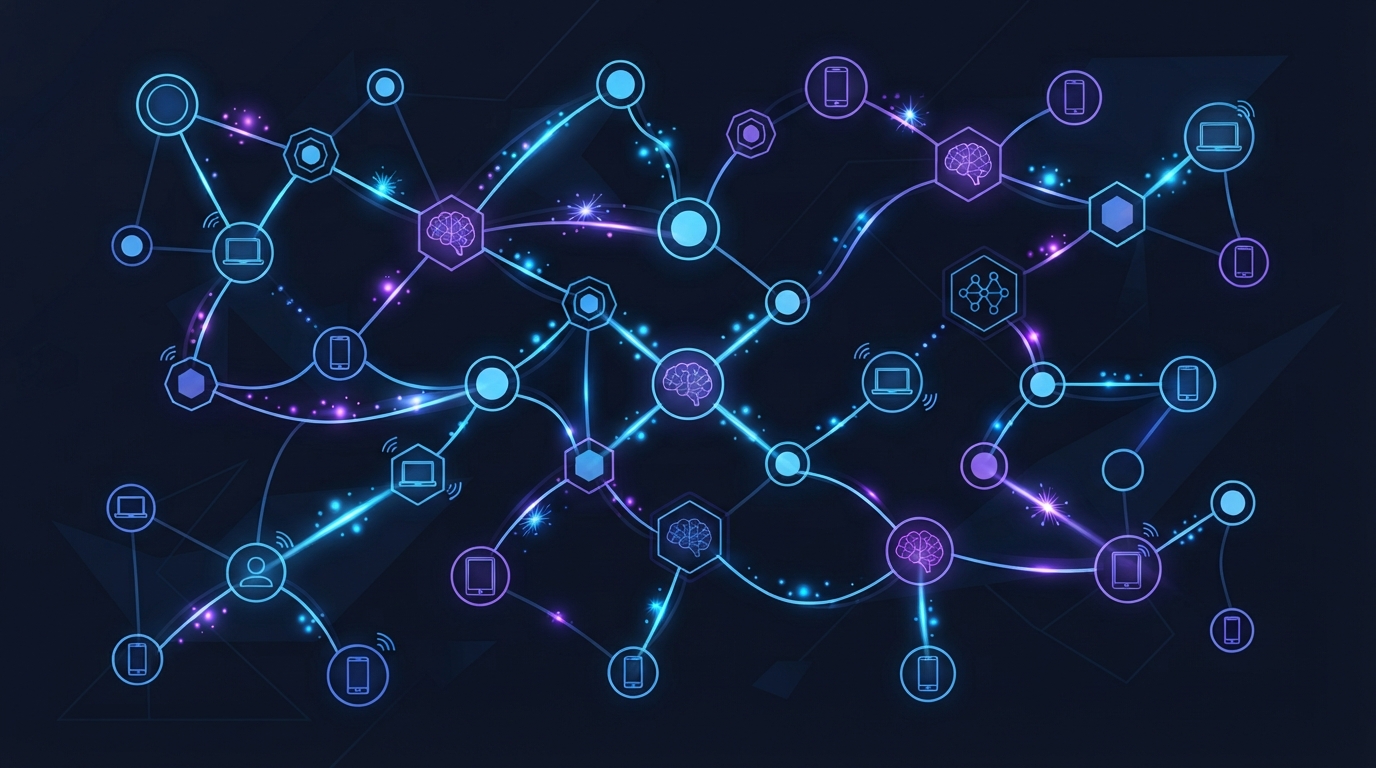
Inside DHT-Based Capability Mapping
To make this work without a central registry, the network relies on DHT-based discovery. Think of a Distributed Hash Table (DHT) as a giant, collaborative phone book spread across thousands of independent computers.
Instead of names, this decentralized AI network maps specific hardware and model capabilities directly to coordinate-like keys. Here is how a node’s profile is translated into findable data:
- Dimension Mapping: Features like parameter size (e.g., 70B) and quantization (e.g., INT4) are hashed into a multi-dimensional coordinate space.
- Mathematical Closeness: Nodes hosting similar models sit “near” each other in this virtual space, regardless of their actual physical location.
- Instant Routing: When you request a specific model, the DHT routes your query through the closest nodes mathematically, finding a match in milliseconds.
This spatial mapping ensures you find the exact resource you need instantly, entirely bypassing centralized bottlenecks.
Optimizing Routing with Multi-Metric Utility Functions
Once the DHT maps out your target nodes, the agent routing protocol must decide which specific provider gets the job. It’s not just about finding any match; it’s about calculating the optimal path in real-time.
To achieve this, this decentralized P2P protocol runs multi-metric utility functions that instantly score available nodes based on three critical vectors:
- Latency: How fast can the node return the completed tokens to the user?
- Cost: What is the current price per million tokens on that specific node?
- Quality: Does the node’s hardware meet the required model quantization and parameter size?
By dynamically weighing these metrics, the network naturally prevents localized traffic congestion. If a popular node becomes bottlenecked, its latency score drops, automatically rerouting queries to underutilized, mathematically close peers. This autonomous balancing ensures lightning-fast, highly cost-effective inference delivery without ever needing a central server.
Securing the Network with Zero-Knowledge Proofs
Dynamic routing keeps the network fast, but how do you trust that a node actually has the hardware it claims without exposing private data? This is where zero-knowledge proofs (ZKPs) step in to anchor trustless collaborative AI.
Instead of forcing nodes to reveal their underlying proprietary data, ZKPs mathematically prove capability. This cryptographic shield secures the network on two critical fronts:
- Capability Verification: Nodes prove they run the exact model and quantization requested without exposing proprietary hardware configurations.
- Data Privacy: User queries are verified as processed correctly without leaking raw data to the public ledger.
By verifying computational integrity silently in the background, ZKPs ensure bad actors cannot spoof their performance metrics. The result is a highly secure, private, and verifiably honest decentralized marketplace.
The Open Agent Routing Protocol (OARP) and Agent Economies
With a secure marketplace established, how do these verified nodes actually communicate and trade? Enter the Open Agent Routing Protocol (OARP), a groundbreaking agent routing protocol designed to connect isolated AI ecosystems.
Think of OARP as the financial and operational lingua franca for autonomous AI agents. It allows diverse AI systems to discover each other, collaborate, and transact instantly without human intervention.
Here is how OARP powers this new decentralized agent economy:
- Cryptographic Identity: Agents use secure cryptographic keys to verify their operational credentials and build trust.
- Dynamic Fee Negotiation: Systems autonomously bid, negotiate micro-payments, and settle transaction fees in real-time.
- Cross-Framework Delegation: A LangChain-based agent can seamlessly hand off a specialized sub-task to a LlamaIndex or AutoGPT agent.
By standardizing these complex interactions, OARP transforms fragmented AI models into a fluid, self-organizing, and highly productive digital workforce.
Overcoming Latency and Interoperability Barriers
Building a global, decentralized AI network sounds great in theory, but real-time agent collaboration requires near-instantaneous communication. Traditional gossip protocols simply cannot handle the heavy payload of AI metadata, leading to crippling network lag.
To solve this, the OARP framework introduces a highly optimized P2P protocol designed specifically for high-frequency model discovery. Recent benchmarks reveal a massive 42% latency reduction compared to standard peer-to-peer gossip networks.
This dramatic efficiency boost relies on three core optimizations:
- Predictive Routing: Queries bypass congested nodes, slashing propagation delays.
- Lightweight Handshakes: Nodes exchange compact, cryptographic metadata instead of bulky model specifications.
- Adaptive Bandwidth: The system dynamically throttles traffic based on real-time network health.
These performance gains prove that decentralized infrastructure can finally match the speed of centralized cloud providers, making global AI collaboration viable at scale.
Conclusion: The Future of Trustless Collaborative AI
By combining DHT-based routing with the lightning-fast OARP framework, we are witnessing the birth of a truly decentralized AI network. We no longer have to rely on centralized tech giants to host, scale, or gatekeep the world’s smartest models. Instead, this infrastructure paves the way for trustless collaborative AI—a self-sustaining, global ecosystem where nodes discover and transact with each other seamlessly.
Here is what this unstoppable AI economy looks like in practice:
- Censorship Resistance: No single entity can shut down, throttle, or restrict access to open-source intelligence.
- Hyper-Efficiency: Idle compute resources worldwide are instantly pooled and routed to where they are needed most.
- Permissionless Innovation: Any developer can deploy a model and plug directly into a global, automated marketplace.
The era of walled-garden AI monopolies is drawing to a close. By building an open, protocol-driven web of machine intelligence, we aren’t just improving network latency—we are democratizing the future of human knowledge.