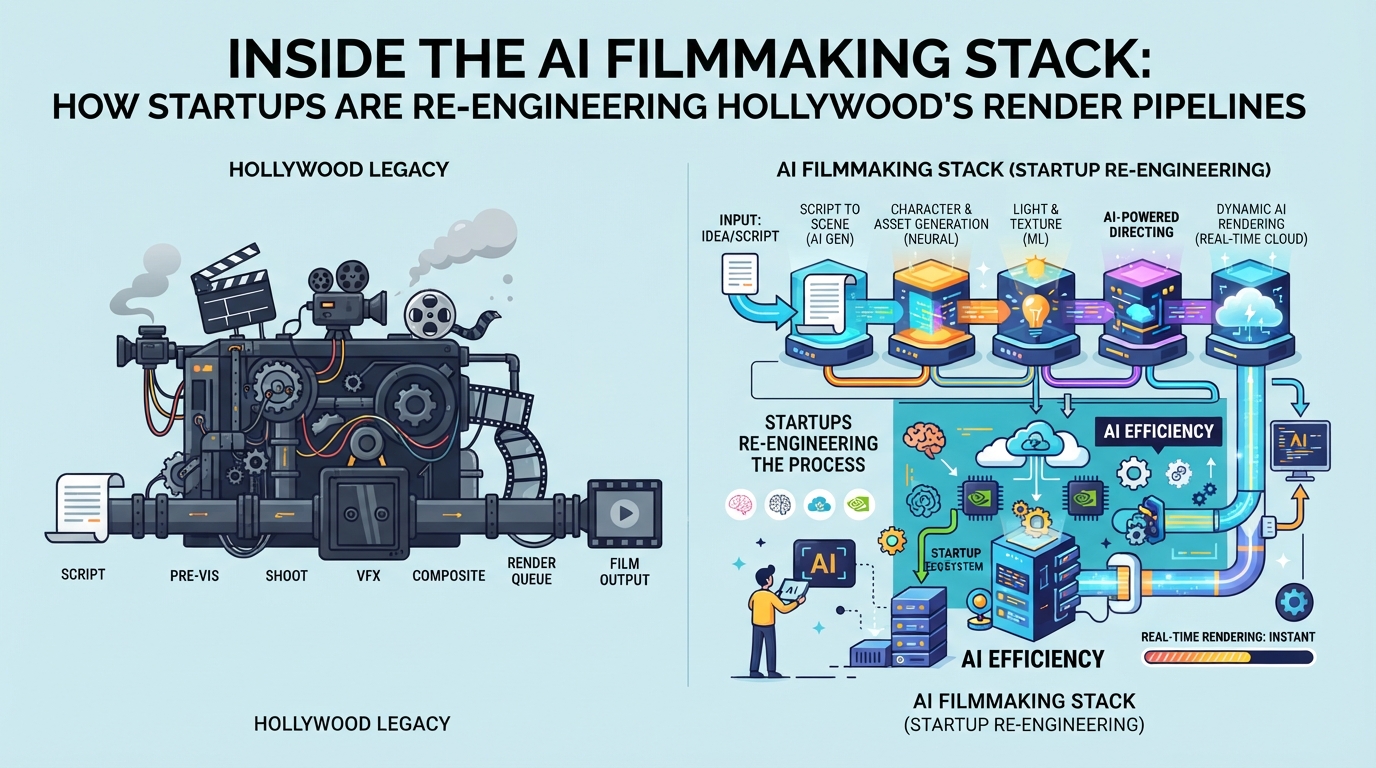
Inside the AI Filmmaking Stack: How Startups Are Re-Engineering Hollywood’s Render Pipelines
Introduction: The Death of the Traditional Render Farm
For decades, Hollywood’s biggest bottleneck wasn’t imagination—it was compute. Traditional render farms require massive server rooms, millions of dollars, and days of processing time just to output a few seconds of photorealistic footage.
This prohibitive cost-of-entry kept high-end visual effects locked behind studio gates. Today, a wave of agile startups is shattering this barrier by replacing brute-force CPU power with AI-driven render pipelines.
By leveraging neural networks, modern AI filmmaking software can generate, upscale, and relight complex 3D scenes in near real-time.
Here is how this paradigm shift is democratizing film production:
- Zero-latency feedback: Directors can iterate on VFX shots instantly on set, rather than waiting overnight.
- Fractional costs: Cloud-based AI models cut compute expenses by up to 90%.
- Infinite scalability: Independent creators can now produce studio-grade visuals from a single laptop.
The era of waiting on the render progress bar is officially over.
The Three-Tier Architecture of the Generative AI Video Stack
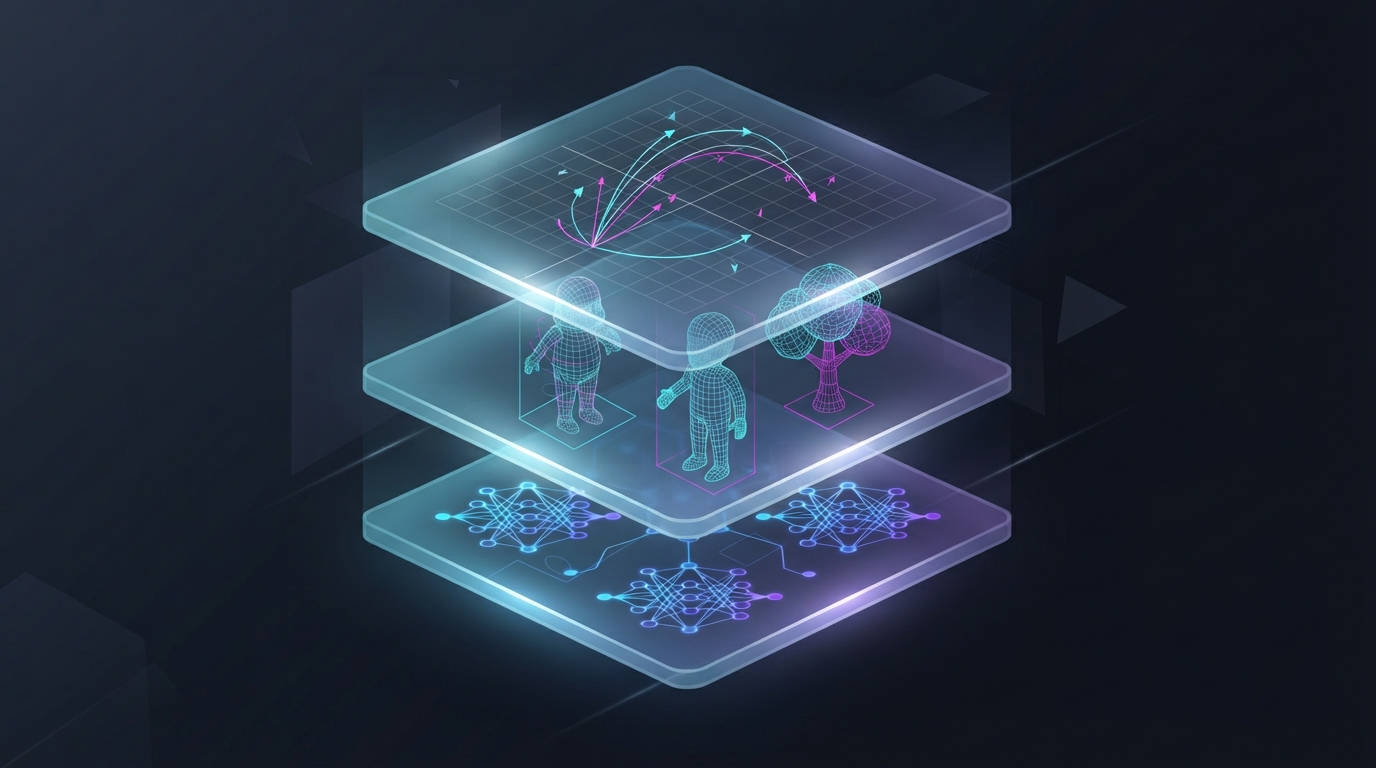
To understand how this revolution works under the hood, we must look at the generative AI video stack. This modern architecture is split into three distinct, interconnected layers that replace the traditional rendering pipeline:
1. The Foundational Layer (The Engine): At the base are massive diffusion models trained on billions of visual data points. These models understand the physics of light, motion, and texture, acting as the raw creative engine.
2. The Asset Generation Layer (The Elements): This tier translates prompts into specific, high-fidelity visual assets. It populates the scene with consistent characters, photorealistic props, and immersive 3D environments.
3. The Control Layer (The Director): The critical final tier ensures temporal consistency across frames. It uses tools like ControlNet and NeRFs to lock down camera movement, character physics, and lighting transitions so the video doesn’t flicker.
By separating raw generation from precise control, this three-tier system gives filmmakers both infinite creative freedom and pixel-perfect predictability.
Neural Rendering: Slashing Render Times by 80%
Traditional 3D rendering is a notorious bottleneck, often requiring hours of compute time to calculate how light bounces off a single surface. Neural rendering completely bypasses this grind by using machine learning to predict how a scene should look, rather than calculating every single photon.
By integrating these models into AI-driven render pipelines, studios can render scenes at a fraction of the resolution and let AI fill in the blanks.
Here is how this shift slashes compute costs:
- AI-Based Denoising: Instead of waiting for a clean, fully-traced image, engines render a noisy, low-sample preview and use AI to instantly reconstruct a crystal-clear, final frame.
- No More Full-Frame Rebakes: If a director moves a single prop, the system only updates the affected pixels, ignoring the rest of the static environment.
- Upscaling on the Fly: Render at 1080p and instantly upscale to pristine 4K without the massive render overhead.
The result is a staggering 80% reduction in render times, transforming overnight render queues into near-instantaneous feedback loops.
The Power of Hybrid Workflows: Unreal Engine, NeRFs, and Diffusion
To unlock this speed without sacrificing cinematic quality, indie studios are pioneering hybrid workflows. By pairing the spatial precision of Unreal Engine AI integrations with the photorealism of generative models, creators get the best of both worlds: perfect structural geometry and infinite visual detail.
Instead of choosing between rigid 3D assets or unpredictable 2D AI generation, this modern pipeline layers three distinct technologies:
- Unreal Engine (The Backbone): Handles precise physics, camera tracking, and lighting layouts.
- NeRFs (The Environment): Instantly converts real-world video footage into fully navigable, photorealistic 3D assets.
- Diffusion Models (The Finisher): Overlays hyper-detailed textures and atmospheric effects onto the low-resolution 3D block-out.
This trio effectively solves the notorious “AI flickering” problem that plagues pure video generators. By anchoring the generative diffusion pass to a rigid 3D coordinate space, the final output remains rock-solid and temporally consistent. It is the ultimate cheat code for high-end, low-budget worldbuilding.
Democratizing Hollywood: Real-World Impact for Indie Studios
Traditionally, rendering a single frame of a CGI-heavy scene required massive, local GPU clusters that only major studios could afford. Today, cloud-hosted AI-driven render pipelines have completely flipped the script by shifting the heavy lifting to remote servers.
This democratization means a three-person indie team can now leverage cutting-edge AI filmmaking software directly from a standard laptop. The financial and operational shift is staggering:
- Zero Local Hardware Bloat: No more $50,000 local render farms or soaring electricity bills; everything runs on elastic cloud compute.
- Fractional Rendering Budgets: Render times that used to take days and cost thousands now finish in minutes for pennies on the dollar.
- Rapid Iteration Cycles: Directors can tweak prompts and adjust lighting on the fly, seeing final-pixel quality results almost instantly.
By stripping away the hardware bottleneck, these modern pipelines are leveling the playing field. Raw creativity—not budget size—now dictates what ends up on screen.
Conclusion: The Future of AI-Powered Cinema
We are rapidly moving past the era of novelty prompt-engineering. The future of cinema belongs to creators who transition from chaotic, experimental tools to a highly structured, professional ecosystem.
Here is what the next era of production looks like:
- From Toy to Tool: Moving away from unpredictable generation toward deterministic, node-based AI filmmaking software that offers pixel-level control.
- The Unified Pipeline: A fully integrated generative AI video stack that seamlessly connects pre-visualization, real-time rendering, and automated post-production.
- Hybrid Artistry: Directors acting as creative directors of algorithmic assets, blending traditional cinematography with machine learning precision.
Ultimately, this technological leap isn’t about replacing human storytellers—it’s about giving them infinite leverage. The filmmakers who embrace these structured pipelines today will be the ones defining the visual language of tomorrow’s box office.