Designing for the Anti-AI Movement: How to Implement Opt-Out Protocols and Data Provenance in Modern Software
The Rise of the Anti-AI Movement in Software Engineering
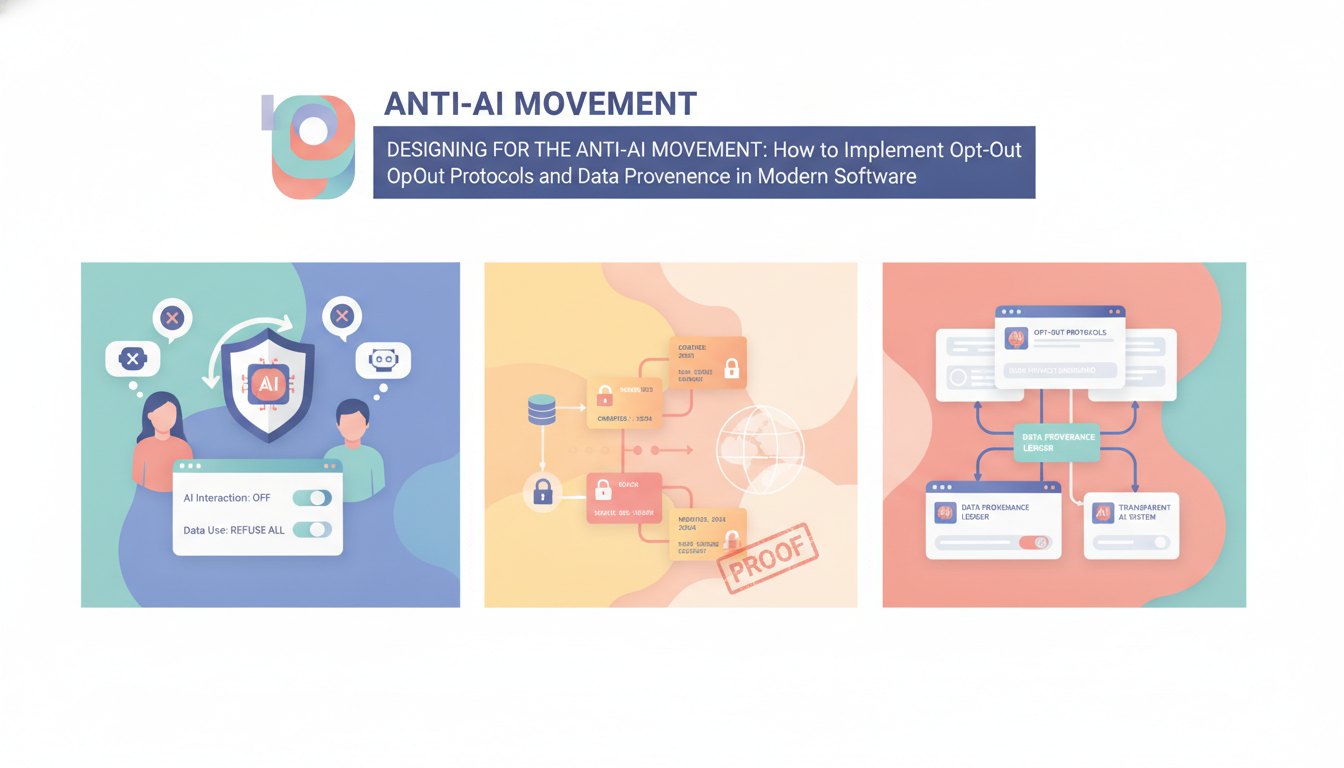
User sentiment and regulatory pressures are driving a fundamental shift in how web applications handle automated data harvesting. Standard scraping defenses like robots.txt are no longer sufficient, as many LLM crawlers bypass these cooperative protocols entirely. Consequently, software architects must adopt anti-AI design patterns to protect user assets and maintain platform trust.
At the core of this engineering challenge is establishing verifiable data provenance. Without cryptographic or metadata-driven proof of origin, downstream consumers cannot verify whether a dataset respects user opt-out preferences. Modern applications must treat user consent not as a static database flag, but as a dynamic, transportable property of the data itself.
Implementing these protections requires a multi-layered defense strategy at the application and network layers. Developers commonly deploy several technical mechanisms to enforce user boundaries:
- Cryptographic Content Signing: Affixing digital signatures to user-generated content to verify origin and explicitly declare licensing constraints.
- Dynamic Egress Filtering: Analyzing outbound traffic patterns and rate-limiting requests that exhibit automated scraping characteristics.
- Structured Schema Metadata: Utilizing JSON-LD or custom schema attributes (such as
noaiornoimageaimicrodata) to signal machine-readable restrictions to compliant crawlers. - Edge-Level User-Agent Blocking: Configuring CDN-level rules to block known AI crawler user-agents before they hit origin servers.
While these defensive patterns improve user agency, they introduce distinct engineering trade-offs. Storing granular consent states increases database schema complexity and query overhead during read operations. Furthermore, relying on client-side or edge-level blocking is an asymmetric battle; determined scraping operations can easily rotate residential proxies and spoof headers to bypass standard blocks.
Standard Opt-Out Protocols: Robots.txt and Meta Tags
Standardizing client-side opt-out protocols requires configuring both network-level crawling directives and document-level metadata. While traditional web crawlers respect the Robots Exclusion Protocol (RFC 9309), modern AI scrapers present a fragmented environment of compliance. Implementing a robust defense involves targeting specific user-agents in the root robots.txt file and embedding explicit machine-readable directives within HTML headers.
The robots.txt file serves as the initial barrier against automated data collection. To block AI-specific crawlers without affecting general search engine indexing, engineers must target the designated user-agents of major LLM operators individually.
User-agent: GPTBot
Disallow: /

User-agent: ChatGPT-User
Disallow: /

User-agent: ClaudeBot
Disallow: /

User-agent: CCBot
Disallow: /

User-agent: Anthropic-AI
Disallow: /

User-agent: Google-Extended
Disallow: /
The Google-Extended token is particularly critical, as it allows webmasters to opt out of Google’s Gemini training pipelines while remaining indexed in Google Search. However, relying solely on robots.txt AI scrapers configuration is insufficient because compliance remains entirely voluntary and unenforceable at the protocol level.
For granular, document-level control, developers deploy NoAI meta tags and custom HTTP response headers. These tags signal to compliant parsers that the containing HTML document or its embedded assets must not be ingested for machine learning training.
<head>
<!-- Signal to compliant AI crawlers to bypass this page -->
<meta name="robots" content="noai, noimageai">

<!-- Alternative vendor-specific implementations -->
<meta name="google" content="notranslate, noai">
</head>
When designing these opt-out protocols, engineering teams must evaluate several architectural trade-offs:
1. Voluntary Compliance: Compliance is purely cooperative; malicious or gray-hat scrapers routinely ignore both robots.txt and meta tags.
2. Caching and Edge Latency: Parsing HTML payloads to inject dynamic meta tags based on user consent states can increase Time to First Byte (TTFB) at the CDN edge.
3. Asset Exposure: Meta tags do not protect direct hotlinking of media assets; an image URL can still be fetched directly if the scraper bypasses the HTML host page.
4. Maintenance Overhead: The list of active AI user-agents changes frequently, requiring continuous updates to the robots.txt configuration.
Advanced Obfuscation: Cloaking and Canvas Rendering
When passive protocols like robots.txt fail, applications must shift to active client-side and asset-level defenses. One prominent method is Glaze cloaking, which introduces high-frequency, imperceptible perturbations to image assets before they are served. These mathematically calculated alterations confuse the feature-extraction layers of generative AI models, preventing them from accurately learning or replicating an artist’s style.
Implementing Glaze cloaking at scale requires an asynchronous processing pipeline, as the algorithmic overhead of calculating perceptual distance is too high for real-time HTTP response cycles. Typically, an asset-ingestion worker runs the cloaking algorithm offline, saving the perturbed variant to an object store. This ensures that client-side delivery remains fast while protecting the underlying intellectual property from unauthorized training runs.
For textual and structural data, developers are increasingly adopting anti-AI design patterns that break standard DOM parsing. By utilizing CSS-in-JS libraries to generate randomized, dynamic class names, you make it difficult for scrapers to target specific data fields using static CSS selectors. Taken a step further, rendering sensitive text directly onto an HTML5 element completely bypasses the DOM tree, leaving traditional headless browsers with nothing but empty containers.
// Renders sensitive text to a canvas element to prevent DOM-based scraping
export function renderSecureText(
canvasId: string,
text: string,
fontSettings: string = "16px Inter, sans-serif"
): void {
const canvas = document.getElementById(canvasId) as HTMLCanvasElement | null;
if (!canvas) return;

const ctx = canvas.getContext("2d");
if (!ctx) return;

// Clear existing buffer and set high-DPI scaling
const dpr = window.devicePixelRatio || 1;
const rect = canvas.getBoundingClientRect();
canvas.width = rect.width * dpr;
canvas.height = rect.height * dpr;
ctx.scale(dpr, dpr);

ctx.font = fontSettings;
ctx.fillStyle = "#111827";
ctx.textBaseline = "middle";
ctx.fillText(text, 10, rect.height / 2);
}
While these techniques offer robust defense against automated extraction, they introduce severe compromises to standard web architectures. The tension between security, search engine optimization (SEO), and web accessibility (A11y) represents a critical design challenge. Engineers must carefully evaluate where to draw the line between asset protection and user experience.
- Accessibility Degradation: Canvas-rendered text and heavily obfuscated DOM structures break compatibility with screen readers, directly violating WCAG 2.1 guidelines unless redundant, hidden ARIA attributes are maintained.
- SEO Penalization: Search engine crawlers struggle to index content rendered outside the standard DOM, meaning canvas-heavy pages will suffer in search engine results pages (SERPs).
- Client-Side Rendering Cost: Dynamic obfuscation and canvas drawing increase CPU utilization on low-end mobile devices, potentially degrading the overall user experience.
- Incomplete Protection: Determined scrapers can bypass canvas rendering by integrating Optical Character Recognition (OCR) engines into their scraping pipelines.
Establishing Data Provenance: Introducing the C2PA Standard
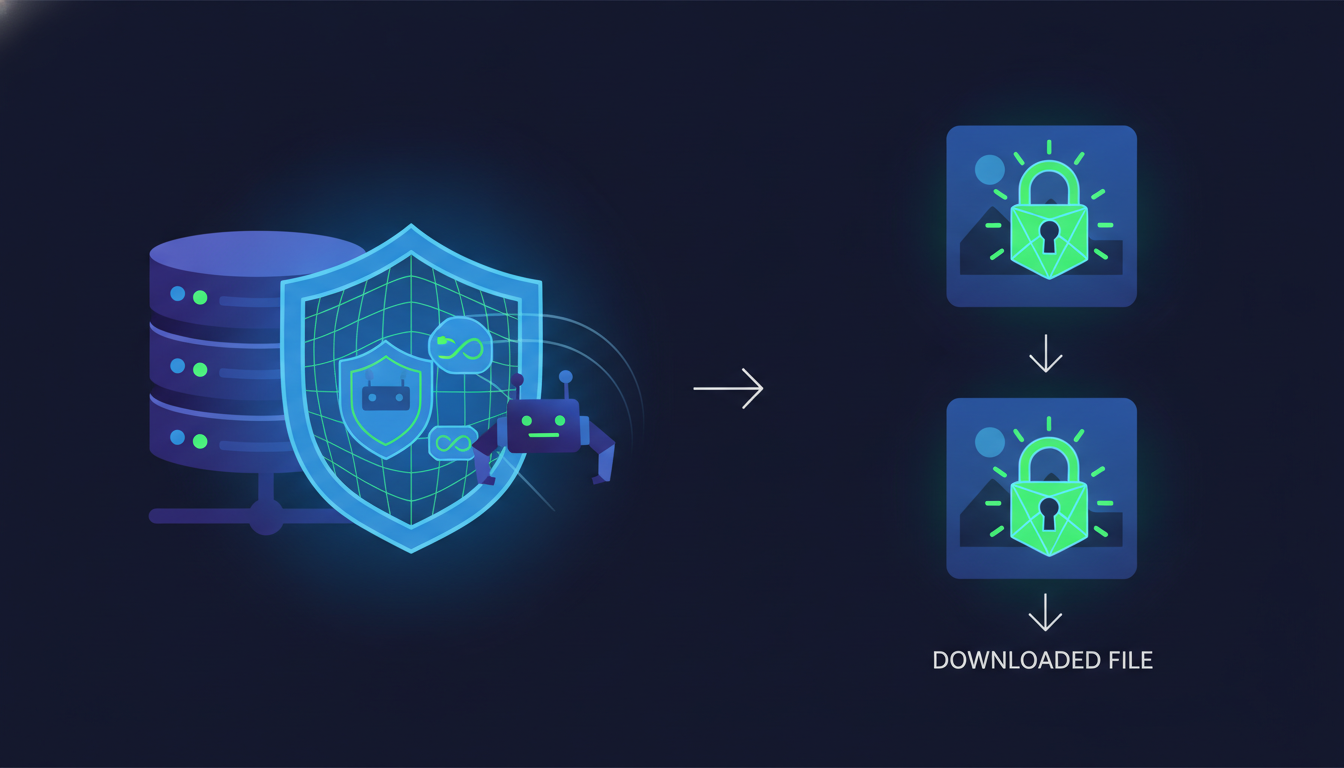
While obfuscation and rate-limiting act as defensive barriers, they do not solve the underlying issue of asset ownership and verifiability once data leaves your servers. True control requires a shift toward proactive data identity, where digital assets carry their own verifiable history. Establishing reliable data provenance ensures that downstream consumers, including ethical AI scrapers and platforms, can programmatically verify the origin and permitted use of a file.
The C2PA standard (Coalition for Content Provenance and Authenticity) addresses this challenge by defining an open industry specification for binding cryptographic metadata to media assets. Managed under the Joint Development Foundation, this framework merges the efforts of the Content Authenticity Initiative (CAI) and Project Origin. It allows creators and platforms to attach a tamper-evident manifest directly to images, audio, video, or text documents.
At an architectural level, a C2PA implementation relies on public-key cryptography to sign a set of assertions about an asset. These assertions—which can declare authorship, licensing terms, and explicit AI training opt-out instructions—are bundled into a manifest. If the asset’s binary payload is modified without updating the signature, the cryptographic chain breaks, immediately alerting downstream systems of tampering.
An operational C2PA implementation relies on four primary architectural components:
- Assertions: Metadata statements about the asset, such as creation date, author identity, and specific data-mining restrictions.
- Manifest Store: A container embedded within the asset file (such as in JPEG APP11 markers) or hosted externally as a sidecar file.
- Claim Signature: A cryptographic signature generated by the asset creator or platform using a trusted private key, securing the manifest against unauthorized edits.
- Trust Anchor: A Public Key Infrastructure (PKI) system that allows verifying parties to validate the signing certificate back to a trusted root authority.
Integrating this standard into your ingestion and delivery pipelines requires minimal modification to your core storage layers. Modern open-source libraries, such as the Rust-based C2PA Tool maintained by the alliance, allow backend services to inject manifests programmatically during asset compilation or export. This ensures that your anti-scraping policies are not just transient HTTP headers, but permanent, cryptographically signed attributes of the media itself.
Technical Implementation: Cryptographic Signing and JUMBF Blocks
Implementing the C2PA standard requires translating high-level trust policies into immutable, cryptographically signed assertions embedded directly within the media binary. This integration relies on JPEG Universal Metadata Box Format (JUMBF blocks), defined by ISO/IEC 19566-5, to act as secure, standardized containers for cryptographic metadata. By encapsulating assertions—such as “do not train” declarations or creator identity—inside these JUMBF blocks, the metadata survives downstream format conversions and distribution channels.
Before writing code, your ingestion pipeline must have access to a valid X.509 certificate chain and a corresponding private key. The private key signs the manifest store, while the public key certificate is embedded within the JUMBF block to allow consumers to verify the chain of custody back to a trusted root authority. For production environments, these keys are typically managed via a Hardware Security Module (HSM) or a secure Key Management Service (KMS) rather than local files.
The following Rust implementation demonstrates how to programmatically build, sign, and embed a C2PA manifest with an AI opt-out assertion into a target media asset.
use c2pa::{Builder, Manifest, Signer};
use std::path::PathBuf;

pub fn embed_provenance_manifest(
source_path: &PathBuf,
output_path: &PathBuf,
signer: &dyn Signer,
) -> Result<(), Box<dyn std::error::Error>> {
// Initialize a new C2PA manifest container
let mut manifest = Manifest::new("acme.provenance.engine");

// Define the AI opt-out assertion (c2pa.ai-bypass)
let ai_opt_out = r#"{
"exclusions": ["mining", "training"]
}"#;

// Add the JSON assertion to the manifest
manifest.add_assertion_json("c2pa.ai-bypass", ai_opt_out)?;

// Build and bind the manifest to the asset, creating the JUMBF blocks
let mut builder = Builder::new();
builder.add_manifest(&manifest)?;

// Sign and inject the cryptographic metadata directly into the target file
builder.sign_file(signer, source_path, output_path)?;

Ok(())
}
The sign_file call performs several low-level operations under the hood. It serializes the manifest into CBOR (Concise Binary Object Representation), hashes the source asset to create a binding cryptographically linked to the pixels, and signs the resulting structure. Finally, it packages this signed manifest into JUMBF blocks and injects them into the appropriate application segments of the target file format (for example, the APP11 marker in JPEG or the uuid box in MP4).
A complete C2PA JUMBF structure contains four critical nested components:
- Manifest Signature: The cryptographic signature block that verifies the integrity of the manifest data using the signer’s public key.
- Assertions Store: The individual metadata claims, such as creation time, editing actions, or AI training restrictions, compiled as CBOR payloads.
- Hashed Asset Binding: A cryptographic hash of the asset’s binary data (excluding the JUMBF block itself) to ensure the metadata cannot be detached and applied to a different asset.
- Certificate Chain: The X.509 certificate or list of certificates enabling verifiers to trace the signature back to a trusted certificate authority.
Engineers must account for the computational overhead associated with cryptographic signing during high-volume ingestion. While hashing large video files requires substantial I/O, the signing operation itself is CPU-bound due to asymmetric cryptography. Offloading the signing process to asynchronous worker pools or utilizing hardware-accelerated cryptographic modules prevents pipeline bottlenecks.
Navigating Implementation Challenges: Latency and CAAML Compliance
Integrating the C2PA standard into high-throughput media export pipelines introduces significant latency, primarily driven by the synchronous invocation of Hardware Security Modules (HSMs) or cloud Key Management Services (KMS) for cryptographic signing. Because asymmetric signing of the manifest anchor cannot be parallelized within a single file’s generation, a synchronous blocking call to an external KMS can degrade export throughput from milliseconds to seconds. High-volume systems must decouple the manifest generation from the final asset sealing using asynchronous worker queues and pre-allocated cryptographic sessions.
Beyond network latency, developers must ensure that the generated cryptographic metadata complies strictly with the Content Authenticity Alliance Metadata Schema (CAAML) specifications. CAAML schemas dictate how assertions—such as AI training opt-out declarations—are structured, hashed, and bound to the asset’s binary. Any structural deviation or malformed JSON-LD block in the manifest payload invalidates the entire certificate chain during client-side verification.
The implementation below demonstrates how to construct a C2PA-compliant manifest containing explicit AI training opt-out assertions, utilizing an asynchronous signing provider to prevent event-loop blocking. The KMSSigner interface abstracts the network call to the KMS, allowing developers to implement batching or local caching of ephemeral session keys.
import { createHash } from 'crypto';

export interface AITrainingAssertion {
label: 'c2pa.ai_training';
data: {
entries: {
[key: string]: {
use: 'allowed' | 'not-allowed';
constraint?: string;
};
};
};
}

export interface C2PAManifest {
alg: 'sha256' | 'sha384';
assertions: [AITrainingAssertion];
assetHash: string;
}

export interface KMSSigner {
sign(payload: Buffer, keyId: string): Promise<Buffer>;
}

export class ProvenancePipeline {
constructor(
private signer: KMSSigner,
private keyId: string
) {}

/**
* Generates and signs a C2PA-compliant manifest with CAAML assertions.
* Handles high-latency KMS calls asynchronously.
*/
public async generateSignedManifest(
assetBuffer: Buffer,
optOutTraining: boolean
): Promise<{ manifest: C2PAManifest; signature: string }> {
// 1. Compute asset hash to bind the metadata to the binary
const assetHash = createHash('sha256').update(assetBuffer).digest('hex');

// 2. Construct CAAML-compliant assertions
const manifest: C2PAManifest = {
alg: 'sha256',
assertions: [
{
label: 'c2pa.ai_training',
data: {
entries: {
'c2pa.ai_mining': {
use: optOutTraining ? 'not-allowed' : 'allowed'
}
}
}
}
],
assetHash
};

// 3. Serialize manifest payload (represented here as JSON string)
const payloadToSign = Buffer.from(JSON.stringify(manifest));

// 4. Delegate to KMS asynchronously to handle cryptographic latency
const signatureBuffer = await this.signer.sign(payloadToSign, this.keyId);
const signature = signatureBuffer.toString('base64');

return { manifest, signature };
}
}
To prevent the KMS network roundtrip from becoming a database connection-hogging bottleneck, architecture teams should adopt specific decoupling strategies:
- Local Ephemeral Key Signing: Generate short-lived signing keys locally within the containerized application, using the remote KMS only to sign the local certificate chain once per hour.
- Decoupled Sidecar Signing: Offload the JUMBF injection and signing operations to a dedicated sidecar service running adjacent to the media storage layer.
- Zero-Copy Hashing: Stream large asset binaries through SHA-256 pipelines directly during upload, passing only the calculated hash to the metadata generator to avoid redundant memory allocations.
- Optimistic Manifest Insertion: Return the compiled asset immediately to the client with a
202 Acceptedstatus, processing the cryptographic signing and metadata injection out-of-band.
Validating compliance against CAAML schemas requires automated testing pipelines that parse the signed output using the official C2PA Tool CLI or Rust-based SDKs. Common integration failures include using non-standard URI schemes in the creator identity field and omitting the mandatory bounding hash of the asset. Incorporating a strict JSON-schema validation step prior to payload serialization guarantees that downstream verifiers can reliably parse the cryptographic metadata without throwing certificate validation errors.
Future Outlook: Designing Web Architecture for Consent and Trust
Integrating decentralized opt-out signals with cryptographic validation shifts the burden of trust from manual compliance audits to automated, verifiable protocols. Modern web architectures can achieve this by combining machine-readable exclusion files, such as ai.txt, with standard-based metadata engines like the Creator Assertions and Authenticity Association (C2PA). This dual-layer approach establishes clear boundaries for crawlers while embedding non-repudiation directly into the media assets.
A primary engineering challenge when implementing these anti-AI design patterns is the computational overhead of cryptographic signing. Generating SHA-256 hashes and injecting C2PA manifest stores can introduce database and CPU latency if handled synchronously within the request-response lifecycle. To maintain high application performance, architectures must offload metadata injection to asynchronous worker queues or edge computing layers, utilizing optimistic UI updates to serve assets immediately while signing occurs out-of-band.
By relying on decentralized data provenance standards, systems ensure that consent preferences remain attached to the content even when it is shared across external platforms. According to the C2PA specification, these assertions are cryptographically bound to the asset binary, preventing silent stripping of creator preferences without breaking the signature chain. This creates a tamper-evident record that downstream training pipelines can programmatically verify before ingestion.
Evaluating this architectural pattern requires balancing immediate security benefits against long-term maintenance costs:
- Verify-on-Ingest Capabilities: Downstream consumers can instantly validate creator consent without querying a central database.
- Resilience to Scraping: Standardized headers (e.g.,
No-AI-Training) provide immediate, machine-readable signals at the HTTP layer. - Key Management Complexity: Rotating signing keys and managing PKI (Public Key Infrastructure) certificates at scale introduces operational overhead.
- Client-Side Processing Overhead: Verifying signatures on low-powered client devices can degrade rendering performance if not optimized.
Ultimately, embedding trust into the web fabric requires treating consent as an architectural invariant rather than an afterthought. As browser APIs and CDN edge nodes evolve to natively parse provenance manifests, applications that proactively adopt these patterns will secure their content pipelines against unauthorized ingestion. This structural shift ensures creator autonomy while preserving the low-latency experiences users expect.