Google is rapidly expanding its artificial intelligence ambitions far beyond chatbots, and its latest AI developments suggest the company is preparing one of the most aggressive ecosystem pushes in the industry so far. Following growing discussions around Gemini Omni and the newly revealed Gemini Spark system, many analysts now believe Google is attempting to transform Gemini into a full-scale AI operating ecosystem capable of generating media, understanding real-world environments, and autonomously handling digital workflows.
The announcements and early demonstrations have quickly gained attention across the AI industry because they combine several of the fastest-growing sectors in artificial intelligence at once — AI video generation, multimodal systems, autonomous agents, and workflow automation.
Gemini Omni Signals Google’s Bigger AI Vision
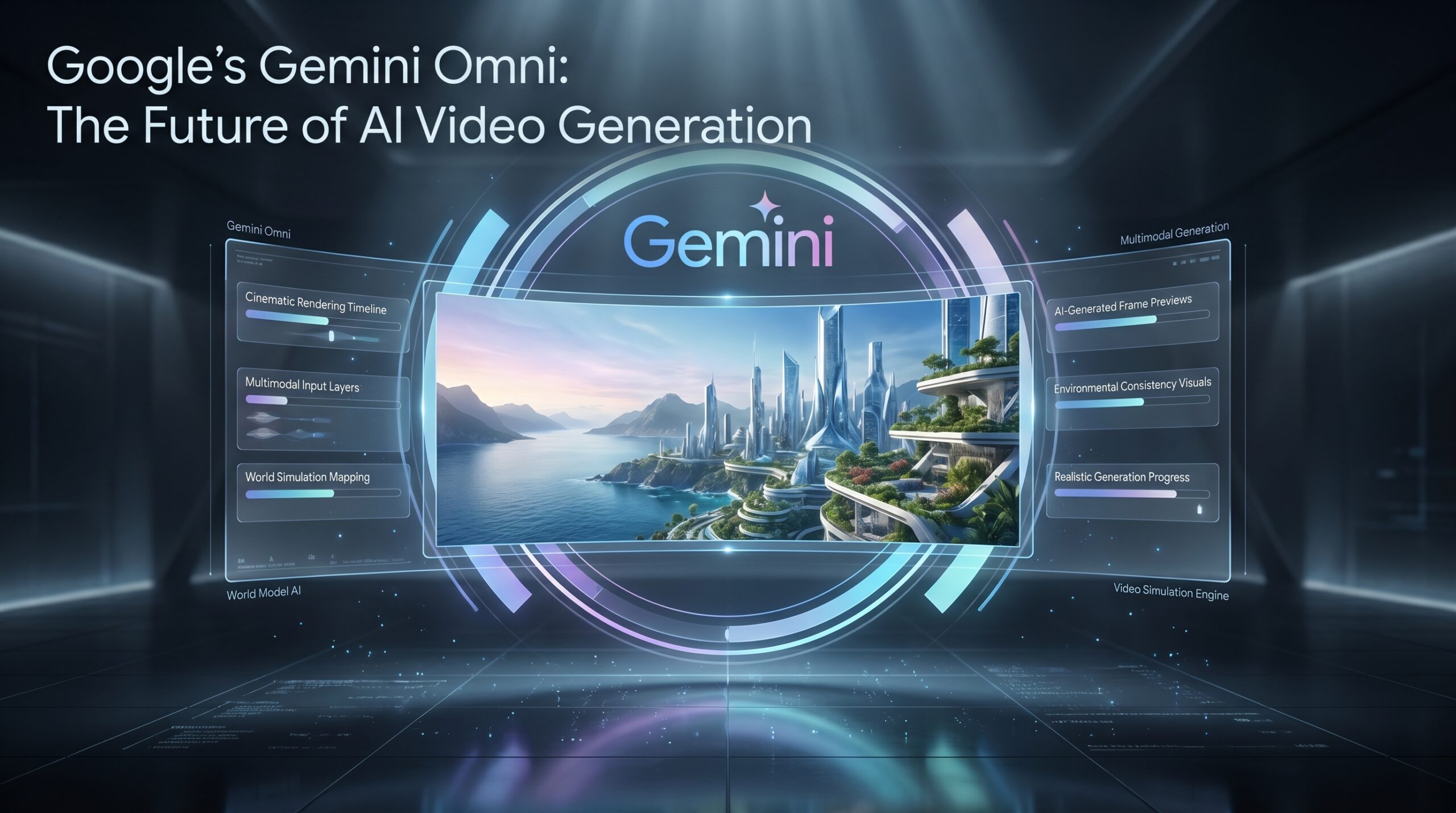
At the center of the discussion is Gemini Omni, which Google is positioning as a much more advanced form of AI generation technology compared to traditional text-to-video tools currently dominating the market.
Unlike older AI systems that mainly respond to prompts in isolated ways, Gemini Omni is designed as a multimodal “world model” AI system capable of understanding text, images, audio, video, and contextual relationships simultaneously. The goal is to create AI that better understands how the real world behaves instead of simply generating disconnected outputs.
This approach could allow future AI-generated videos to maintain more realistic physics, object consistency, environmental awareness, and scene continuity across longer sequences. Industry experts believe this represents one of Google’s biggest attempts yet to compete directly with rapidly advancing AI video platforms from OpenAI, Runway, Pika, and other companies racing to dominate AI-generated media.
The concept of “world models” has become one of the most talked-about areas in artificial intelligence because many researchers believe systems that can better simulate and understand the real world may become foundational for future AGI-level technologies.
AI Video Generation Is Becoming the Next Major Battleground
The rapid growth of AI video generation has already started reshaping the technology industry over the past year. What began as experimental short clips has now evolved into increasingly cinematic AI-generated content capable of producing advertisements, animated scenes, visual storytelling, and realistic simulations.
Google’s push with Gemini Omni signals that the company does not want to remain behind in this rapidly expanding market. Instead of focusing only on generating visually impressive clips, Google appears to be emphasizing realism, consistency, and deeper contextual understanding.
Many analysts believe this shift is important because current AI video systems still struggle with:
- character consistency,
- realistic movement,
- object permanence,
- and long-scene coherence.
By introducing a world-model approach, Google may be attempting to solve some of the biggest limitations currently affecting AI-generated video quality.
Gemini Spark Introduces Autonomous AI Workflows
Alongside Gemini Omni, growing attention is also surrounding Gemini Spark — an autonomous AI agent system reportedly designed to manage digital workflows and perform actions across connected environments.
Unlike standard chatbot assistants that simply answer questions, Gemini Spark appears focused on helping users automate tasks such as scheduling, organizing workflows, managing applications, handling reminders, and interacting across multiple systems more independently.
This is significant because autonomous AI agents are becoming one of the fastest-growing areas inside the broader AI industry. Companies including OpenAI, Microsoft, Anthropic, and Meta are all exploring AI systems capable of acting more independently rather than functioning only as conversational assistants.
Many experts believe the long-term future of AI will involve systems that can:
- perform tasks,
- manage workflows,
- coordinate software,
- and assist users continuously in the background.
Google’s movement toward AI agents suggests the company is trying to position Gemini as a central operating layer for future AI-powered productivity ecosystems.
Google’s AI Strategy Is Expanding Beyond Search
For years, Google’s dominance largely revolved around search, advertising, and mobile software. However, the AI race is now forcing technology companies to rethink how users interact with digital systems entirely.
Instead of treating AI as an additional feature, Google increasingly appears to be integrating Gemini across nearly every part of its ecosystem, including Android, Workspace, Search, Chrome, and cloud infrastructure.
This broader ecosystem strategy may become one of Google’s biggest advantages against competitors because it allows the company to connect AI services across billions of existing users and devices.
Industry analysts believe Google’s long-term goal is no longer simply building an AI chatbot. The company appears to be building a connected AI infrastructure capable of powering search, productivity, content generation, automation, and personal digital assistance simultaneously.
The AI Industry Is Entering a New Phase
The emergence of systems like Gemini Omni and Gemini Spark highlights how quickly artificial intelligence is evolving beyond simple prompt-based interactions.
The next phase of the AI race is increasingly focused on:
- multimodal understanding,
- autonomous agents,
- workflow automation,
- and AI systems capable of interacting more naturally with real-world environments.
This shift is also intensifying competition between Google, OpenAI, Microsoft, Anthropic, Meta, and xAI as companies race to control the future infrastructure of AI-powered computing.
Many experts believe the companies that successfully combine powerful AI models with developer ecosystems, automation systems, and large-scale consumer integration could ultimately dominate the next generation of digital technology.
Final Thoughts
Google’s expanding Gemini ecosystem shows the company is moving aggressively into some of the most important sectors in artificial intelligence at the same time. With Gemini Omni focusing on advanced AI video generation and world modeling, while Gemini Spark pushes deeper into autonomous AI workflows, Google appears determined to position Gemini as far more than just another chatbot platform.
As the AI industry continues accelerating, these developments may represent an early glimpse into how future AI systems will create content, manage digital environments, and interact with users on a much broader scale.