The AI Capital Pivot: Why VCs Are Shifting Funding from Foundation Models to Infrastructure Optimization
Introduction: The Changing Tides of AI Investments
Remember the gold rush of 2023? Venture capitalists were throwing billions at any startup promising to build the next massive LLM. Today, that frantic hype is cooling down as a cold, pragmatic reality sets in.
We are witnessing a massive evolution in AI venture capital trends. While building gargantuan foundation models once guaranteed a blank check, investors are now asking a critical question: how do we make this technology sustainable and profitable?
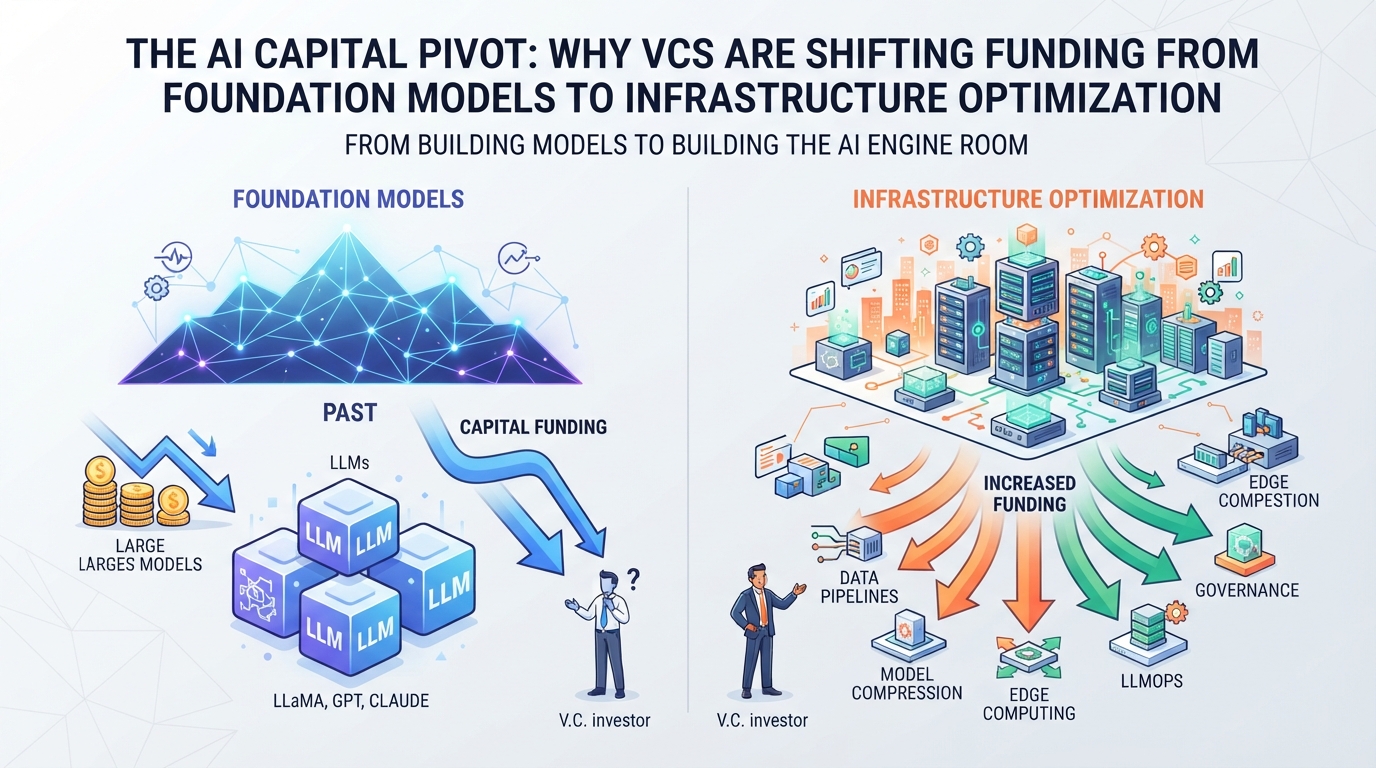
The investment thesis has officially flipped:
- Then (Model Mania): Funding raw parameters, massive compute budgets, and theoretical capabilities.
- Now (Infrastructure Era): Funding efficiency, middleware, hardware acceleration, and cost-reduction tools.
Instead of backing another costly LLM clone, smart money is flowing into the digital plumbing—the optimization technologies that make existing models faster, cheaper, and enterprise-ready. Welcome to the era of the practical AI stack.
The Prohibitive Reality of Foundational LLMs
To understand why venture capitalists are closing their checkbooks for new foundation models, we have to look at the brutal math of LLM development. The barrier to entry has evolved from a steep hill into an impassable mountain, driven by three harsh realities:
- Astronomical Compute Costs: Training a state-of-the-art model now requires hundreds of millions of dollars in specialized hardware, priced far beyond the reach of traditional startup rounds.
- Diminishing Returns on Scaling: We are hitting a physical wall where doubling parameter sizes no longer yields the exponential leaps in intelligence we saw in early GPT iterations.
- The Incumbent Stronghold: Giants like OpenAI, Google, and Meta have locked down the market with massive distribution networks and deep-pocketed tech partnerships.
For a new startup, trying to out-train these behemoths is a financial suicide mission. Investors have realized that funding another general-purpose LLM is no longer a bold bet—it’s a redundant, high-risk gamble with a shrinking path to profitability.

Shifting to the ‘Picks and Shovels’: What is AI Infrastructure Optimization?
Instead of funding the gold miners, smart capital is backing the merchants selling the picks and shovels. This is the essence of AI infrastructure optimization—the software, tooling, and middleware that makes running AI models commercially viable.
While foundation models grab the headlines, enterprises face a harsh reality: deploying these models is incredibly expensive, slow, and complex. This optimization layer acts as the vital bridge, helping businesses customize and run AI efficiently at scale.
VCs are heavily prioritizing this middle layer because it solves three critical enterprise pain points:
- Cost Reduction: Tools that compress models (like quantization) to slash ongoing inference bills.
- Latency & Speed: Frameworks that maximize GPU utilization for real-time, lightning-fast performance.
- Reliability: LLMOps pipelines that monitor, secure, and govern AI outputs in production.
By investing in this infrastructure, VCs aren’t betting on which single model wins. They are betting on the indispensable plumbing that every enterprise needs to succeed.
Key Pillars of the Infrastructure Boom: MLOps and Compute Efficiency
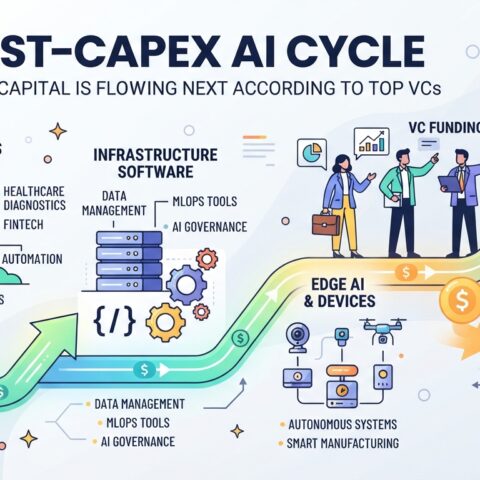
To understand where the smart money is moving, we have to look at the specific building blocks of this new AI tech stack. VCs are bypassing flashy consumer apps and funding the foundational plumbing instead.
Here is where capital is flowing right now:
- Compute Efficiency Solutions: Startups building software-level GPU virtualization and compiler optimizations are raising massive rounds. These tools maximize compute efficiency, squeezing every drop of performance out of scarce hardware.
- Advanced MLOps: The investment focus has shifted from training models to managing them. Next-gen MLOps platforms automate LLM evaluation, guardrails, and continuous integration in production.
- Vector Databases: As Retrieval-Augmented Generation (RAG) becomes the enterprise standard, specialized databases are securing heavy funding to index and search high-dimensional data instantly.
- Model Orchestration: Frameworks that chain LLMs together with APIs and enterprise data sources are seeing explosive growth. They streamline deployment, turning raw models into functional, autonomous agents.
The Application Layer: Building Defensibility on Top of Existing Models
While infrastructure handles the heavy lifting, the battle for customer attention is happening further up the stack. VCs are no longer looking for the next massive LLM; instead, they are backing application-layer AI startups that know how to turn raw API calls into highly defensible business tools.
The secret to securing funding here isn’t the model itself—it’s the proprietary workflow built around it. By acting as intelligent middleware, these platforms orchestrate complex, multi-step tasks that generic models cannot handle alone.
To win venture backing today, modern application startups rely on three core pillars:
- Proprietary Data Moats: Feeding specialized, industry-specific enterprise data into existing APIs to deliver hyper-accurate, tailored results.
- Deep Workflow Integration: Embedding AI directly into daily employee habits so deeply that replacing the software becomes a logistical nightmare.
- Contextual Guardrails: Wrapping foundational models in custom business logic to ensure enterprise-grade compliance, security, and predictability.
Conclusion: What the Pivot Means for the Future of AI Startups
The era of raising millions on a slide deck and a promise to build “the next GPT” is officially over. As AI venture capital trends shift toward infrastructure optimization, the funding spotlight is now on efficiency, scalability, and tangible ROI.
For founders looking to capture this next wave of capital, survival means adapting your pitch to this new reality. Here is how to position your startup for success:
- Sell the Plumbing, Not the Poetry: Focus on how your tool reduces latency, slashes compute costs, or optimizes GPU utilization.
- Prove the Unit Economics: Show VCs how your platform scales sustainably without burning through massive API budgets.
- Target the Developer Bottleneck: Build tools that make it easier for enterprise teams to deploy, monitor, and secure their AI pipelines.
The gold rush isn’t about finding the gold anymore; it’s about selling the picks, shovels, and maps. By focusing on the infrastructure layer, you position your startup exactly where the smart money is heading.