Squeezing LLMs into Budget Hardware: Software Optimizations Defeating the Smartphone Memory Crunch
Introduction: The Smartphone Memory Crunch and the Rise of On-Device AI
We all want the magic of on-device intelligence—instant, private, and completely offline AI. But there is a massive roadblock standing in the way: tight smartphone memory constraints.
While a typical Large Language Model (LLM) requires dozens of gigabytes of VRAM to run smoothly, the average smartphone in your pocket is severely limited.
- The Budget Reality: Most standard smartphones top out at just 8GB of RAM.
- The OS Tax: Android or iOS easily consumes 3GB to 4GB of that memory just to keep the device running.
- The AI Deficit: This leaves a meager 4GB of free space for an LLM to load and execute.
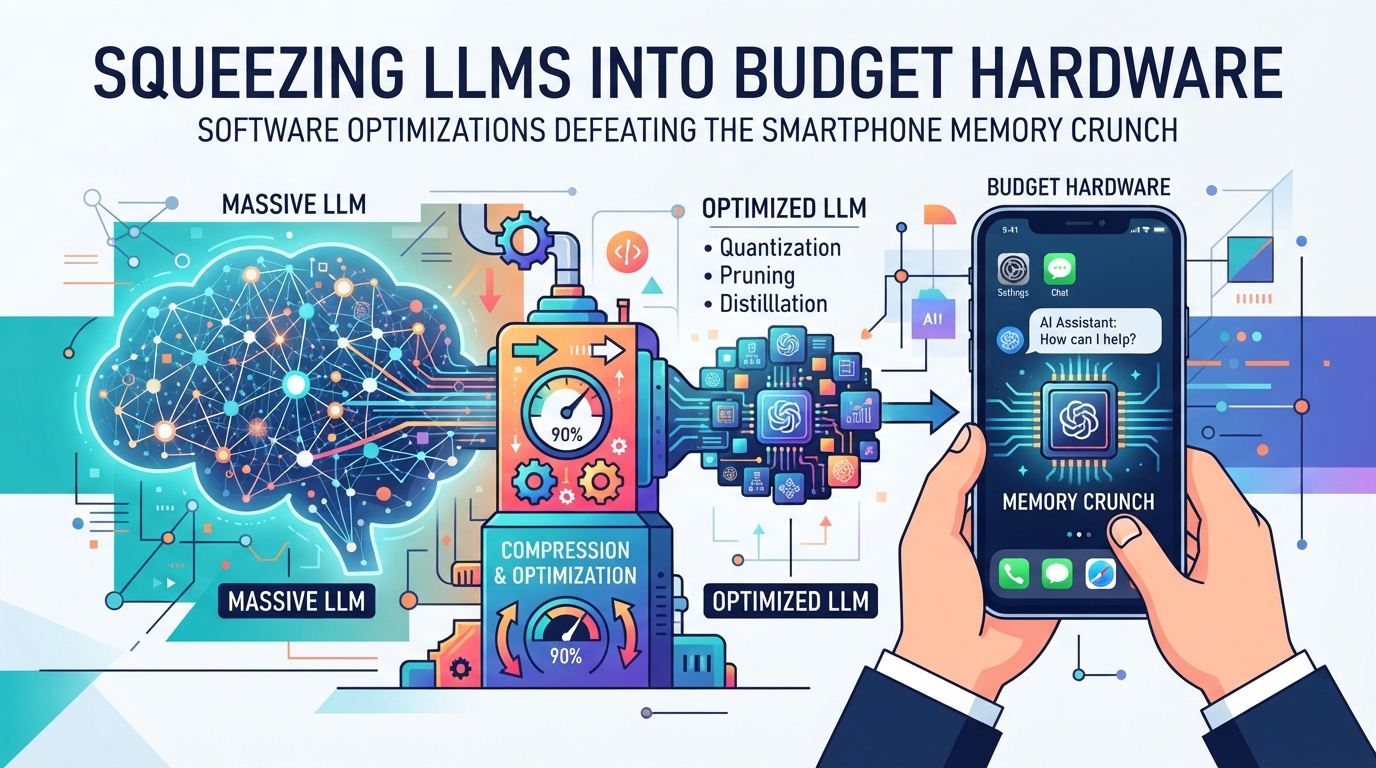
To bridge this massive gap, developers can no longer rely on hardware upgrades. Instead, unlocking local AI demands aggressive, clever software optimizations to squeeze giant models into these tiny spaces.
Demystifying LLM Quantization Techniques: From FP16 to INT8 and INT4
To fit a massive model into that 4GB budget, developers rely on LLM quantization techniques. Think of quantization as converting a high-resolution, uncompressed audio file into a clean, compact MP3—the file size shrinks dramatically, but the song sounds almost identical.
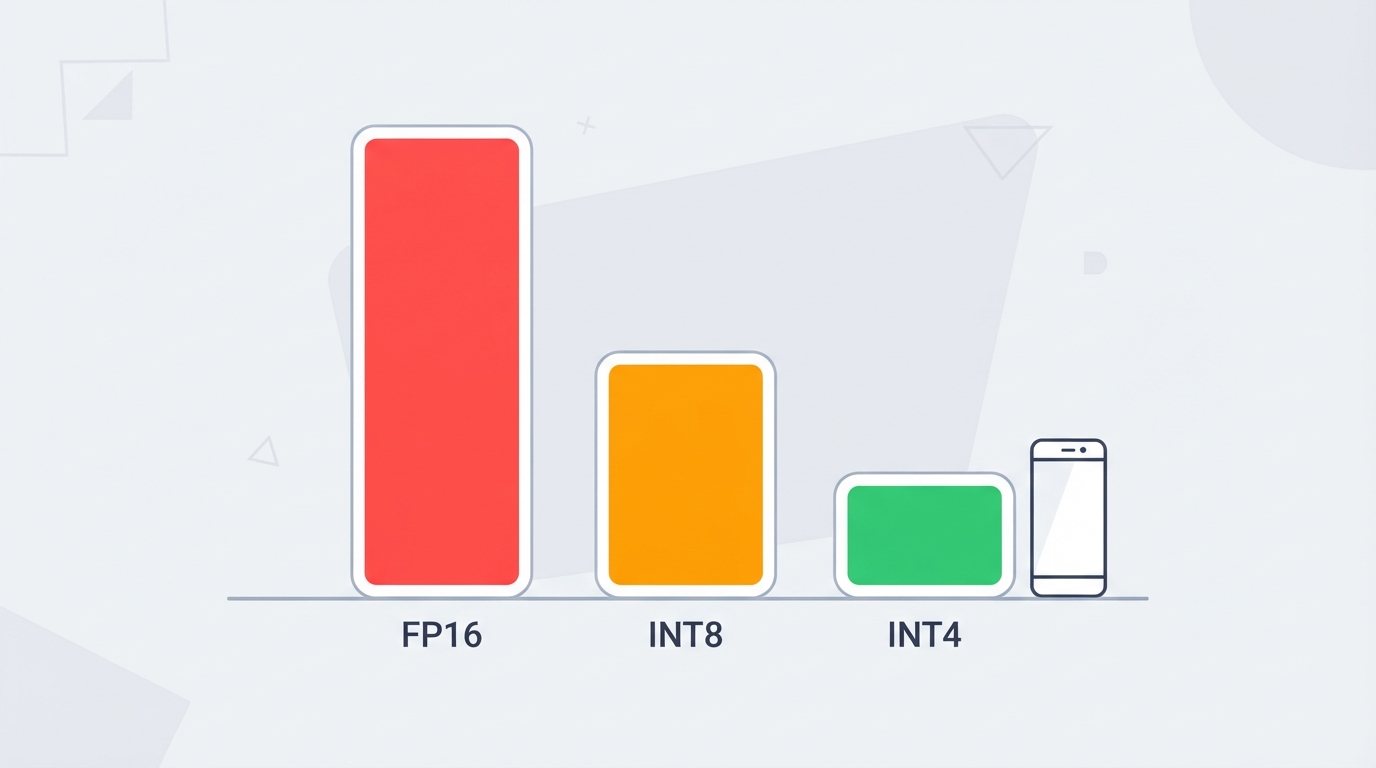
In standard training, models use FP16 (16-bit Floating Point) precision, where each weight takes up 2 bytes of memory. Quantization compresses these weights into lower-precision formats like INT8 (8-bit integer) and INT4 (4-bit integer).
When comparing INT4 vs INT8, the memory savings are staggering:
- FP16: 14 GB RAM needed (for a 7B parameter model)
- INT8: 7 GB RAM needed (50% savings, near-perfect accuracy)
- INT4: 3.5 GB RAM needed (75% savings, minor accuracy trade-off)
By swapping FP16 for INT4, that once-impossible 7B model suddenly slides comfortably under your phone’s 4GB limit. It is the ultimate digital diet, trading negligible brainpower for massive hardware accessibility.
The Trade-Off Analysis: INT4 vs INT8 on Mobile Hardware
Choosing between INT4 vs INT8 isn’t just about shrinking file sizes; it’s about balancing raw speed against cognitive capability on actual mobile silicon. Real-world benchmarks reveal a classic engineering compromise between these two formats.
Here is how the two stack up in the wild:
- INT4 (The Speed Demon): Cuts memory usage by roughly 70% compared to FP16 and achieves a sub-100ms first-token latency for near-instantaneous responses. However, this speed comes at a cost, introducing a 12% reasoning benchmark degradation compared to INT8.
- INT8 (The Balanced Scholar): Retains near-perfect accuracy with virtually zero degradation from the baseline, but demands more RAM and takes longer to output that crucial first token.
Ultimately, the choice comes down to your user experience goals. If your app demands deep, multi-step logic, INT8 is your anchor. But for snappy, real-time conversational UI on budget hardware, INT4’s performance-to-size ratio is the undisputed king.
Optimizing the Memory Pipeline: KV Cache and Unified Memory
Shrinking static model weights is only half the battle. During a long conversation, the real silent killer of smartphone RAM is the Key-Value (KV) cache, which stores past context to speed up generation. Without smart management, long prompts quickly trigger Out-of-Memory (OOM) crashes.
This is where KV cache optimization saves the day:
- Cache Quantization: Compressing the KV tensors to INT8 or INT4 to slash runtime memory footprints by up to 75%.
- PagedAttention: Fragmenting the cache like virtual memory to eliminate wasteful, contiguous RAM pre-allocation.
Fortunately, modern mobile SoCs have a secret weapon: a shared unified memory architecture. Unlike traditional PCs that constantly copy data between CPU and GPU over a bottlenecked PCIe bus, mobile chips let both processors access the exact same physical pool of RAM.
By eliminating redundant data copying, this architecture dramatically reduces latency and thermal throttling. It transforms budget smartphones from struggling calculators into lean, efficient AI engines.
Unlocking Mobile NPUs for Accelerated Inference
While unified memory keeps data moving, mobile NPUs (Neural Processing Units) are the silicon muscle that actually crunches the numbers. Unlike general-purpose CPUs, these specialized engines are custom-built for parallel matrix multiplication—the exact math powering LLMs.
When you feed a quantized INT4 or INT8 model to an NPU, magic happens. Instead of choking on heavy FP32 floating-point calculations, the NPU fires through low-precision integer math with staggering efficiency.
This hardware-software synergy delivers two massive wins:
- Thermal and Battery Mercy: Integer operations on mobile NPUs consume up to 10x less energy than CPU execution, preventing your phone from turning into a pocket-warmer.
- Sub-millisecond Latency: Dedicated hardware pipelines process quantized weights instantly, slashing time-to-first-token (TTFT) to keep conversational responses feeling instantaneous.
By offloading these quantized layers from the power-hungry CPU to the NPU, budget devices can finally run complex LLMs locally without draining your battery by lunchtime.
Conclusion: Democritizing Private AI on Budget Devices
The dream of truly private, accessible AI is no longer gated by thousand-dollar flagship phones. By pairing advanced LLM quantization techniques with smart memory optimization, we are rewriting the rules of what budget hardware can achieve.
This shift marks a massive leap forward for on-device intelligence, delivering three game-changing benefits directly to your pocket:
- Absolute Privacy: Your personal data never leaves the device, keeping chats, drafts, and queries entirely secure and offline.
- Uncompromised Performance: Shrinking models to low-precision formats means budget chips can run highly capable LLMs without lagging.
- Zero Subscription Costs: Running models locally eliminates reliance on expensive cloud APIs and monthly subscription fees.
Democratizing AI isn’t about building bigger data centers; it’s about making existing silicon smarter. With these software optimizations, powerful local AI is finally a reality for everyone, everywhere.