Beyond Single Points of Failure: How Autonomous Fleets Architect Edge Resiliency During Systemic Pauses
Introduction: The Vulnerability of Centralized Fleet Orchestration
Imagine a fleet of autonomous delivery drones or self-driving trucks suddenly freezing in place because of a minor cloud outage. Traditional autonomous fleet orchestration relies heavily on a continuous connection to a centralized cloud. When that connection drops, operations grind to a halt.
This extreme dependency exposes modern fleets to severe vulnerabilities:
- Latency Spikes: Microsecond delays in decision-making can cause physical accidents.
- Network Blackouts: Tunnels, remote areas, or cyberattacks can instantly sever the cloud link.
- Systemic Pauses: A single cloud server failure can paralyze an entire global fleet simultaneously.
To prevent these catastrophic halts, the industry is shifting toward edge resiliency. True autonomy means vehicles must think, adapt, and coordinate locally when the cloud goes dark.
Decoding the Systemic Pause Protocol
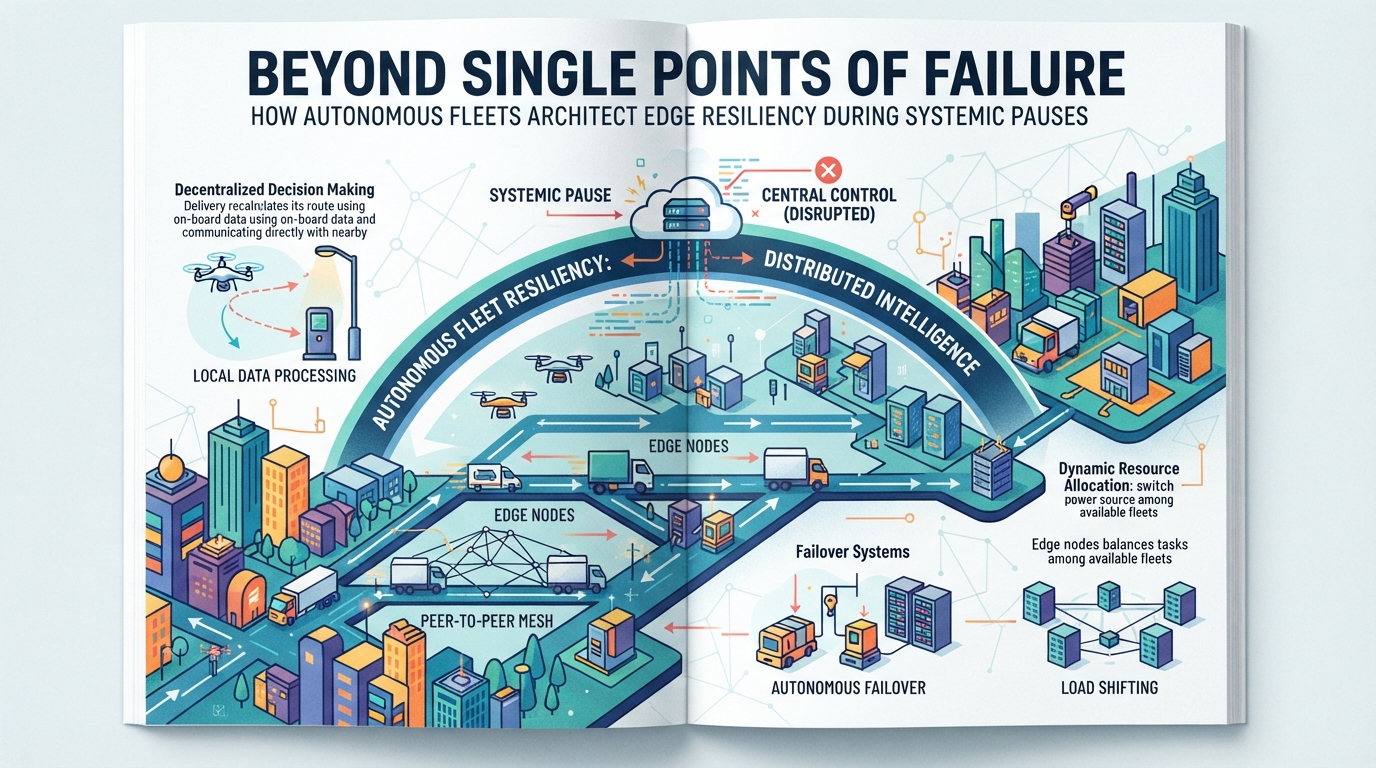
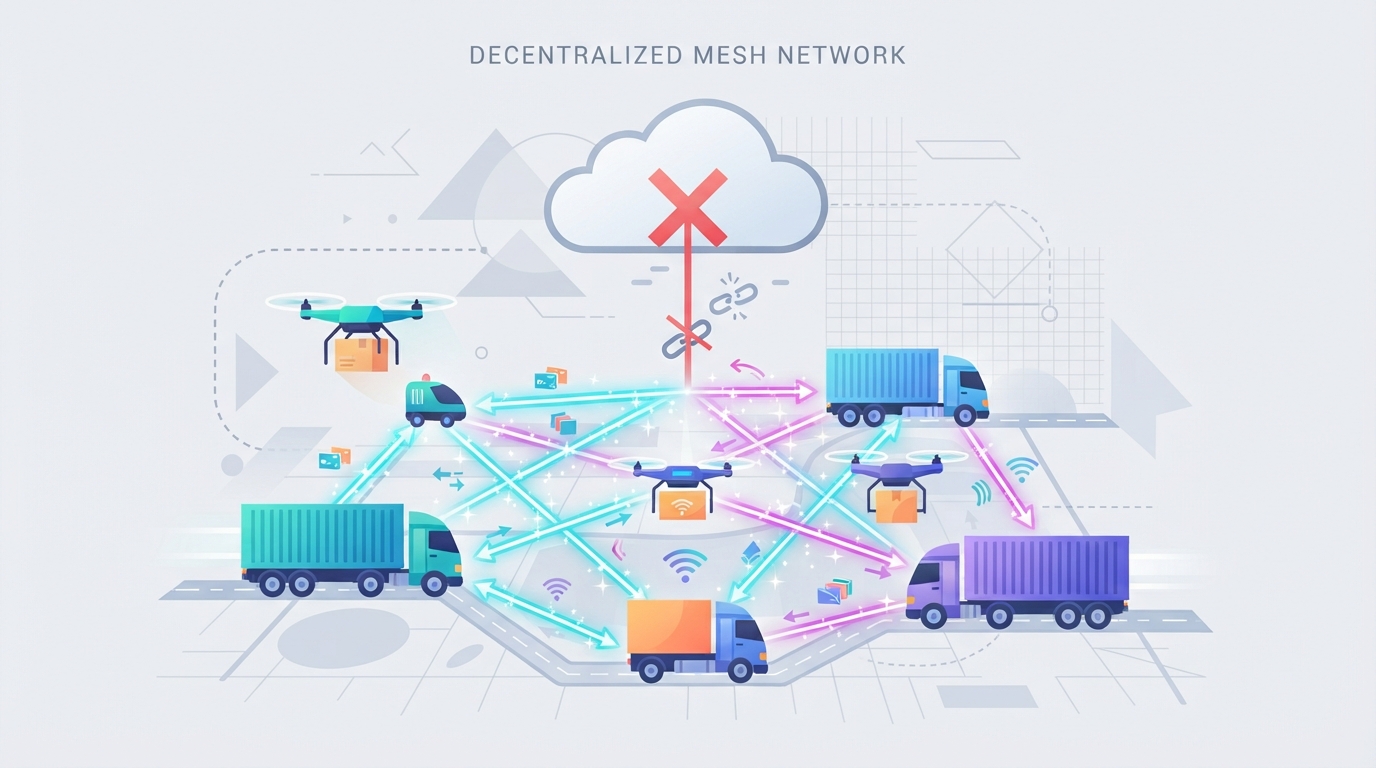
When the cloud link snaps, the systemic pause protocol instantly triggers at the edge. Instead of freezing in place, the fleet immediately transitions into a decentralized, self-governing mesh network.
By leveraging peer-to-peer V2X communication, vehicles exchange telemetry directly with neighboring units—completely bypassing the offline cloud. In under 50 milliseconds, the local fleet negotiates and executes a multi-tiered safety response:
1. Dynamic Spacing: Vehicles instantly increase following distances to buffer against sensor uncertainty.
2. Graceful Degradation: Non-essential auxiliary tasks pause, dedicating 100% of onboard compute to localized path planning.
3. Coordinated Safe-Stops: If the degradation persists, the mesh orchestrates a staggered, synchronized pull-over sequence to prevent collisions.
This rapid, localized negotiation ensures that even during a total network blackout, the fleet behaves as a single, intelligent organism rather than isolated, vulnerable machines.
Decentralized Edge Architectures and Localized Consensus
To coordinate these split-second maneuvers without a central cloud director, vehicles rely on decentralized edge architectures. Instead of waiting for a distant server to referee decisions, each vehicle acts as an independent voting node in a localized network.
This peer-to-peer coordination is powered by localized consensus algorithms like Raft or Paxos, modified specifically for high-mobility edge environments. These algorithms ensure the fleet reaches a single, undeniable “ground truth” regarding safety actions through a structured, three-step process:
- Leader Election: The fleet rapidly elects a temporary “coordinator” node to propose path adjustments.
- State Replication: Proposed safety maneuvers are distributed and committed across all nearby nodes simultaneously.
- Quorum Validation: Decisions require a majority vote, preventing a single rogue or damaged sensor from hijacking the fleet’s behavior.
By embedding these consensus engines directly into the vehicle’s onboard compute, the fleet maintains absolute operational integrity—completely isolated from the cloud.
Surviving the Disconnect: State-Machine Fallbacks and Blind-Runs
When the local network drops entirely, consensus is no longer an option. This is where edge resiliency shifts from a collective effort to individual survival, triggering an automated state-machine fallback that initiates a controlled “blind-run.”
Instead of freezing in place and causing a warehouse-wide logjam, the AMR relies entirely on its onboard intelligence to safely complete its immediate task. It executes a precise, three-step survival protocol:
1. Localized Sensor Fusion: Onboard LiDAR and cameras scan the immediate environment for unexpected obstacles, bypassing the need for central map updates.
2. High-Precision Dead Reckoning: The AMR uses wheel odometry and IMU data to calculate its exact position relative to its last known coordinate.
3. Graceful Degradation: The robot completes its active micro-task—like clearing a busy intersection—before safely bringing itself to a controlled halt.
By navigating the dark autonomously, AMRs prevent minor dropouts from escalating into costly, facility-wide standstills.
Preventing State Divergence with Onboard Telemetry Buffering
While an AMR halts safely, it doesn’t stop generating critical operational data. If this data vanishes, the central control system loses track of the robot’s actual state. To prevent this, modern autonomous fleet orchestration architectures rely on offline telemetry buffering.
Instead of discarding sensor readings during a network drop, the robot writes them directly to a lightweight, onboard SQLite database. This local ledger acts as a resilient data shock absorber.
Once the network connection is restored, the AMR safely flushes its local cache using a strict synchronization protocol:
- MQTT QoS Level 2 (Exactly Once): Guarantees that buffered telemetry is delivered to the broker exactly once, preventing duplicate logs or missed state changes.
- Chronological FIFO Streaming: Data is uploaded in order, rebuilding an accurate timeline of the offline event.
- State Reconciliation: The central system updates the robot’s digital twin, ensuring seamless alignment without manual intervention.
Conclusion: Building a Fail-Safe Future for Autonomous Fleets
Moving away from fragile, cloud-dependent architectures isn’t just about surviving a temporary network drop—it is about redefining how robots think and act in isolation. Achieving true edge resiliency requires shifting critical decision-making power away from distant, centralized servers and directly onto the physical assets on the floor.
To build a fail-safe future, modern autonomous fleet orchestration must be anchored on three core architectural pillars:
- Decentralized State Machines: Individual units must be capable of negotiating tasks peer-to-peer, completely independent of a central broker.
- Dynamic Consensus Protocols: Localized coordination ensures the fleet can safely re-route and adapt during systemic pauses.
- Graceful Degradation: Edge nodes must automatically shed non-essential telemetry tasks while fiercely preserving core safety and navigation functions.
By treating the edge as the primary source of truth rather than a passive endpoint, fleets transition from merely surviving connectivity outages to thriving through them. The future of automation belongs to those who architect for autonomy at the absolute edge.