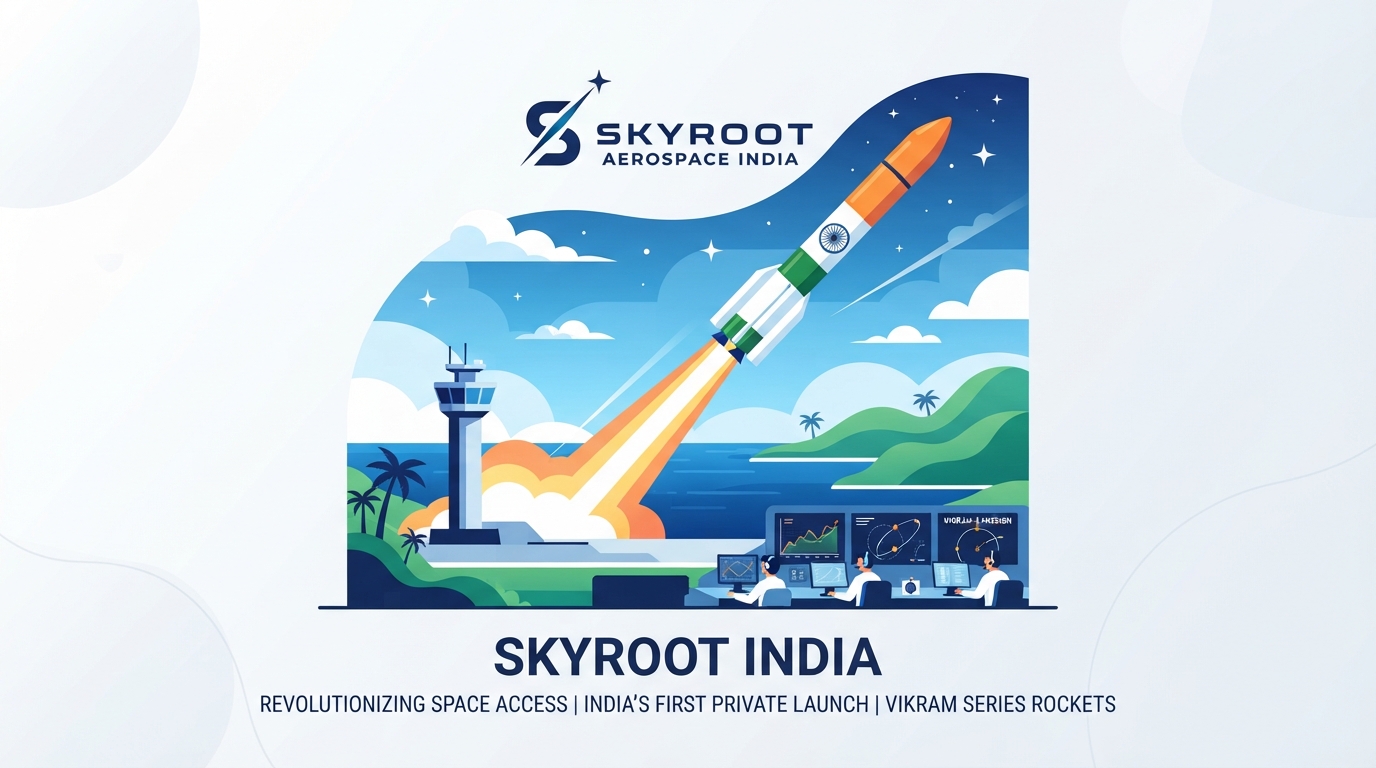
Skyroot India
Introduction to Skyroot Aerospace and India’s Space Revolution
For decades, India’s cosmic ambitions were driven solely by the state-run ISRO. Today, a thrilling transformation is underway as India space startups take the driver’s seat, turning the nation into a global commercial hub.
At the absolute forefront of this Space India revolution is Skyroot Aerospace. Founded by former ISRO scientists, this pioneering company made history by launching India’s first privately developed rocket, the Vikram-S, in 2022.
Here is why they are a game-changer in the modern space race:
- Cost-Effective Launchers: Developing the Vikram rocket series to put small satellites into orbit at a fraction of traditional costs.
- Rapid Manufacturing: Utilizing advanced 3D-printed cryogenic engines to drastically slash production timelines.
- Global Appeal: Positioning India as the ultimate, highly-reliable launchpad for international commercial payloads.
The cosmos is no longer reserved just for government giants. With trailblazers like Skyroot leading the charge, the sky is no longer the limit—it is just the beginning.
The Historic Prarambh Mission and Vikram-S
On November 18, 2022, the Indian space sector witnessed its “Apollo 11” moment. Operating under the aptly named Prarambh mission—which translates to “the beginning”—Skyroot Aerospace successfully launched the Vikram-S rocket into the heavens from ISRO’s spaceport in Sriharikota.
This wasn’t just a test flight; it was a masterclass in precision engineering. The single-stage, solid-propellant rocket achieved several historic milestones during its breathtaking flight:
- First Private Launch: Officially crowned India’s first privately developed rocket to reach outer space.
- Hypersonic Speed: Reached a peak altitude of 89.5 kilometers, touching speeds of Mach 5 (five times the speed of sound).
- Payload Success: Safely carried and deployed three customer payloads into suborbital flight.
This flawless 291-second flight did more than just validate advanced technology. It shattered the entry barriers for private space tech, proving that India’s private sector is ready to compete on the global stage.
Key Technologies Validated in the Vikram-S Flight
The success of the Vikram-S mission rested on three core technological breakthroughs that will define Skyroot’s future orbital vehicles:
- Kalam-80 Engine: This flight successfully demonstrated Skyroot’s proprietary solid fuel propulsion system. Built with high-strength carbon-epoxy filaments, the Kalam-80 delivered consistent, high-thrust performance in real-world flight conditions.
- Carbon-Composite Structures: To shed dead weight, the rocket’s main airframe was fabricated entirely from advanced carbon-composite materials. This dramatically reduced structural mass, proving that Skyroot can build ultra-lightweight yet incredibly strong launch vehicles.
- 3D-Printed Thrusters: The vehicle utilized cutting-edge, 3D-printed spin-stabilization thrusters. This advanced manufacturing technique not only slashed production times by 90% but also ensured pinpoint attitude control during high-speed ascent.
By validating these three pillars in a single flight, Skyroot proved its manufacturing processes are both flight-proven and ready to scale.

Scaling to Orbit: The Vikram-1 Launch Vehicle
Building on previous suborbital successes, Skyroot is stepping up to the major leagues with Vikram-1. This multi-stage launch vehicle is custom-built to deliver small satellites to Low Earth Orbit (LEO) reliably and affordably.
What makes this rocket a game-changer is its smart, hybrid propulsion architecture:
- Solid-Fuel Boosters: The first three stages utilize high-thrust solid propellants, providing massive power at liftoff while simplifying launchpad operations.
- Liquid Upper Stage: The final stage features a restartable liquid engine, allowing for precise orbital positioning and multi-satellite deployments.
With a lift capacity of up to 290 kg, Vikram-1 can easily house multiple payload setups. It is engineered to make space access quick, customizable, and incredibly efficient for global commercial operators. This orbital powerhouse is fully prepped to redefine rapid satellite deployment.
Skyroot Aerospace vs. Agnikul Cosmos: Two Paths to Orbit
While Skyroot dominates the solid-propellant arena, its chief rival, Agnikul Cosmos, is carving out a completely different trajectory. This friendly space race represents two distinct engineering philosophies aiming for the same destination.
Here is how their technical strategies stack up:
- Skyroot (Solid Scalability): Relies on solid-fuel boosters for its lower stages to ensure massive thrust, simplified launchpad logistics, and rapid, cost-effective manufacturing at scale.
- Agnikul Cosmos (Liquid Customization): Focuses heavily on liquid-propellant systems. Their flagship rocket, Agnibaan, utilizes a single-piece, 3D-printed semi-cryogenic engine running on liquid oxygen and aviation turbine fuel.
Ultimately, Skyroot is built for speed and mass production, whereas Agnikul Cosmos prioritizes ultimate mission flexibility, allowing clients to configure the number of engines based on payload needs. It is a classic matchup of scalable power versus tailored precision.
Propulsion, Manufacturing, and Launch Infrastructure Comparison
To understand how these two giants operate, we have to look at how they build and launch. Skyroot relies on its Kalam series of solid state motors, which are manufactured using carbon-composite cases. These modular motors can be mass-produced quickly, assembled like Lego bricks to scale up thrust.
On the flip side, Agnikul Cosmos leverages a radically different manufacturing philosophy. They designed Agnilet, the world’s first single-piece, 3D-printed engine. By printing the entire engine as one component, they eliminate hundreds of joints and potential points of failure.
Their launch strategies are just as divergent:
- Skyroot’s Infrastructure: Utilizes traditional, highly stable static launchpads for rapid, high-thrust deployments.
- Agnikul’s Dhanush: Uses Dhanush, a fully mobile, custom-built launchpad. This allows Agnikul to launch from virtually any port, offering unparalleled geographical flexibility.
While Skyroot excels at rapid factory-to-pad assembly, Agnikul redefines where and how a rocket can take flight.
The Future of Commercial Spaceflight in India
The launch of Vikram-S was just the opening act. Today, Skyroot Aerospace is positioning itself at the forefront of a massive global shift. As international demand for small satellite launches skyrockets, the private space sector India is uniquely primed to disrupt the global market.
By leveraging India’s historically low-cost engineering and the supportive regulatory backing of IN-SPACe, local startups are transforming Space India into a dominant commercial powerhouse.
Here is what the future roadmap looks like:
- Aggressive Market Share Goals: India aims to scale its share of the global space economy from 2% to 10% by 2030.
- Unmatched Cost Leadership: Offering commercial launch services at a fraction of the cost of Western competitors.
- High-Frequency Launches: Shifting the paradigm from custom, slow-paced missions to rapid, on-demand rideshare deployments.
With pioneering companies leading the charge, India is no longer just a budget-friendly alternative—it is fast becoming the premier destination for global satellite operators.