The Lakehouse Advantage: Why Databricks’ $188B Valuation Proves Data Infrastructure is AI’s Real Gold Mine
Introduction: The AI Gold Rush and the Shovels
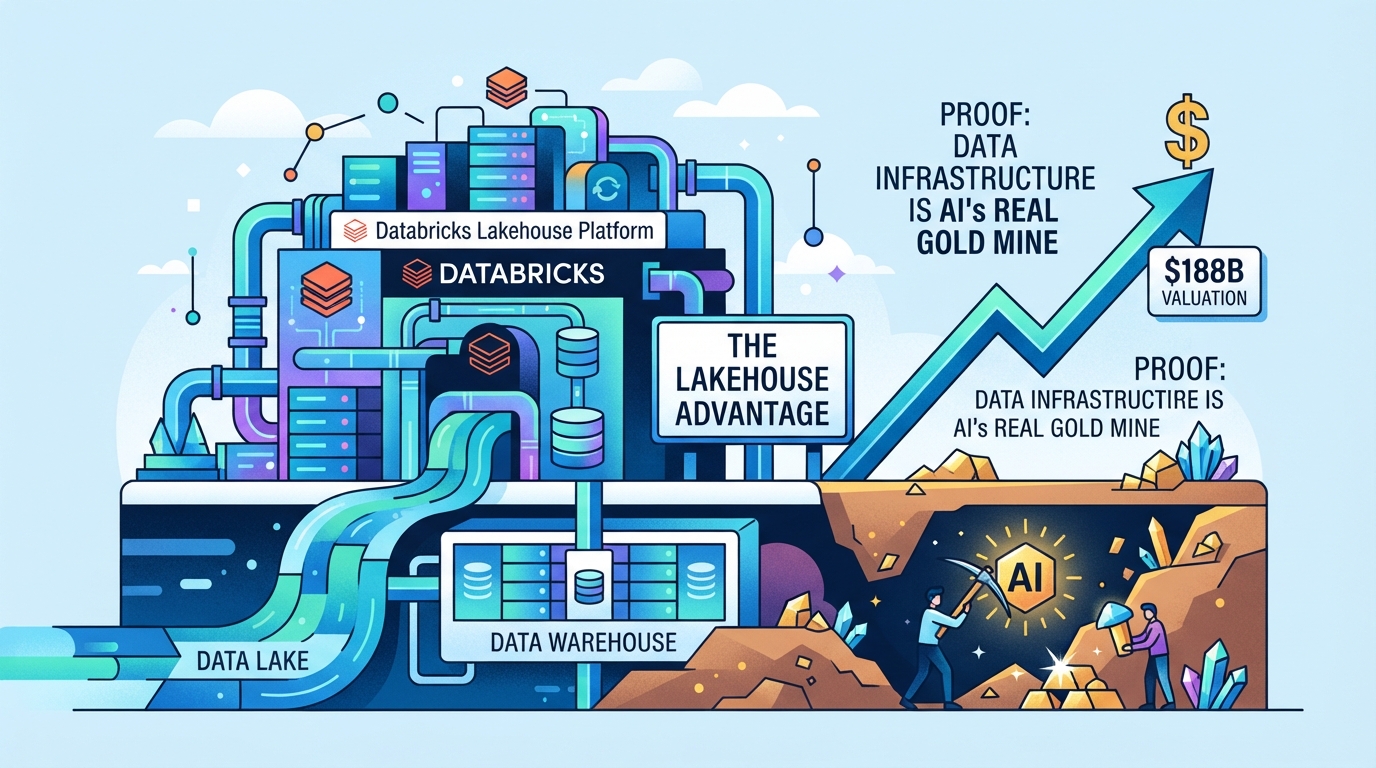
During the 1849 Gold Rush, the people who got richest weren’t the miners—they were the merchants selling shovels. Today, as the generative AI boom dominates global headlines, history is repeating itself in the digital realm.
The jaw-dropping Databricks valuation of $43 billion—established during its Series I funding round in September 2023 led by financial giant T. Rowe Price—isn’t just a win for one company; it is a defining industry signal. It proves that while consumer-facing chatbots get the hype, the real wealth is being generated behind the scenes.
To build reliable AI, companies need clean, structured, and highly accessible data. That is why robust enterprise AI infrastructure has become the ultimate high-value asset of this tech cycle.
Here is how the power dynamic has shifted:
- The “Gold” (AI Models): Flashy front-end applications that are rapidly becoming commoditized.
- The “Shovels” (Data Infrastructure): The unified data lakes and pipelines required to feed those models.
Without a solid foundation, even the most advanced AI model is useless. This massive market valuation confirms that the plumbing is where the true fortune lies.
Deconstructing the Valuation: Why Infrastructure Wins the AI Era
Investors aren’t just throwing money at the latest AI wrapper; they are chasing data gravity. This concept dictates that as data grows, it naturally pulls applications, analytics, and AI models toward it.
If you own the data layer, you own the entire ecosystem. This is the core driver behind the staggering Databricks valuation.
Here is why venture capital is flowing into enterprise AI infrastructure instead of flashy AI apps:
- Infinite Moats: Building a new LLM wrapper takes a weekend. Replacing a unified data lakehouse, however, is an incredibly complex endeavor. According to industry database migration benchmarks from research firms like Gartner, large-scale enterprise data migrations typically take between two to four years of intense effort and carry significant operational risks. Once an organization commits to a lakehouse, the gravity of that infrastructure makes migration highly impractical.
- Zero Churn Risk: App-layer startups face brutal user churn as newer models launch. Infrastructure providers enjoy locked-in, recurring enterprise revenue.
- The Gravity Effect: Once an enterprise stores petabytes of proprietary data in one place, they will build their AI there, not export it elsewhere.
Ultimately, application startups are renting temporary attention, while infrastructure giants are building permanent digital real estate.

The Lakehouse Paradigm: Resolving the Legacy Data Warehouse and Data Lake Split
For decades, enterprise data was trapped in a dysfunctional, two-state system. On one side stood data warehouses—highly structured, expensive environments built for business intelligence (BI) and SQL queries. On the other side lay data lakes—cheap, vast repositories of unstructured raw data perfect for machine learning, but notoriously disorganized.
This split forced companies to constantly copy data back and forth, creating massive latency, security gaps, and redundant storage costs.
The Lakehouse architecture solved this fragmentation. By merging the best of both worlds, a unified data lakehouse delivers:
- Warehouse Reliability: ACID transactions, schema enforcement, and robust data governance.
- Lake Flexibility: Low-cost, open-format storage capable of housing raw audio, video, and text for AI training.
Instead of maintaining two separate, competing pipelines, enterprises now have a single source of truth for both legacy BI and generative AI.
Unifying Structured and Unstructured Data for Generative AI
To unlock the true power of generative AI, enterprises can’t just rely on neat rows and columns. In fact, up to 90% of enterprise data is unstructured—think customer service audio, PDF contracts, and internal chats.
The challenge isn’t just storing this raw information; it’s making it usable and secure. Feeding sensitive data into LLMs without strict guardrails is a recipe for compliance disasters.
This is where the lakehouse model shines, bringing enterprise-grade data governance to unstructured formats. It allows organizations to:
- Secure Sensitive Assets: Apply role-based access controls to PDFs and audio files.
- Trace Data Lineage: Track exactly which document trained which model to prevent “hallucination” liabilities.
- Unify Context: Combine structured purchase histories with unstructured chat logs for hyper-personalized AI outputs.
By unifying these data types under a single security umbrella, companies can build secure, context-aware AI applications without risking proprietary secrets.
The Strategic Impact of the MosaicML Acquisition
Having secure, well-governed data is only half the battle; you still need a way to train the models. Databricks closed this gap spectacularly with its $1.3 billion acquisition of MosaicML, transforming the lakehouse from a passive data repository into an active generative AI powerhouse.
This strategic move allows enterprises to build, pre-train, and deploy custom LLMs directly where their data already lives. Here is how this integration bridges the gap:
- Cost-Efficient Training: MosaicML’s optimization algorithms slash the compute and financial costs of training models from millions of dollars to just thousands.
- Absolute Data Sovereignty: Organizations no longer need to ship proprietary data to third-party APIs; the entire training pipeline remains inside the secure Databricks boundary.
- Seamless Customization: Businesses can easily fine-tune open-source models using their unique, domain-specific data.
Instead of renting generic intelligence from external providers, companies can now build proprietary AI assets cheaply, securely, and natively.
Databricks vs. Snowflake: The Battle for Modern Data Gravity
The battle for modern data gravity—the concept that applications and compute are naturally drawn to where data lives—has created a fierce rivalry between Databricks and Snowflake. While Databricks built its foundation on the open data lake, Snowflake dominated the structured data warehouse.
Now, as organizations rush to build enterprise AI infrastructure, these two giants are colliding in the middle. Snowflake is aggressively pushing into Databricks’ territory by supporting open table formats like Apache Iceberg to decouple storage and compute.
Here is how their architectural philosophies stack up for AI workloads:
- Databricks (Lakehouse Native): Built from the ground up for unstructured data (audio, text, PDFs) and machine learning, giving it a native head start in generative AI.
- Snowflake (Warehouse First): Exceptionally fast for structured SQL analytics, now adapting to open lakehouse architectures via Iceberg to prevent customer churn.
Ultimately, the winner of this clash will be the platform that makes raw data the easiest to harness for AI.
Reducing Total Cost of Ownership (TCO) in Enterprise AI
Building a robust enterprise AI infrastructure shouldn’t mean bankrupting your organization with overlapping software licenses and redundant storage. A unified lakehouse pipeline slashes Total Cost of Ownership (TCO) by eliminating the “data tax” of constantly moving information between separate warehouses and data lakes.
Here is how unifying your data pipeline directly impacts your bottom line:
- Faster Model Training: Direct, zero-copy access to raw data means data scientists spend less time waiting on tedious ETL pipelines and more time optimizing models.
- End-to-End Lineage: Tracking data from raw ingestion to the final LLM output ensures compliance and drastically reduces debugging hours.
- Automated Data Governance: Implementing a single security framework across both BI and AI workloads eliminates the administrative overhead of managing fragmented access controls.
Ultimately, consolidation is the ultimate cost-saver. By running BI and AI on a single platform, enterprises can redirect millions from infrastructure maintenance directly into model innovation.
Conclusion: Building Your Business on Solid Data Ground
As the AI gold rush continues to pick up speed, it is easy to get distracted by the flashiest prospectors. But history has shown us time and again that the most sustainable, lucrative path lies in supplying the tools. Databricks’ $43 billion valuation is a testament to this truth: the real winners of this era aren’t those chasing the fleeting hype of front-end applications, but the ones providing the essential infrastructure.
For enterprise leaders, the message is clear. To stake your claim in the AI future, you cannot rely on shaky, fragmented data. You must build your business on solid ground by investing in a unified data lakehouse. By consolidating your structured and unstructured data, securing your pipeline, and owning your data layer, you aren’t just mining for gold—you are owning the shovel factory.