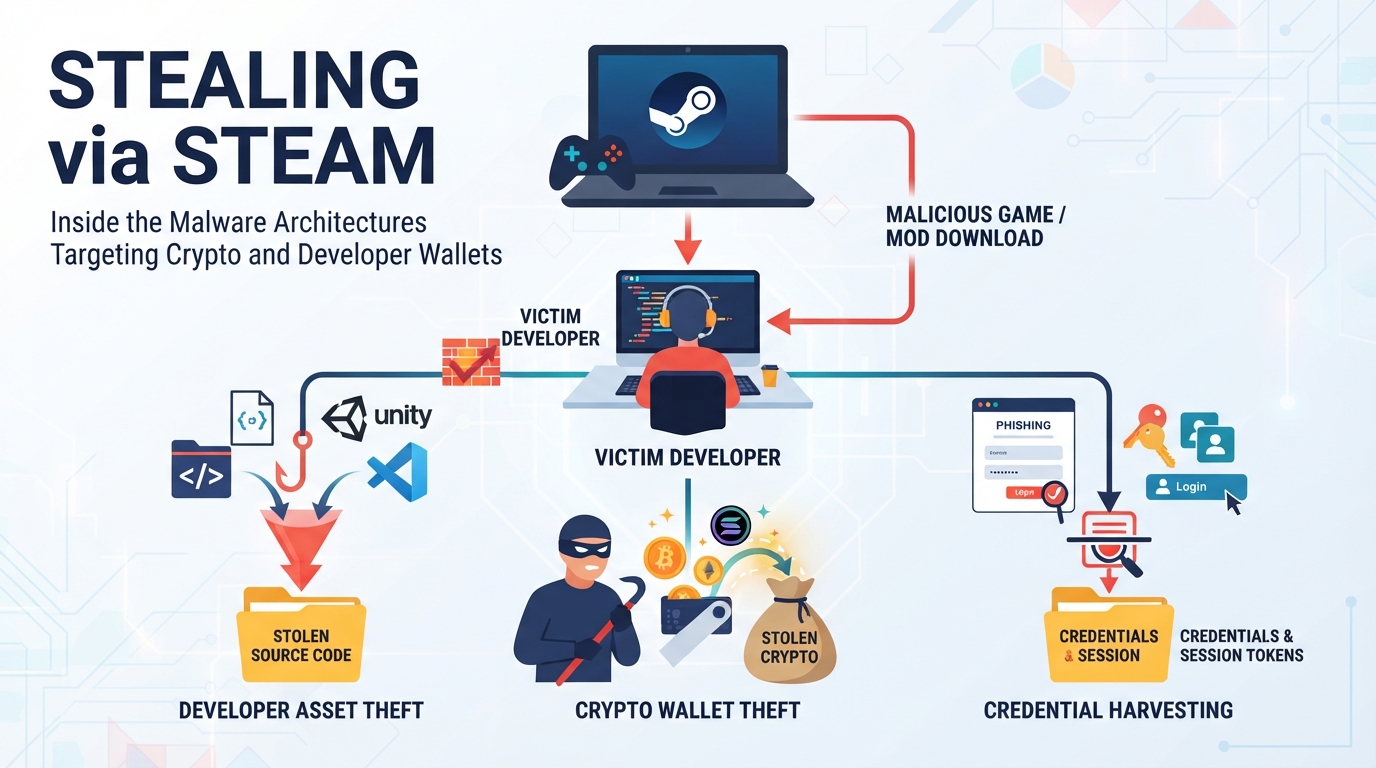
Stealing via Steam: Inside the Malware Architectures Targeting Crypto and Developer Wallets
Introduction: The Rising Threat of Gaming Ecosystem Supply Chain Attacks
For years, gaming cybercrime was simple: hackers phished players to steal virtual skins or hijack Steam accounts. Today, the stakes are exponentially higher. Threat actors have shifted their crosshairs from casual gamers to the actual infrastructure powering the industry, leveraging sophisticated gaming ecosystem supply chain attacks.
Instead of targeting end-users, modern adversaries infect developer pipelines and compromise trusted integrations. Their weapon of choice is stealthy infostealer malware designed to siphon high-value assets silently.
The threat landscape has fundamentally shifted:
- The Old Target: Players, virtual items, and basic login credentials.
- The New Target: Developers, proprietary source code, and hot crypto wallets.
By poisoning the software supply chain, a single compromised developer credential can distribute malicious payloads to millions of unsuspecting users instantly.
The Anatomy of Steam Developer Account Takeovers
To execute a successful Steam developer account takeover, adversaries typically bypass traditional defenses entirely. Instead of brute-forcing passwords, they deploy infostealers to harvest active browser sessions, executing a technique known as session cookie hijacking.
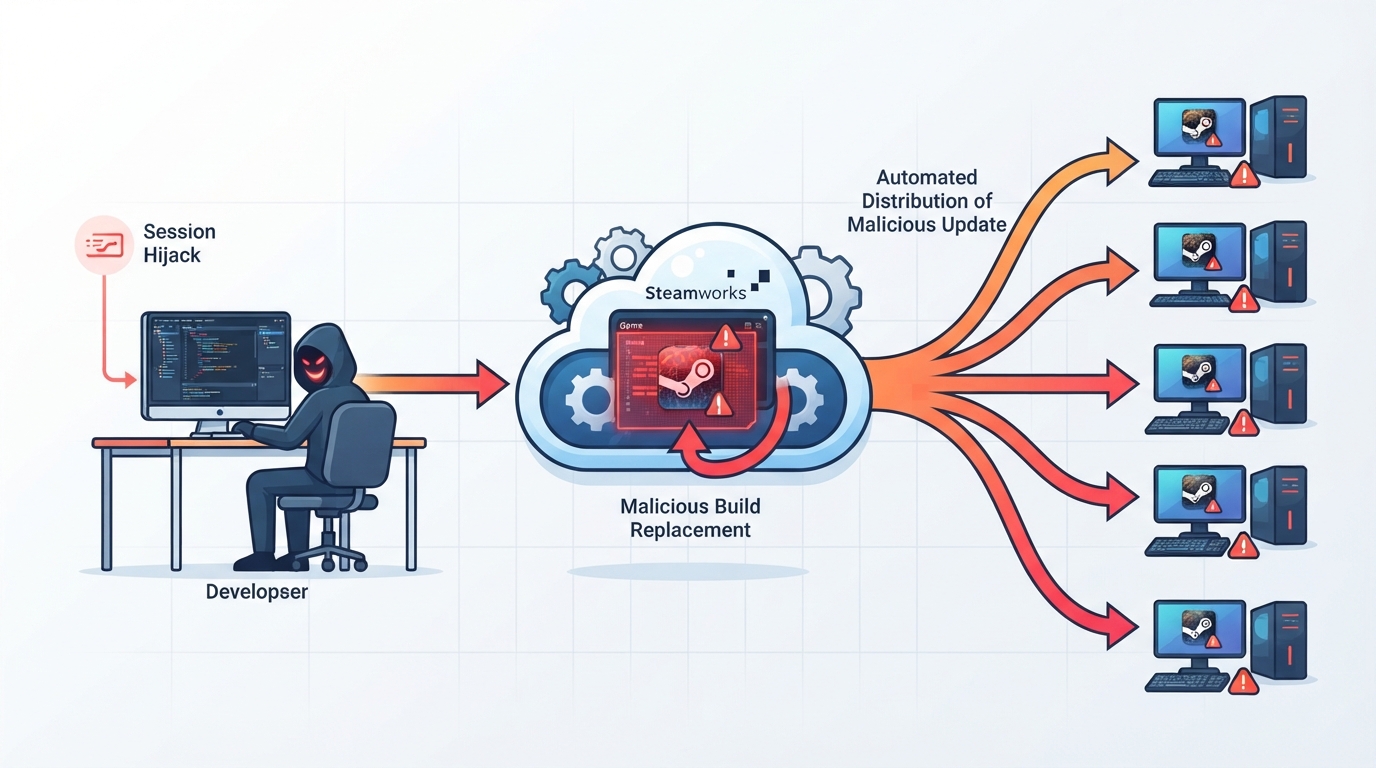
Once these stolen cookies are imported, attackers bypass Multi-Factor Authentication (MFA) to achieve a complete Steamworks portal compromise. With administrative access secured, the infiltration phase transitions into an active supply chain attack:
1. Session Hijacking: The attacker clones the developer’s active session, gaining instant portal access without triggering MFA prompts.
2. Build Replacement: The legitimate game files are replaced with compromised binaries containing silent infostealer payloads.
3. Automated Distribution: Steam’s trusted infrastructure automatically signs and pushes these malicious game updates directly to unsuspecting players.
By abusing the inherent trust between developers and the Steam platform, malware operators turn routine patches into silent delivery vehicles for credential-harvesting payloads.
The Playtest Trap: Targeting Crypto Developers via Discord and Telegram
While compromising Steamworks portals is highly effective, attackers often prefer a more direct, personalized approach. This is where the Web3 game playtest scam comes into play, targeting crypto developers and high-value users directly on Discord and Telegram.
The attack unfolds in a highly coordinated sequence:
- The Pitch: Attackers pose as indie game recruiters, offering lucrative compensation (often $100–$500) to beta-test an upcoming, visually stunning Web3 project.
- The Payload: To “test” the game, the target is directed to download a custom launcher or game build, often hosted on professional-looking landing pages.
- The Execution: Once launched, the software bypasses traditional antivirus detection to deploy silent infostealers, specifically scanning for browser extensions, private keys, and cold wallet configurations.
By exploiting the collaborative nature of developer communities, attackers turn a simple job offer into a devastating vector for crypto wallet theft. It proves that sometimes, the most dangerous exploit isn’t a zero-day vulnerability—it’s a friendly DM.
Inside the Malware Payload: RedLine and Lumma Stealers
Once executed, the payload unleashes highly specialized infostealer malware designed to dissect your digital footprint in seconds. Two of the most prolific threats targeting developers today are the RedLine stealer and the Lumma stealer, both employing surgical precision to harvest high-value assets.
Here is how these threats systematically strip your defenses:
- Credential Harvesting: They scan local directories for Chromium- and Gecko-based browsers, decrypting stored login credentials and auto-fill data.
- Session Hijacking: The Lumma stealer excels at grabbing active session cookies. This lets attackers bypass Multi-Factor Authentication (MFA) to hijack live Discord, Steam, or GitHub sessions.
- Crypto Wallet Extraction: The malware actively hunts for hot wallet browser extensions (like MetaMask). It targets the extension’s local storage to extract private keys, seed phrases, and wallet configurations.
This automated extraction takes less than a minute, leaving victims compromised before they even realize the “game” has crashed.
The Blast Radius: Repository Exploits and Digital Asset Theft
Once the malware executes, the damage doesn’t stop at a single machine; it spirals outward. For game developers, hijacked GitHub sessions allow attackers to inject malicious code directly into active codebases. This triggers devastating gaming ecosystem supply chain attacks, turning trusted game patches into Trojan horses that target thousands of players downstream.
The fallout of these compromises typically follows a brutal, three-stage sequence:
- Repository Poisoning: Attackers commit malicious updates directly to production branches using stolen developer credentials.
- Downstream Infection: Unsuspecting players download the official update, silently installing the infostealer on their own rigs.
- Instant Asset Drainage: The malware executes, initiating automated crypto wallet theft by sweeping funds and NFTs to attacker-controlled addresses.
What begins as a single compromised developer account quickly scales into a widespread security crisis, wiping out player trust and digital wealth in minutes.
Securing the Pipeline: Defending Against Gaming Supply Chain Compromises
Securing your studio against gaming ecosystem supply chain attacks requires moving beyond basic passwords. When infostealers strike, standard multi-factor authentication (MFA) isn’t enough to save your pipeline.
To lock down your environment, implement these non-negotiable defenses:
- Enforce Hardware MFA: Switch to FIDO2 hardware security keys (like YubiKeys) for all repository and publisher portal access. This completely neutralizes session cookie hijacking attempts, as physical presence is required to authorize actions.
- Tighten Session Management: Set aggressive, short-lived expiration policies for developer sessions and API tokens. If a cookie is stolen, its operational window should be minutes, not weeks.
- Isolate Build Environments: Never build or sign production code on machines used for daily browsing or gaming. Use dedicated, ephemeral CI/CD runners instead.
- Train for Social Engineering: Educate your team to spot targeted phishing on Discord and Telegram. A single “test this beta build” download can compromise your entire network.