How to Build a Multi-Agent AI System: A Developer’s Practical Guide
Introduction to Multi-Agent AI Systems
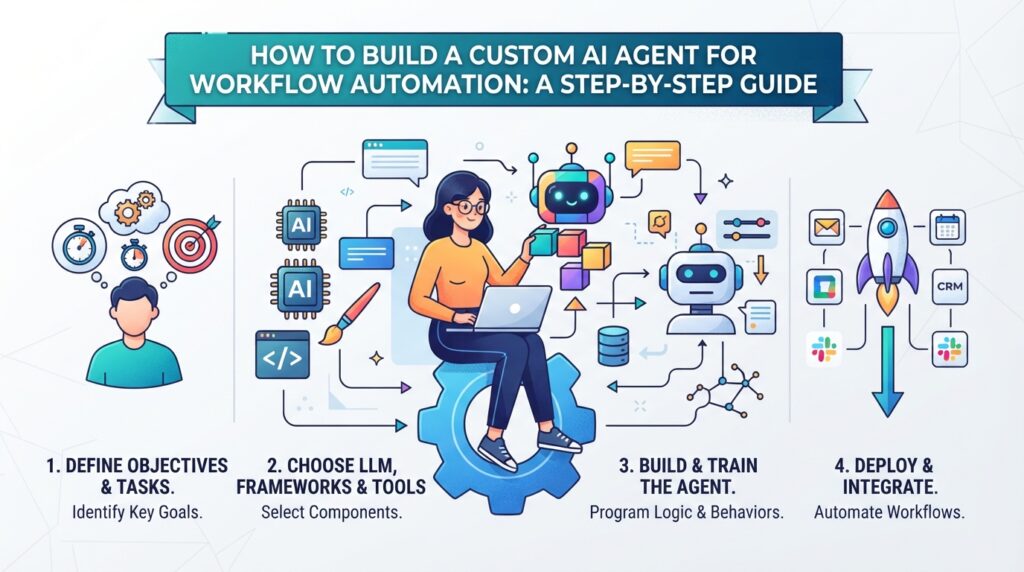
Remember when we thought a single, well-crafted prompt could solve any problem? While single-prompt LLM applications are great for simple Q&A, they quickly fall apart when tackling complex, multi-step workflows. To solve real-world enterprise challenges, developers are shifting toward collaborative, multi-agent architectures.
When you build a multi-agent AI system, you divide a massive task into specialized roles. Instead of one overwhelmed model trying to do everything, you design a network of micro-agents—each a specialist in its own domain.
This shift relies on strategic agentic workflow design, which replaces linear prompting with dynamic collaboration:
- Specialization: Agents have dedicated tools, system prompts, and personas (e.g., researcher, coder, or editor).
- Iterative Feedback: Agents can critique, debug, and refine each other’s work before delivering the final output.
- Resilience: Complex tasks are broken down into manageable loops, reducing the risk of hallucination and context-window exhaustion.
Core Components of a Multi-Agent Architecture
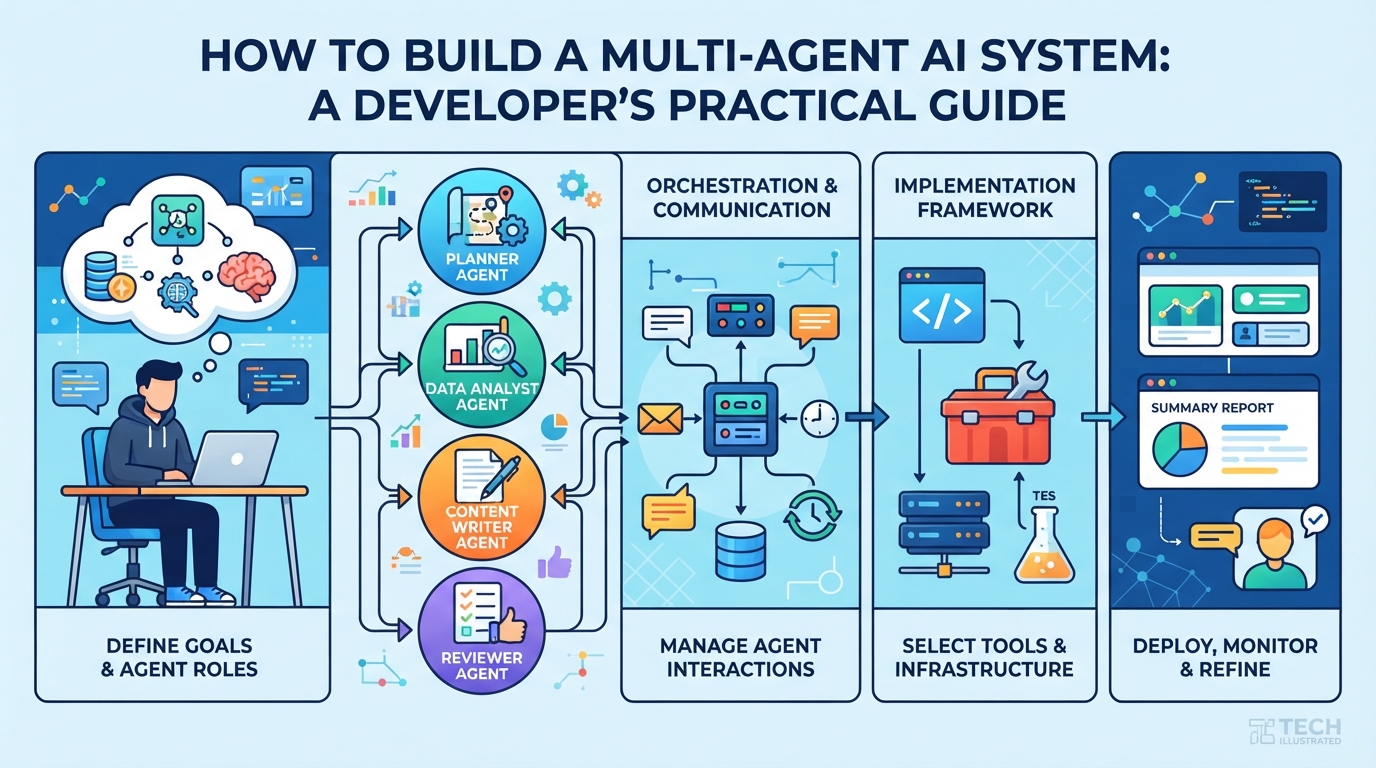
Any robust multi-agent framework relies on four interconnected building blocks to turn chaotic model outputs into predictable, high-quality results.
Here are the core components you will configure:
- LLM Role-Based Agents: These are your specialized digital workers. Each agent is defined by a specific system prompt, memory window, and LLM backend tailored to its unique job.
- Tasks: The concrete, actionable assignments given to your agents. A task defines the input data, the required output schema, and which agent is responsible for execution.
- Computational Tools: The external APIs, web scrapers, databases, or secure code-execution sandboxes that allow agents to interact with the physical and digital world.
- Orchestration: The control plane that governs communication. It dictates how agents share information, managing whether they work sequentially, hierarchically, or autonomously.
By combining these four elements, you transition from simple prompt engineering to building a scalable, self-directing software ecosystem.
Step 1: Defining the System Overarching Goal
Before you write a single line of code, you need to know exactly what success looks like. If you attempt to build a multi agent ai system without tight guardrails, your agents will quickly spiral into infinite execution loops or burn through your API budget.
Scoping is about drawing hard boundaries around your system’s capabilities. To keep your agents on track, establish these three critical pillars:
- Clear Boundaries: Define what the system cannot do to prevent scope creep and runaway agent execution.
- Structured Outputs: Specify the exact data schema (such as a strict JSON format) required for the final delivery.
- System KPIs: Track metrics like execution latency, API cost ceilings, and task accuracy rates to measure performance.
By anchoring your architecture to these guardrails, you ensure your autonomous agents remain efficient, predictable, and highly cost-effective.
Step 2: Designing Specialized Agents (Roles and LLMs)
Now it’s time to build your digital workforce. Creating high-performing LLM role-based agents requires moving past generic prompts and designing highly specialized personas backed by the right cognitive engines.
To configure an effective agent, you must balance three critical elements:
- The Persona & Backstory: Define a clear identity and motive. A “Security Auditor” with a skeptical, pedantic backstory will catch edge-case bugs that a generic assistant misses.
- The Cognitive Engine: Match the task complexity to the optimal LLM. Don’t burn your budget on an expensive frontier model for simple routing or formatting tasks.
| Agent Role | Backstory/Focus | Optimal LLM |
|---|---|---|
| Lead Analyst | Deep synthesis, strategic planning | Claude 3.5 Sonnet |
| Triage Bot | Fast routing, classification | Llama 3 (8B) or GPT-4o-mini |
This strategic pairing ensures each agent has the exact level of intelligence needed, keeping your entire multi-agent system fast, accurate, and cost-effective.
Step 3: Assigning Discrete Tasks and Expected Outputs
Now that your agents have clear identities and engines, you need to give them precise, isolated jobs. Think of this as the blueprint of your agentic workflow design: if an agent’s scope is too broad, the system collapses into hallucination and endless loops.
To keep your system predictable, apply the Single Responsibility Principle to your agents. Every task you assign must have a strict, machine-readable boundary.
Here is how to structure a bulletproof task handoff:
- The Input: Strip out noise; pass only the exact context the agent needs to act.
- The Directive: Use explicit, action-oriented prompts (e.g., “Extract,” “Validate,” “Format”).
- The Expected Output: Define the exact schema (like a strict JSON object) so the downstream agent knows exactly what to expect.
By constraining each step to a single input and a structured output, you turn unpredictable LLM behavior into a reliable, deterministic pipeline.
Step 4: Establishing Orchestration Workflows
Once your agents have clear boundaries, you need a director to run the show. How you route data between them defines your system’s architecture.
You will typically choose between two primary patterns:
- Sequential Workflows: Think of this as a software assembly line. Agent A processes the data and passes the output directly to Agent B. It is highly predictable and perfect for fixed pipelines like automated content publishing.
- Hierarchical Orchestration: Here, a central “manager” agent evaluates the user’s request and dynamically delegates tasks to specialized “sub-agents.” The controller collects their outputs, decides if further iteration is needed, and synthesizes the final response.
| Workflow Type | Best For | Complexity |
|---|---|---|
| Sequential | Fixed, step-by-step pipelines | Low |
| Hierarchical Orchestration | Dynamic, open-ended problem solving | High |
Choose sequential workflows when deterministic reliability is paramount. Opt for a controller-led model when your system must adapt dynamically to unpredictable user inputs.
Equipping Agents with Tools and APIs
An LLM on its own is like a brilliant strategist with no hands. To make your agents truly autonomous, you must equip them with tools to interact with the physical and digital world.
Within a modern multi-agent framework, this is achieved through tool calling—a mechanism where agents dynamically generate structured arguments (like JSON) to trigger external code.
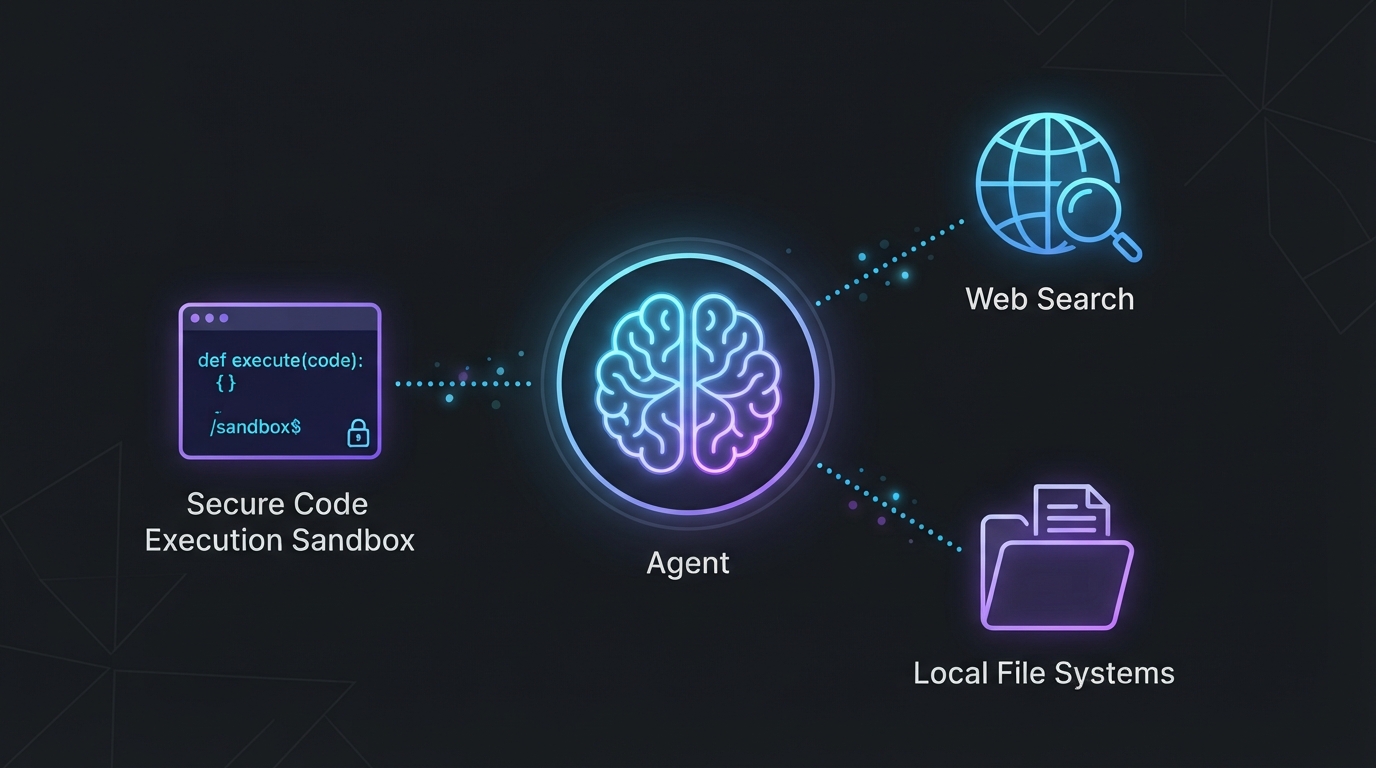
Here are the three primary tool categories you should integrate:
- Web Search APIs: Connect agents to services like Tavily or Serper to fetch real-time data and bypass LLM knowledge cutoffs.
- Local File Systems: Grant read/write permissions so agents can parse local PDFs, update CSV databases, or generate markdown reports.
- Secure Sandboxes: Provide isolated environments (like Docker or E2B) where agents can safely execute Python code to analyze data or render charts.
By binding these capabilities to specific agents, you transform passive text generators into active, goal-oriented executors.
Choosing Your Framework: CrewAI vs. Microsoft AutoGen
Once you have your tools ready, you need an orchestrator to manage how your agents interact. The battle of CrewAI vs AutoGen represents two fundamentally different design philosophies for building multi-agent systems.
CrewAI is built for structured, role-based workflows. Think of it like a corporate department: you define specific roles (e.g., Researcher, Writer), assign sequential tasks, and let them execute. It is highly deterministic, production-ready, and incredibly easy to set up out of the box.
Microsoft AutoGen, by contrast, treats agents as conversational peers. It excels at dynamic, event-driven interactions where agents chat with each other to solve complex problems. AutoGen shines when you need deep customization, algorithmic flexibility, and seamless human-in-the-loop feedback.
Here is how to choose:
- CrewAI: Best for predictable, linear processes, content creation, and rapid prototyping.
- AutoGen: Best for open-ended problem solving, complex group chats, and developer-centric customization.
Best Practices for Debugging and Scaling
When you build multi agent ai system architectures, operational complexity scales exponentially. Without strict guardrails, agents can easily get stuck in expensive, infinite feedback loops.
Keep your system fast, deterministic, and cost-effective with these production-ready practices:
- Set Hard Iteration Caps: Always hardcode a
max_iterationslimit (typically 3 to 5) for agent-to-agent interactions to prevent runaway API bills. - Use Structured Tracing: Replace generic print statements with dedicated LLM observability tools like LangSmith or Phoenix to track agent states and tool execution in real-time.
- Implement Semantic Caching: Store common agent queries and responses in a vector database to bypass redundant LLM calls and slash latency.
- Enforce Token Budgets: Apply strict rate limits and daily spending caps at the API gateway level to prevent unexpected cost spikes during testing.
Designing with these constraints from day one ensures your agent network remains reliable, predictable, and highly scalable.