Local LLMs vs Cloud APIs: Which is Best for Your Development Workflow?
Introduction: The Developer’s Dilemma
Imagine building a killer AI feature. You are immediately faced with a critical fork in the road: do you tap into a sleek cloud endpoint, or do you spin up a model directly on your machine?
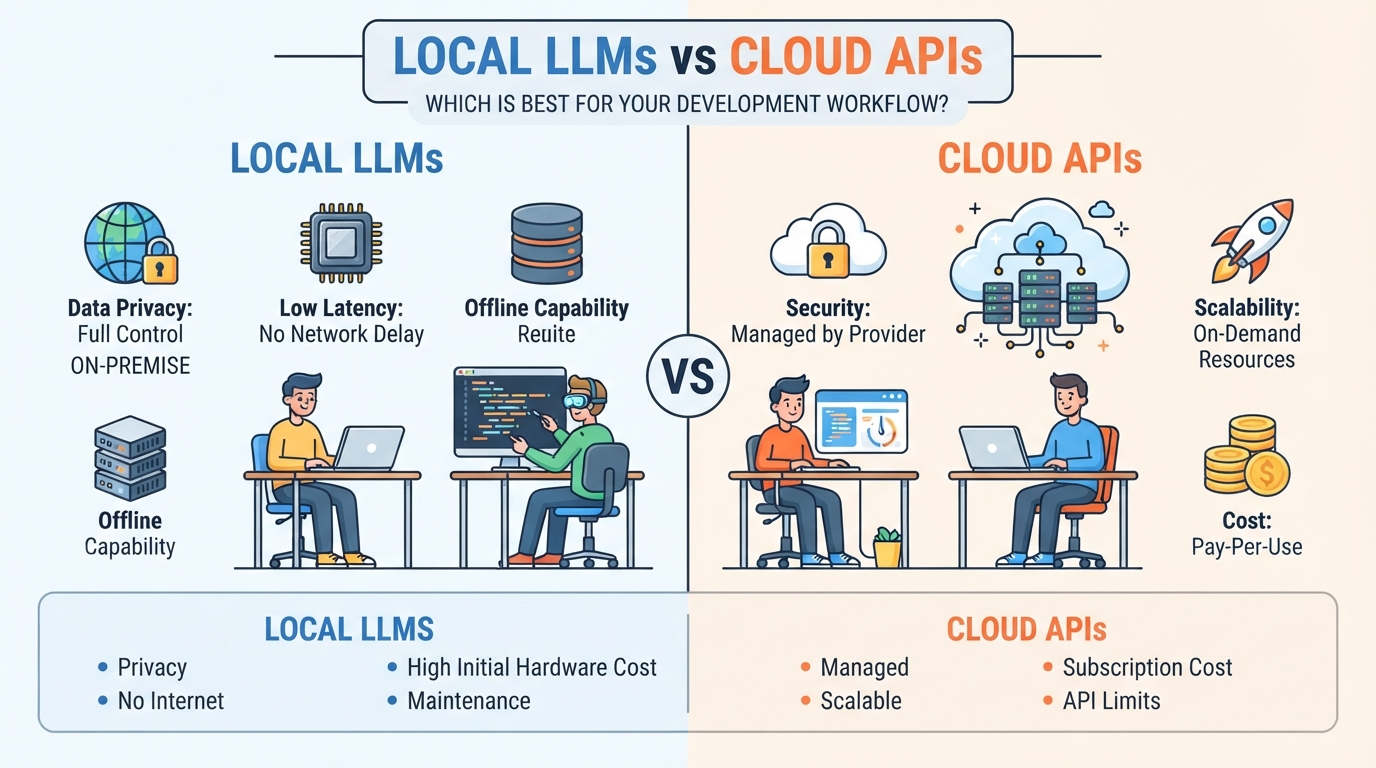
This is the modern local llm vs cloud api debate, and it is reshaping the entire software development lifecycle. Your choice dictates not just your application’s latency, but your budget, data privacy, and offline capabilities.
For many, a local LLM development workflow offers total data sovereignty and zero per-token costs. For others, cloud APIs provide unmatched frontier-model performance with zero setup hassle.
Here is what is at stake with this crucial architectural decision:
- Data Security: Keeping sensitive user data on-premise versus sending it to third-party servers.
- Cost Predictability: Heavy upfront hardware investments versus ongoing, usage-based API bills.
- Speed & Latency: Offline, low-latency execution versus network-dependent, high-throughput cloud processing.
Let’s unpack how these two paths stack up so you can choose the right engine for your stack.
Understanding Local LLMs: Privacy and Offline Control
Running a local LLM has never been easier, thanks to developer-friendly tools like Ollama. Instead of sending proprietary code to external servers, you can now run powerful open-source models like Llama 3 or Mistral directly on your workstation.
When evaluating Ollama vs OpenAI, the local approach offers three massive advantages:
- Complete Code Sovereignty: Your intellectual property never leaves your machine, instantly solving strict data compliance hurdles.
- Zero Per-Token Costs: Run infinite test prompts, agentic loops, and dry runs without watching an API billing dashboard.
- Offline Independence: Build and debug on a flight, in a remote cabin, or during a local internet outage.
However, this local freedom isn’t entirely free. The ultimate bottleneck is your GPU hardware. To run highly capable models with acceptable latency, you need a machine with serious VRAM—such as Apple Silicon M-series chips or dedicated Nvidia RTX graphics cards—to avoid painful token-generation bottlenecks.
Exploring Cloud APIs: Agility and State-of-the-Art Power
If hitting those local hardware bottlenecks feels like running into a brick wall, stepping into the cloud changes the game entirely. Leveraging a cloud API from industry giants like OpenAI or Anthropic shifts the heavy lifting from your local GPU to massive, world-class data centers.
This approach offers three massive advantages for rapid development:
- Instant SOTA Access: You immediately tap into frontier intelligence—like GPT-4o or Claude 3.5 Sonnet—without configuring a single model weight.
- Zero-Maintenance Infrastructure: Skip the driver updates and VRAM calculations; your setup is a simple, plug-and-play API call.
- Effortless Scaling: Go from a local prototype to serving millions of users overnight, relying on the provider’s infrastructure for seamless scaling.
For teams prioritizing speed-to-market, cloud APIs eliminate the friction of managing hardware, allowing you to focus purely on building your application’s core logic.
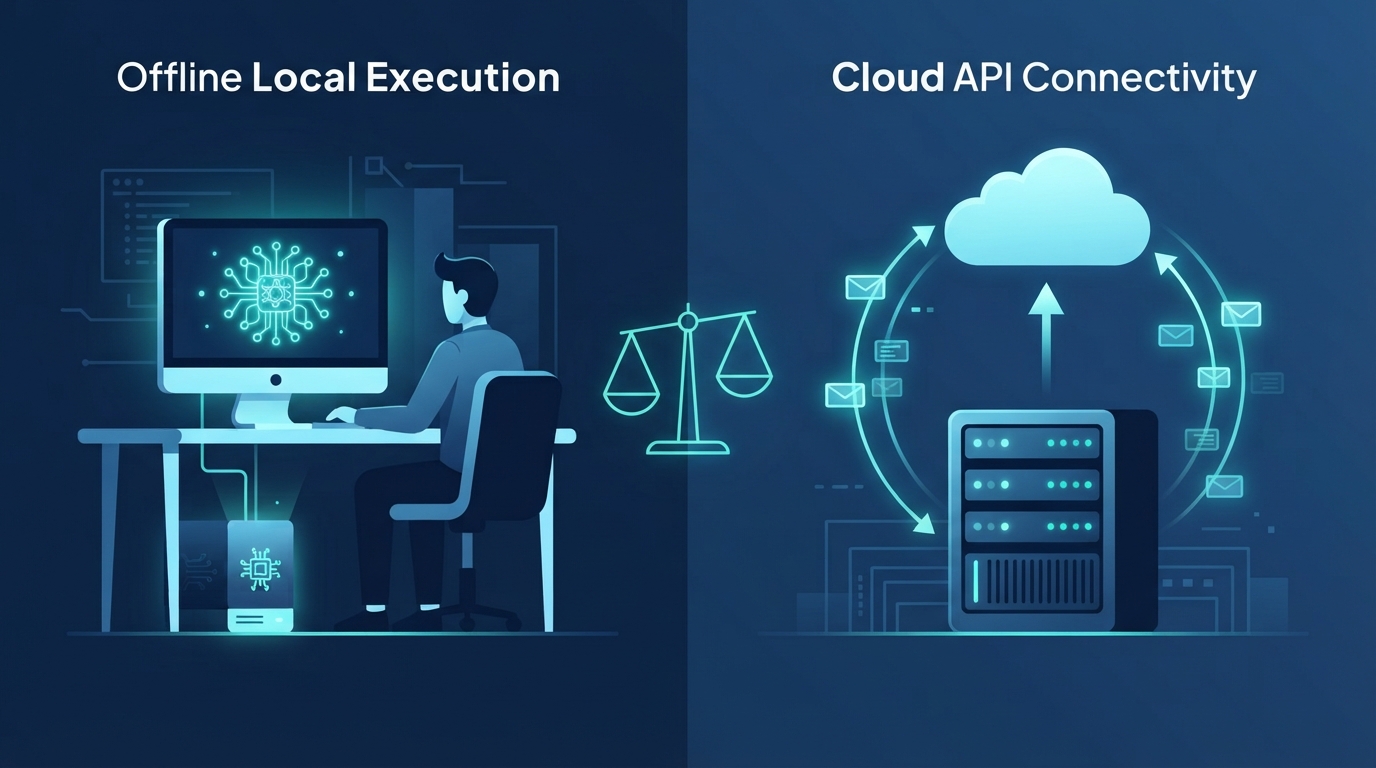
Head-to-Head: Key Decision Metrics
Choosing the right path isn’t about finding a universal winner. It’s about finding the perfect fit for your specific application requirements.
To settle the local llm vs cloud api debate for your project, you must weigh your development priorities against four critical operational pillars:
- Data Privacy & Security: Do your users’ prompts need to stay strictly on-premises, or can they safely travel to third-party servers?
- Latency & Throughput: Will network round-trips bottleneck your user experience, or do you need the raw speed of local hardware?
- Cost Predictability: Are you prepared for variable, usage-based monthly API bills, or do you prefer the one-time capital expense of local GPUs?
- Customization & Control: Do you need to fine-tune model weights on proprietary data, or are system-level prompts sufficient?
Let’s break down how each architecture stacks up across these make-or-break metrics so you can choose with confidence.
Cost Structure: CapEx vs. OpEx
When it comes to the financial side of your AI stack, the choice boils down to paying upfront or paying as you go. Hosting locally represents a Capital Expenditure (CapEx) model, while relying on cloud APIs is a pure Operating Expenditure (OpEx) play.
Here is how the financial trade-offs break down:
- Local LLMs (CapEx): You face high upfront LLM hosting costs—think $1,500 to $5,000+ for high-end GPUs like the RTX 4090. However, your marginal cost per query is virtually zero, making high-volume runs incredibly cheap over time.
- Cloud APIs (OpEx): Entry is free, but you are locked into variable monthly bills dictated by API token pricing. If your application scales to millions of users, these micro-transactions can quickly snowball.
If your query volume is massive and predictable, investing in local hardware pays for itself in months. But if you are prototyping or have highly volatile traffic, the pay-as-you-go cloud model keeps your cash flow agile.
Security, Sovereignty, and Compliance (HIPAA & GDPR)
Beyond the financial cost, where your data actually lives is a make-or-break decision. If you handle sensitive customer information, local LLMs offer the ultimate peace of mind. By keeping all data transactions strictly internal, you eliminate external leak vectors entirely.
On the flip side, relying on cloud endpoints introduces inevitable data-in-transit risks. To maintain robust cloud LLM API security, you must trust third-party vendors not to train models on your proprietary inputs or expose them during transmission.
This distinction is critical when navigating strict regulatory frameworks. Here is how the two approaches stack up regarding data privacy GDPR HIPAA standards:
- Local LLMs: Absolute data sovereignty. Zero data leaves your local network, making compliance audits incredibly straightforward.
- Cloud APIs: Requires complex Business Associate Agreements (BAAs) for HIPAA and strict Data Processing Agreements (DPAs) for GDPR.
If you operate in healthcare, finance, or legal tech, keeping your pipeline local isn’t just a preference—it is often a legal necessity.
Latency, Throughput, and Concurrency
Beyond security, your choice of architecture radically impacts how fast your application responds. When evaluating local setups versus cloud endpoints, you face distinct performance trade-offs regarding speed and volume.
Local LLMs shine in single-user scenarios. Because there is no network hop, time-to-first-token (TTFT) can be blazing fast. However, they struggle with concurrency; if multiple users query your local model simultaneously, your hardware will quickly bottleneck.
- Local LLMs: Ultra-low latency for single users, but hardware-capped scaling.
- Cloud APIs: Higher baseline network latency, but unmatched global throughput.
Cloud APIs leverage massive, distributed infrastructure. While you pay a minor latency penalty for the round-trip web request, they handle thousands of parallel requests effortlessly.
If you are building an offline agent for a single developer, go local. But if you are launching a SaaS app to thousands of users, the cloud’s elasticity is indispensable.
The Hybrid Approach: The Ultimate Developer Workflow
You don’t have to make an all-or-nothing choice. The smartest engineering teams are combining the best of both worlds into a hybrid LLM architecture. By splitting your environments, you maximize speed during development and guarantee scalability in production.
Here is how to structure a seamless local LLM development workflow:
- Phase 1: Local Prototyping & Debugging: Build and test your application logic offline using lightweight open-source models (like Llama 3 or Mistral). You can iterate instantly and refine prompts for free without racking up API bills.
- Phase 2: Production Scaling: Once your application is stable, swap your local endpoint for a robust cloud API (like OpenAI or Anthropic) to handle production-grade traffic.
Using unified tooling like LangChain, LlamaIndex, or LiteLLM makes this transition as simple as changing an environment variable. You get zero-cost iteration during R&D, and enterprise-grade reliability when you launch.
Conclusion: Choosing the Right Stack for Your Project
Deciding on the winner of local llm vs cloud api depends entirely on your project’s unique constraints. Use this quick checklist to choose your ideal stack:
- Go Local if:
- Strict Regulations: You handle highly sensitive data (like HIPAA or GDPR) that absolutely cannot leave your local servers.
- Zero API Costs: You need to run millions of queries on a tight budget and already own the hardware.
- Offline Access: Your application must run reliably without an internet connection.
- Go Cloud if:
- Rapid Scaling: You need to support thousands of concurrent users instantly without worrying about rate limits.
- Maximum Accuracy: Your app requires state-of-the-art reasoning capabilities from frontier models.
- Zero Infrastructure: You want to focus purely on software and avoid managing GPU clusters.
- Go Hybrid if: You want the best of both worlds—local prototyping to keep R&D costs at zero, paired with cloud APIs for production reliability.